



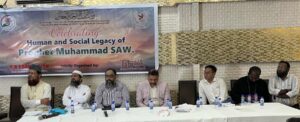
Kolkata: “Some people say Islam is a violent religion, not a peaceful one. It confuses me,” said Dr. Jamir, a Christian professor of Islamic Studies from the Northeast, at the beginning of his speech during the celebration of the Human and Social Legacy of Prophet Muhammad. While Dr. Jamir delivered a 10-minute speech, Dr. Sarfaraz Adil, one of the organizers, addressed questions on the subject.
“Let me narrate a historic incident from the life of Prophet Muhammad to debunk this narrative. After eight years of exile from Mecca, the Prophet had gained thousands of followers in Madina and an army of ten thousand. When he decided to return to Mecca with this army, it was a moment when he could easily conquer or overpower any group. Among those in Mecca were people who had deeply wronged him—the woman who had eaten the liver of his uncle, the man who had divorced his daughter just to hurt him, and those who had thrown camel intestines on him while he prayed. Despite his followers’ calls for revenge, no retaliation was taken. His close companion Umar Farooq wanted to make it a day of revenge, but the Prophet declared it a day of mercy,” narrated Dr. Adil.
“And when the day ended, and Mecca was conquered with almost no bloodshed, the Prophet did not spend the night in a rich man’s palace celebrating victory. Instead, he stayed with a poor cousin. That night he reflected on his family—his father, who had died before his birth, his mother, who passed away when he was just six, and other relatives,” added Dr. Adil.
A Day of Mercy, Not Revenge
He emphasized, “On the day when he had every right to seek revenge, and no one would have questioned it, the Prophet chose forgiveness. Neither he nor his followers resorted to violence, even when no one could stand against them.”
In his address, Dr. Jamir stressed that the legacy of Prophet Muhammad should be embraced by all of humanity, as it benefits everyone.
Several other misconceptions about Islam were discussed during the event, with organizers presenting documented historical facts to counter them.
Global Recognition of the Prophet’s Legacy
The Organization of Islamic Cooperation (OIC) has declared Hijri year 1447 (2025–26) as the Year of Commemoration of the 1500th Anniversary of the Birth of Prophet Muhammad, highlighting him as the “Prophet of Mercy.”
In Kolkata, the event—Celebrating the Human and Social Legacy of Prophet Muhammad (SAW)—was jointly organized by SR and Tahreek Foundations at Hotel Ivory Inn. Rabiul Awwal, the third month of the Islamic calendar, marks the Prophet’s birth, and Muslims traditionally celebrate it in different ways. Since 2024, the two foundations have chosen to mark the month by highlighting the Prophet’s human and social contributions in interfaith gatherings with non-Muslims.
Echoes of the Prophet Across Faiths
“When I studied the life of Prophet Muhammad, I found striking similarities with Mahavir. What Mahavir taught in the 6th century BC, Prophet Muhammad said in the 7th century. For example, the Jain faith is based on five core principles, and the Prophet emphasized the same five values,” said Dr. Namrata Kothari, a Jain scholar.
Pallav, a member of the Baháʼí faith, highlighted the Prophet’s lifelong commitment to truth and tolerance.
Father Francis Aogo noted, “If he wished, Prophet Muhammad could have lived a comfortable life. But Allah entrusted him with responsibility, and he chose hardship instead.”
Aliah University professor Abdur Rashid also spoke about the Prophet’s life and work.
Tarsem Singh of the Indian Pluralism Foundation reflected, “Prophet Muhammad used to remind people to remove their ego, as everything is done by Allah, not by humans themselves. This teaching is similar to what Guru Nanak later emphasized.”
Other speakers included Imtiyaz Mollah, Bhim Army state president; Mufti Abdul Mueed; Owaiz Aslam of the Indian Pluralism Foundation; and Athar Firdausi of SR Foundation.

