



Seeing is believing.
And watching the Bharat Jodo Yatra on the roads of Kerala, it was difficult not to notice the connection between Rahul Gandhi and the people who came out to see him.
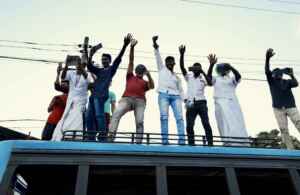
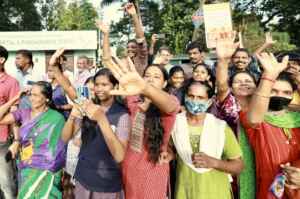
It was not only political workers or party supporters. Elderly men and women stood by the roadside. College students gathered on terraces. Homemakers waited outside their houses. Small children ran along the road shouting, “Rahul Gandhi, Rahul Gandhi.”
There was something almost familiar about the way people greeted him. At several places, the interaction looked less like a conventional political roadshow and more like the arrival of someone people had known for a long time.
At one point, the roads were lined with people simply waiting for him to pass.
The music added another layer to the atmosphere. Songs about the Bharat Jodo Yatra played in Malayalam. For someone who did not understand the language, the two phrases that stood out were “Bharat Jodo Yatra” and “Rahul Gandhi”.
The songs were lively and energetic, and the crowd seemed to absorb that energy.
It was around 2 pm, with the Kerala heat and humidity at their worst, when thousands of people were still moving along the highway. The crowd had swelled to more than 20,000.
The sheer number of people walking in that heat was striking.
A Yatra That Begins Before Sunrise
The Bharat Jodo Yatra began its day at around 6 am.
There were different groups travelling with the Yatra. The Bharat Yatris were around 125 people selected from across the country to walk the entire distance from Kanyakumari to Kashmir.
Then there were the Pradesh Yatris, who joined the Yatra in their respective states and generally walked until the next state boundary. Congress leaders and workers from different states also joined for a day or two.
And then there were the locals.
They came in thousands.
The organisation required for moving such a large group every day was itself a story.
At designated camping sites, containers were arranged for the Bharat Yatris. Inside, the facilities were basic. There were two berths, roughly eight feet by four feet, a small washroom and very little space to move around.
After seeing the arrangements, the description of these as “five-star containers” sounded rather different from what was actually visible on the ground.
The Yatra covered roughly 25 kilometres a day. Once Rahul Gandhi and the yatris left the camp in the morning, the camp itself began to disappear.
Containers, fixtures and other equipment were loaded and transported to the next designated camping site.
By the time the Yatra reached the next halt in the evening, the camp was expected to be ready.
The Pradesh Yatris had separate arrangements in the vicinity. At the different halts, arrangements were made for large numbers of people.
The routine was demanding.
The Yatra started around 6 am. There was usually a short break around 11 am for tea and light refreshments. By then, the number of people walking with the Yatra could rise dramatically.
The march continued until around 2 pm, when the participants stopped for lunch and rest.
The Yatra resumed at about 4 pm and continued until the evening, usually reaching the day’s destination around 8 pm.
Schools, local grounds and dharamshalas were among the places used for breaks and halts.
The Pain Behind the March
The crowds were perhaps the most visible part of the Bharat Jodo Yatra. But the physical strain on the people walking every day was much less visible.
The women among the Bharat Yatris were dealing with some particularly painful consequences of the long-distance walking.
During breaks, when they removed their shoes, the injuries became visible. Some had large boils on the soles and upper parts of their feet.
The pain was visible on their faces.
But once the break was over, they put their shoes back on and returned to the road.
The selection process itself had been demanding. Around 24,000 people had applied for the opportunity to become Bharat Yatris, from which around 125 were selected.
Walking alongside Rahul Gandhi for months was not going to be a symbolic exercise. It meant spending day after day on the road, covering roughly 20 to 25 kilometres, often in difficult weather.
The real test was not simply whether someone could walk.
It was whether they could keep walking when the feet hurt, the body was tired and the next morning’s journey was waiting.
At the end of the day’s march, the Bharat Yatris would prepare for the following day.
There were patriotic songs and songs of courage at the camps. After spending hours on the road, it was striking to see the energy with which many of them spoke, sang and prepared themselves for another early start.
The next morning, they were back.
As Rahul Gandhi took his first steps on the road, the crowd around him became a curious mixture of movement and discipline. There was plenty of noise and excitement, but thousands of people somehow continued moving in the same direction.
The Man Who Was Already on the Road
Every morning, Digvijaya Singh, the convener of the Bharat Jodo Yatra, would start early with a group of Seva Dal workers.
He would often walk several hundred metres ahead of the main Yatra.
It was a small but revealing part of the operation. Before the main crowd arrived, someone had to be on the road, looking at what lay ahead.
The Yatra was not just about Rahul Gandhi walking from one place to another. Behind the scenes was a constantly moving operation involving accommodation, food, transport, security, route management and thousands of people joining at different points.
The scale of the exercise became apparent only when one looked beyond the main procession.
And yet, on the road, much of that organisation disappeared from view.
What people saw was Rahul Gandhi walking.
And thousands walking behind him.
A 1970s Photograph and a Family Connection
There was also a very different kind of moment during the Kerala leg.
At the base camp on the first night, Digvijaya Singh showed visitors the arrangements inside the containers.
Jairam Ramesh was nearby, talking to members of the team. Singh called him over and told him about Yassir and his father.
Ramesh then showed a photograph on his mobile phone.
It was an old wedding photograph from the 1970s, from the wedding album of the late R. Kumaramangalam, who was the first national president of the National Students’ Union of India.
The photograph had several young political figures in it.
Among them were a young Ashok Gehlot, who had been the first NSUI president of Rajasthan, and Hasnat Siddiqui, the first NSUI president of Madhya Pradesh.
For Siddiqui’s son, seeing that photograph was an unexpected moment.
It was not just the photograph itself. It was where the photograph appeared.
A picture from the 1970s, belonging to an old wedding album, had somehow travelled decades later to Kerala and ended up on Jairam Ramesh’s mobile phone during the Bharat Jodo Yatra.
Digvijaya Singh pointed out the coincidence. He had been talking to Ramesh about Siddiqui’s father shortly before Ramesh showed him the photograph.
And there, unexpectedly, was the younger Siddiqui’s father, standing alongside young political leaders who would go on to occupy important positions in Indian politics.
For a journey that was attracting tens of thousands of people every day, it was a remarkably small and personal moment.
The Bharat Jodo Yatra was undoubtedly a major political mobilisation. But walking alongside it in Kerala revealed another side of it.
People came to see Rahul Gandhi. Some came to walk with him. Children ran beside the procession. People stood on rooftops and by the roadside.
For many, it appeared to be less about a speech or a political meeting and more about getting close enough to see, greet or walk alongside the person at the centre of the Yatra.
And somewhere in the middle of that enormous moving crowd, a photograph from the 1970s brought one family history unexpectedly back into the present.

