



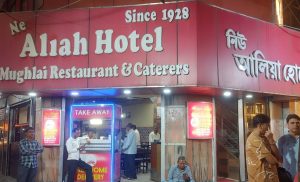
Kolkata: In the heart of Kolkata’s vibrant Prafulla Sarkar Street, Jamal Ahmed, the 98-year-old hotelier and poet, sits in the backroom of Aliah Hotel, his voice resonating with the same intensity as the lively street outside.
Jamal Ahmed, a nonagenarian, is known in the city as a poet and a concerned citizen. But the 98-year-old is also a philanthropist. He has donated 15 Katthas of land in his native village in Bihar for a government hospital, which last year became operational.
A Philanthropic Legacy: Land Donation for a Government Hospital in Bihar
“The land (in Marui village, Nawada district) was the costliest in the adjoining areas. But my father, who decided to donate it to the government to build a hospital there, did not hesitate,” informed Firdaus Jamal, son of Jamal Ahmed.
The market rate for land in Marui village is at least Rs 20 lakhs per kattha. In Bihar’s Nawada district, one kattha of land is equivalent to 3 decimals.
“I had told my mother that one day there will be a hospital in your name. So I had to do it,” Jamal Ahmed told eNewsroom. The family proposed the name of the hospital as QZJ Government Hospital, incorporating the names of Jamal and his parents. There is a board at the hospital where Jamal Ahmed Jamal’s name as the donor is mentioned. However, the Bihar government has yet to adopt the name suggested by the donors’ family.
The 20-bed primary hospital is now operational.
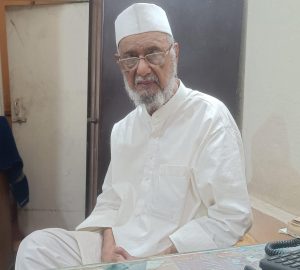
“When donating, I did not make any demands, such as asking for government jobs for my family members or insisting that a doctor from my family should practice here,” he said.
“I demand that either the Bihar Chief Minister (Nitish Kumar) or the Health Minister inaugurate the hospital,” the donor added.
Jamal Ahmed, a multifaceted personality, knows five languages and completed his Master’s in Sanskrit from Banaras Hindu University (BHU) and his Bachelor’s in Science (BSc) from Patna University. He frequently uses Sanskrit shlokas in his poetry. Much of his poetry focuses on communal harmony in the country.
A major event in his life was meeting the Father of the Nation, Mahatma Gandhi, on August 13, 1947 in Kolkata.
A Life of Literature and Peace: Jamal Ahmed’s Encounter with Mahatma Gandhi
“I was just 18 years old, but Gandhiji was desperately seeking peace for the country. When I heard that Gandhiji was in Kolkata and my uncle, Kareem Sahab, was going to meet him, I joined my uncle and reached Beleghata,” recalled the nonagenarian, quickly adding that he has no picture with Gandhiji.
“In my brief interaction, I requested Gandhiji for peace in the country and to stop the riots. Gandhiji replied that he came to Kolkata for this very purpose and would be traveling to other parts of the country for the same reason.”
The well-known hotelier has great command over recipes and dishes. “I have helped several hotel outlets in Kolkata and abroad set up their centers. Some of them are now big names, like Arsalan and Mezban.”
Jamal Ahmed’s sons run several hotels in Kolkata, including the famous Arafat Hotel on Rafi Ahmed Kidwai Road, which is managed by Firdaus Jamal.
Preserving Harmony Through Poetry: The ‘Tatkal’ Poet’s Message for Unity
But in Kolkata’s literary circles, ‘Jamal’ is known for his ‘Tatkal’ poetry. A ‘Tatkal’ poet is one who can deliver a poem instantly, depending on the situation.
“I was very young when I met Gandhiji, and still, I recited a poem for him:
Andhi Tawaf Karti Hai, Gandhi Ki, Aye Jamal.
Ye To Bhanwar Se Laye Hain Kashti Nikal Ke
(The storm circles around Gandhi, O Jamal. He is the one who has brought the boat out of the whirlpool.)”
The poet ‘Jamal’, an Acharya in Sanskrit often uses the couplet to promote communal harmony.
Yem niza pro weti ganna laguchetshaam udarnaam chatrinantu, washudhew kutumbakam.
A rough translation of this Sanskrit couplet is:
“This is ours, that is yours—those who think this way have small hearts. But for the great ones, the entire world is one.”
He also mentioned that the shloka is written at the entrance of the old Parliament building’s gate. Eleven members of Parliament, including Maulana Azad, had agreed to imprint it there.


Such stories should be reached to more people to make a better society.