



Kolkata: Prime Minister Narendra Modi’s Didi-O-Didi remark has done more harm to the campaigning of the Bharatiya Janata Party during the West Bengal elections than helping the party.
PM Modi has good oratory skills, and it catches the attention of the masses. But the use of certain words, tones have many a time raised the debate of its standard in society. On most occasions, BJP gets benefits from Modi’s speeches, however, his latest use of Didi-O-Didi for Bengal chief minister Mamata Banerjee has not gone down well in the state which 49 per cent of 7.2 crore electorate is women.
In fact, the political mileage that the ‘attack’ on chief minister Mamata Banerjee at Nandigram could not bring for the Trinamool Congress, the misogynist remark Didi-O-Didi managed to do.
PM Modi continues using the remark, just like he did during his Tarkeshwar rally on Saturday, TMC MP Mahua Moitra strongly objected to the comment and compared it with the cat-calls made by a ‘street-side fellow’.
Moitra reacted angrily, “There is something we have in Bengal called ‘rock-er chhele’, which means, a street-side fellow who sits on a wall and who basically calls out to every lady walking past, saying ‘Diddi-ei Diddi’,” Moitra told NDTV in an interview.
Earlier, the leading Newspaper of Bengal, The Telegraph had done a story on Modi’s remark.
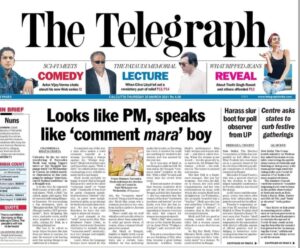
The Telegraph had carried a piece on 25 March when PM Modi had used the term for the first time at Contai rally, stating, “Modi would probably be happy to know that in Bengali this practice used to be called “comment mara” or “taunt kata”. Classically it was done by parar chyangra (neighbourhood boys, “useless” variety), on parar meye (neighbourhood girls), as an attempt by the boys to mark their territory. We live in the para, therefore we have the sole right to abuse our women.”
The newspaper also gave an example of a Bengali movie in which Bengali cinema’s legendry actor Soumitra Chatterjee did the ‘comment mara’ act, “A good example is the “twist” scene in the film Teen Bhubaner Paare (1969), in which revered actor Soumitra Chatterjee is actually doing “comment mara”, musically, to a very elegant and slightly bristling Tanuja.”
And added, “Later, when the language became more mixed in this city, the “comment mara” evolved. Using a line from popular Hindi film songs was a common practice in any case, from Laila o Laila to Jumma chumma de de.”
An advocate at Mumbai High Court, Freeda Nicholas, who keeps a tab on Bengal politics, writes about the entire episode on social media, “Modi’s Didi-O-Didi remark received strong disapproval from the people of Bengal, the patent misogynist was ridiculed for getting it all mixed up (North India into Bengal) culture. The temerity with which the ‘elite’ misogynists displayed their uncouth behaviour on all mediums, real and virtual just went on to prove how little it takes for the peels to fall off. The only advantage – since they wear their badge on their sleeve now, the cat is literally out of the bag.”
Reports also suggest that from Nandigram to other parts of the state, women voters have participated in large numbers in voting and it went against the saffron party. It is also believed that in the rest six phases, this trend will catch up.
Meanwhile, TMC, lead by its female leaders has knocked on the door of the Election Commission on the ‘cheap’ remark by PM Modi.

