[dropcap]I[/dropcap]nternationally renowned author, RK Narayan told me in 1995, that he felt a book fair well organized was a true platform for sensitive minds who wanted to broaden their mental horizons. It was the same view Mulk Raj Anand aired in a conversation with Satyajit Ray in the 1960s when Ray was all praise for the author’s Two Leaves And A Bud.
My connection with literature ranges from my childhood days. My father inspired me to read Shakespeare, PB Shelley and George Bernard Shaw. My mother taught me the finer aspects of Tagore, Sarat Chandra Chattopadhyay and Sukanta Bhattacharya. My friend Chandranath’s father, the late Bimal Chandra Chattopadhyay in my elderly days contributed a lot of literary fundamentals. His residence at Philips Mor, Entally, had a rich library of literary masterpieces, history of printing and books on arts and culture.
Chandranath edited for four decades for a little magazine, Kinjal, which is one of the true attractions at every International Kolkata Book Fair. Kinjal has dealt with many issues and its cartoon special editions have earned rare repute. Chandranath mentions, “To me, every book fair at Kolkata is of prime importance. Here I receive the right opportunity to display my works, learn about others and have intelligent interactions.”
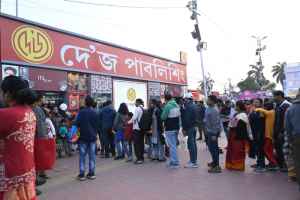
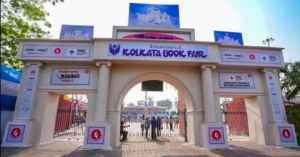
The current International Kolkata Book Fair was inaugurated by the chief minister Mamata Banerjee on January 18, 2024. Initially, there were not many visitors but as days passed, crowds poured in. The main theme of the current book fair is Britain. Eminent economist Lord Meghnad Desai said in a message from London,” The essence of the Kolkata Book Fair is deeply rooted in classic literature. Bengal has literary icons who can match the best in the world on sheer dint of merit. I am eager to be there as my connection with Kolkata is dear to me.”
Bengalis are well aware of English classics. In former book fairs at the Maidan, there were literary addas where there were fruitful discussions about Bibhuti Bhusan Bandopadhyay, Charles Dickens and even Karl Marx. I remember visiting many such book fairs with my mentor in communications, Subir Ghosh who taught me a lot about literature. I have vivid memories also discussing capitalism and socialism with many stalwarts from whom I learnt a lot and they appreciated my viewpoints.
Sadly, present book fairs have become more of picnic-like affairs where a large section of crowds join in the rigmarole of nonsense talks and flirt with literature. If many of them are questioned it is doubtful if they can speak critically about the works of Tarashankar Bandopadhyay or Bonophul (Dr Balaichand Mukhopadhyay) not to mention Earnest Hemingway or Jonathan Swift. As academician Sanjay Mukhopadhyay rightly points out, “Present book fairs are more of fancy parades compared to those of yore. In the earlier days, book fairs were true educational grounds.”
Sujata Sen, Ex-Director of British Council (East), reputed journalist and Director of Future Hope School informs, “I am part of organizing the literary festival in Kolkata Book Fair. The trend is more towards Bengali literature and I am more familiar with English works. However, our mother language Bengali should never be neglected. Each language has its own merits.” Renowned poet Sharmila Ray says, “I read my poems in English and launched a book two days ago at Kolkata Book Fair. My poetry experiment, Varanasi Within Varanasi was released recently. It is a poetic philosophical journey into the heart of Benaras.” She does agree that literature in every language should receive equal prominence.
Tridip Chatterjee, President, Publishers Guild has assured the best quality of books from publishers all over the world and a disciplined atmosphere at the book fair. He and his team are trying their best to live up to the standards they have promised. After all, with its lacunae the present book fair is not witnessing any lumpen culture. There is definitely a craze among the visitors to see and read various kinds of books. From Penguin Random House to Jayco to Ananda Publishers all have set up stalls at the book fair. Books ranging from autobiographies to science and technology to cinema as well as sports are available.
It remains to be seen how much this book fair improves the intellectual qualities of readers. This is a fact that the habit of reading classics has given way to reading pulp fiction which is not at all a healthy sign. The essence of classic literature needs to be brought back in a big way so that the upcoming generation can be made aware of Tagore, George Bernard Shaw and Mark Twain. Alas, such efforts are missing. I remember an interesting comment by Dr Shital Ghosh, the legendary physician, “If the trend of reading masterpieces is waning it is a sign of a sick and deteriorating society.”