

Kolkata: In a major development, in the death of IIT Kharagpur student Faizan Ahmed, whose dead body was found inside his hostel room in October last year, Calcutta High Court, after going through ‘second autopsy report’ observed that it as a ‘homicide’.
The Court of Justice Rajasekhar Mantha further said that in the next hearing, it will be decided who will be the investigating agency.
On October 14, 2022, the partially decomposed body of third-year mechanical engineering student Faizan Ahmed, who was also a member of the Aerial Robotics and RoboSoccer teams of the research team, was found in a hostel inside the IIT Kharagpur campus.
A resident of Tinsukia, Faizan, who had cracked the Joint Entrance Exam (JEE) in 2020 with 11th AIR, was also getting a scholarship from the Assam government.
After the incident, IIT authorities were claiming it is a case of suicide. The first postmortem report of the 23-year-old youth could not ascertain any concrete cause for the death. No poisonous substance found inside nor was any hanging mark outside Faizan’s body.
In fact, after going through the first autopsy report, retired forensic expert Ajay Kumar Gupta, who was instructed by the High Court to submit his report, claimed that the video clippings of the first postmortem report indicated a case of hematoma. On the request of Dr Gupta, the High Court had ordered a second autopsy of Faizan’s body. The body was exhumed from Dibrugarh and flown to Calcutta Medical College Hospital, where it was performed on May 27.
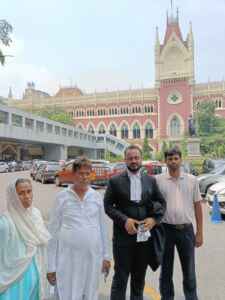
Today, during the hearing the court, also did not allow IIT Kharagpur to get a copy of postmortem report as of now, as they may be the accused.
While hearing the case, Justice Mantha once said: “IIT Kharagpur has also tried to fudge the documents.”
Meanwhile, lawyers representing the case Ranjit Chatterjee, Atis Biswas, Niladri Sengupta and Aniruddha Mitra described it as a major step towards establishing the fact that Faizan was murdered.
Ranjit Chatterjee told eNewsroom after the court hearing, “The second postmortem establishes a case of homicide with death occurring due to profuse bleeding from injuries in the head and chest.”
Advocate Chatterjee also added, “Second PM report will be handed over to IO but not IIT at this stage because of their likely involvement in the murder.”
Rehana and Salim Ahmed, mother and father of Faizan, who are fighting a tireless battle for the justice of their only child, Faizan, told eNewsroom, “Today, the court order proved that my son had not committed suicide. He was not a weak human. He was murdered. We always maintained and believed in this ever since we got the news of his death at IIT Kharagpur.”
eNewsroom tried contacting, VK Tiwari, Director, IIT Kharagpur but the calls remained unanswered.
However, now the biggest question is, who killed Faizan Ahmed inside the IIT campus?
The court will institute an inquiry body to find the answers on Wednesday, June 14.