



Giridih/Ranchi: A 40-year-old tribal woman died of starvation in Sewatand village of Giridih district in Jharkhand. The woman, identified as Budhni Soren, was a widow and had a 7-year-old son was her only family member.
Budhni was not getting any ration. Leave aside Aadhar, she had no ration card either. Her death marks the seventh hunger death in Jharkhand. However, the Giridih administration has refused to term it as death from starvation. They have maintained that Budhni died of a cold on Saturday. She was buried on Sunday in Sewatand of Tisri block, which is about 100 kilometres away from the district headquarters.
Budhni’s had married for second time and her husband Tuddu Hemburm had died a year ago. Villagers informed that she used to collect leaves from the nearby forest and make dona-pattals to make ends meet. A few days back, she caught a cold and was unable to venture out. Hence Budhni did not have money to buy food. A villager claimed, “She even used to drop in at her son’s school during lunchtime so that she could share the mid-day meal with him.”
Watch the video:
Her stepdaughter Sunita Soren claimed that she had not eaten anything for the last three days. “She had no Aadhar card, ration card. And there was nothing at home to eat,” Sunita said.
Tisri has a history of middlemen exploiting the poor villagers. Often they take bribes to get any government-related work done. “Budhni even had an Indira Awas, but the roof is fixed. And someone had even withdrawn the money from her account,” alleged Dharmendra Yadav of Tiger Force. Tiger Force is a social organization, meant to fight corruption and Dharmendra is a resident of Gumgi village, near Sewatand.
Significantly, the Mukhiya of Thansinghdih Panchayat Baleshwar Rai also stated that the villagers had informed him about the tribal woman dying due to starvation.
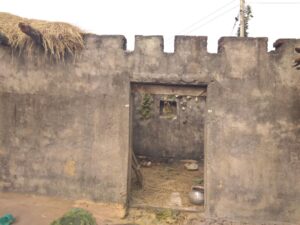 Budhni’s Indira Awas, which has no roof
“When I got the information, I came for an inquiry and all the people told me that she died from hunger. If I had known it earlier, I would have arranged everything,” said the panchayat head Rai.
However, when contacted Sub-Divisional Magistrate (SDM) Ravi Shankar Vidyarthi, he refuted all the statements. “There was food in her house. Block Development Officer (BDO) found rice and potatoes and he has made a video of it too,” he informed eNewsroom.
But villagers alleged that the food grains had been kept at Budhni’s house, after her death.
The MLA of Rajdhanwar, under which Tisri block falls, Rajkumar Yadav, told eNewsroom, “I had raised Santoshi Kumari and Baijnath Mahto’s hunger death case inside the assembly. And the most important aspect in all these cases is that the administration in such cases claim that they have died from cold and not hunger, and they never conduct a postmortem of the deceased.”
No post-mortem was conducted for Budni’s dead body too, informed a source.
Budhani’s death from starvation is not one of case in the state.
Significantly, Tisri is also a native block of the first chief minister of Jharkhand and Jharkhand Vikas Morcha (JVM) chief Babulal Marandi.

