Jharkhand boy’s fascinating Bollywood journey

0

Ranchi/Mumbai: He was a teen when he acted in Ayan Banerjee’s award winning short film, Reflected Dreams. And now that he has turned 22, he got to work in a film that will be first screen at major film festivals. Between the two films, he has kept himself busy with Ekta Kapoor’s Ragini MMS Returns, a successful franchisee converted into the web series format. He has also acted in a couple of television series. And before getting a filmy break, he used to live in a remote village in Jharkhand. Meet, Raquib Arshad, a resident of Bharkatta village in Giridih, Jharkhand.

A Dream Break

Raquib proudly accepts that he is a ‘gaon wala’. A self-made actor, who made it into this industry on his strength is slowly and steadily getting a firm footing in the Indian Film Industry.

“I had reached Mumbai in May, 2013. And in December, I cleared the audition for Ayan Banerjee’s short film —Reflected Dreams. This short film won awards in many film festivals and also from the Ministry of Information Bureau as well,” Raquib told eNewsroom over the phone.

Raquib, who is currently based in Mumbai, has nearly 10000 followers on Instagram. He is pursuing a Master degree from IGNOU.

Raquib arshad Ragini mms returns manu ka surrender bollywood
Raquib Arshad

Born To Be An Actor

Raquib’s father is a doctor, one brother studying medicine, another work with Google, so how he chose to opt for acting as a career? Explaining his choice he says, “I was interested in participating in dramas, right from my school days. But I never got a chance to explore my skills. Then one day, I got a chance, but I couldn’t do anything special. After a long gap, I got my second chance and this time, luckily I played the lead role in this drama. My acting skills were much appreciated and it paved the path for my acting career in my alma mater, Subhash Public School.”

An when he shifted base to Ranchi to pursue his higher education, he continued acting. “Once in Ranchi, I began participating in dramas beyond my college theatre. I was an average student, so I decided to choose acting as a career as I love doing it. But when I told my family about my career choice, they were not ready to accept it. After sometime, when they realized, that I was firm on my decision. They allowed me to continue on the condition that I will not quit studying at any cost. So, I shifted to Mumbai, where I believed I could pursue both my acting career and education simultaneously.”

Raquib arshad Ragini mms returns manu ka surrender bollywood
Raquib Arshad with Sanjay Mishra during their movie’s shooting at Lohardaga, Jharkhand

Beginner’s Luck?

The 22-year-old acted in the several episodes of serials—like Chidiya Ghar, Bal Gopal, Nadaniyaan, and Meri Durga. He has also tried his hands in a couple of advertisements.

After having struck gold with his short film, getting work has not been difficult for Raquib. Sharing his experience of working for Ragini MMS Return’s third lead character, a negative one under the banner of Balaji Telefilms, he says, “I play the ghost in the web series of Ragini MMS Returns. It’s a difficult role, as I have to use prosthetic make-up to get my look. It took three hours to put the make-up in place and an hour to remove it. With make-up on, I could neither eat nor sleep. It was so taxing that at times it left burns on my skin.”

The young actor’s Facebook and Instagram, has several posts and messages from co-actors appreciating his role as Anshuman and old woman.

Raquib feels that acting has nothing to do with having a great body, says Raj Kumar Rao and Nawazuddin Siddiqui are his favourite actors. He loves Anurag Kashyap as a director.

Journey Continues…

In his first feature film, Raquib got a chance to work with actor like Sanjay Mishra and Vijay Raaz. It is a film by Lal Vijay Shahdeo, which highlights naxalism related issues and extensively shot in Jharkhand. “I can’t reveal much about the story, but the story is so good and it has been made so well that the movie will be sent to world’s best film festivals,” the young actor signed off.

Irony of fodder scam: Lalu is in jail, but raghubar govt wants public to believe that Rajbala has done nothing wrong

0

Ranchi: Along with Chief Secretary Rajbala Verma, Raghubar Das government seems to be convincing the opposition and people of Jharkhand that the chief secretary has nothing to do in the Fodder Scam case, similar to the one in which former Chief Minister and Rastriya Janta Dal (RJD) chief is serving a term of three-and-half-year jail.

The 1983 batch officer was the District Magistrate of Chaibasa in 1990-91, during which fraudulent withdrawals had been made from the Chaibasa treasury, a similar case for which former Chief Minister Lalu Prasad is in jail. When CBI took up the fodder scam case (RC 50A/96), it sent several letters to Rajbala, to which she never replied. She has also not replied to several notices served to her by Jharkhand Chief Secretaries between the years 2003 and 2014. With all these controversies around her, Rajabala is going to retire in February end, this year.

With Lalu Prasad being put behind the bars, this matter is not just being escalated by the opposition parties but also by Bhartiya Janata Party (BJP)’s senior leader Saryu Roy. He has even written a letter to Raghubar Das, asking the Jharkhand Chief Minister to start a departmental proceeding against the Rajabala.

But despite the opposition raising the issue inside the State Assembly, the CM is yet to take any action against the chief secretary. However, he had issued a show cause order against Rajbala a fortnight back. But that was all Raghubar Das has done so far in the matter.

“We will keep demanding for her removal from the post of chief secretary. An inquiry into accumulation of disproportionate properties should also be initiated against her,” stressed Ajoy Kumar, President of Jharkhand Pradesh Congress Committee (JPCC) while talking to eNewsroom.

The chief secretary in her explanation letter claims that she had no idea of how the fraudulent withdrawals took place from the Chaibasa treasury. She maintains that she did not check the diaries on a daily basis and has alleged that the then treasury officer had kept her in the dark.

However, former Chief Minister Babulal Marandi has made some serious allegations against the chief secretary and her role in the fodder scam and is not ready to buy her argument. He has not only demanded a Central Bureau of Investigation (CBI) inquiry against Rajbala Verma but has also alleged that she has conspired against Lalu Prasad Yadav.

“A District Magistrate (DM) also remains the head of treasury. Every month withdrawals get made after getting DM’s signature. So how on earth, being Chaibasa’s DM for one and half year, she did not see that fraud was happening? It means, she did it in a planned way. In other words, she was getting the fraudulent withdrawal being made by others,” Babulal Marandi told eNewsroom.

Marandi also sheds light on Lalu Prasad and Rajbala’s ‘good’ relations.

“Some people have claimed that when Lalu Prasad Yadav was going to the jail for the first time, she was crying. She was crying because she was aware that she will be meeting with a similar fate. And that is why she did not reply to 23 letters sent to her from different government between the year 2003 to 2014,” JVM chief said.

He then asked, “But as a government what is Raghubar Das doing? Will it not send a wrong message to junior employees who will also not reply to notices?”

Marandi also mentioned that earlier officials have been suspended and even dismissed on failing to respond to three consecutive notices.

On the other hand, Roy, who has written a letter to the chief minister, is also not satisfied with Rajbala’s reply and stands on his demand of initiating a departmental proceeding against her.

During the assembly session on Friday, CM Das has told the house that he has yet to go through the reply and an appropriate action will be taken. He further mentioned that there is no corruption charge on the chief secretary, but certain alleged lapses.

Kolkata’s engineer is revolutionizing farming culture of India

0

Kolkata/Bengaluru: Are you one of those who has dreamt of owning a farm plot and harvesting your own crops, after being introduced to online games like HayDay and Farmville? Or are you one of those who keeps thinking of pesticides or colouring agents used in your veggies or fruit? Then hang on! For Kolkata’s techie, Shameek Chakravarty is all set to give wings to your dream. Thanks to Shameek and Farmizen, you can do farming of your own.

This alumna of Calcutta Boys’ School, who is stationed in Bengaluru these days, is busy networking with farmers across India to collaborate and make this dream a reality. Shameek, a software engineer by education and an entrepreneur by passion, has only one dream – “Revolutionize the way India grows its veggies and to empower both the consumers and producers”.

From virtual to real

Speaking to eNewsroom, Shameek, CEO of Farmizen shares, “I as a consumer was wary of the food that I bought for consumption. I kept looking for organic produce, but I always questioned myself about the authenticity of their claims. You see, the green revolution has actually done more harm to the Indian soil than help. The rampant use of fertilizers and pesticides has actually depleted the rich Indian soil of its natural nutrients. Farmizen is an initiative which aims at reviving the traditional organic way of producing crops, by taking help from modern technology.”

On being asked how did this idea of replicating an online game came to him, he reveals, “Online games like Farmville or HayDay are extremely popular. Many of my friends play it and are really concerned about their online farms. This popularity made me realize that there would be many who would be interested in practicing what they did online; this was when Farmizen was born. And thus we collaborated with farmers in the vicinity of Bengaluru city to help those interested to harvest their own yields.”


How does Farmizen work?

Mini-farms of the size of 600 square feet is let out to the urban farmers, who want to grow their own organic produce. These mini farms are further divided into 12 beds, where seeds of crops you want to grow are sown by the farmers. “Those renting these mini farms are free to visit their farms, help in planting seeds in nurseries or even participate in preparing humus for their farms. However, we understand that the urban working class has little time to attend their farms on a daily basis. So, they have the option of paying weekly visits while we along with the real farmers take care of the crops through the week,” he says.

He explains that the farms are not tilled using any machines or tractors barring the first time. “We don’t till the land the earthworm does it for us. When we first began with this concept of growing your own organic produce, there were no earthworms in the soil. But now the soil is rich with them. We believe in following the natural way of growing crops, which is multi-cropping. You see, the forests have the most fertile land. Is it ploughed? Is only one variety of trees grown there? No. We are following the same principle, as it doesn’t deplete the soil of a certain mineral. We don’t use pesticides. We use Neem oil sprays to protect the crops or even pant marigold flowers to ward off the unwanted pests.”

Who benefits?

It’s a win-win situation for all. While the consumers get quality organic produce at a cost, the risks of farmers are greatly reduced. “In the business of agriculture, unfortunately, the maximum risk is born by the farmers. The middlemen involved in marketing crops from farmers to consumers suffer from no real loss. Farmizen reduces this risk for farmers. They now have a fixed income, based on the number of mini farms they lease out to the urban farmers.”

“It’s a great joy to see to grow your own veggies naturally along with other like-minded people,” says Saee Bapat, a Bengaluru-based yoga trainer. Saee maintains that Farmizen has made her realize her dream of becoming a city-base part-time farmer.

Jaipur and Kolkata calling

The model has been getting a good response from across India. And Shameek and his partners are planning to reach to those interested in this model. “We are working out a partnership with our partners in Jaipur. We have received many requests from the Pink City. We plan to launch Farmizen in Jaipur by the end of this year.”

What about his hometown Kolkata? “Well, my city does feature in the top ten city list. We do have plans to come here but to be honest the city is difficult to penetrate. And it still has access to better produces in comparison to other metro cities. If you want, you can find suppliers of really good organic produce on Kolkata, even now. And I have mentioned earlier, we will be taking Farmizen to all metro cities by the end of this year, so yes, we do have plans for Kolkata,” elaborated the Maniktalla boy.

Super Power of Kolkata’s Padman Comes from His Mother

Kolkata: Twenty-one-year-old Sobhan Mukherjee, an MSc (Geography) student of Ashutosh College, has been silently installing Bandhan sanitary napkin boxes in the public toilets of Bansdhroni, Golpark and Naktala area of Kolkata. The agenda of Kolkata’s Padman is simple, women travelling or in emergency need not rush to a chemist. First the aid then the purchase.

It all began with a query

He wears no fancy attire but he has a superpower – commonsense, which many lack. So, when one of his female friends excused from a college meeting citing some emergency, he asked his friend the reason. “She told me that she had got her periods and wasn’t carrying a sanitary pad. So, she needed to go to the chemist. I found this incident very disturbing. In an emergency like situation, she had to rush to a chemist. This was when I thought, if some sanitary napkin could be stocked in public toilets, it would definitely come handy in such emergency-like situation,” narrates Sobhan.

With this came the idea of installing boxes, under the name of Bandhan in public toilets. “I began with Tridhara, toilets from transgender. Sometime back, I had played a vital role in convincing local councilors to have a separate toilet for this community within the premise of public toilets. So, I took my study table and set it up on the toilet premise. I purchased some sanitary napkins and displayed them on the table for women to use during emergencies.”

Bandhan for women

Since then there has been no looking back for him. “From October 2017 I have been meeting local councilors with this request of having a Bandhan box installed in public toilets of their area. The support has been good so far. We will be meeting the mayor soon, and that will definitely speed up the process.”

Kolkata-Padman-bandhan-subhan-mukherjee-sanitary-napkins-periods
Sobhan Mukherjee with Bandhan box

The Bandhan box is nothing but a carton designed to stock sanitary napkins in public washrooms. A cheap and effective answer to the many sanitary pad vending machines installed in 150 government colleges of India under the direction of the West Bengal government in 2015. Unfortunately most lie defunct today. He says, “The vending machines in colleges are non-functional and those working have not been refueled. Also, not many girls know about the existence of such boxes.  However, we are hopeful of Bandhan taking off very well, as we are using social media, making videos, creating posters to make women aware of these boxes, which can come handy during emergencies or for women who can’t really afford expensive sanitary napkins.”

He then adds, “Even today in remote areas women use sand during periods. My aim is to reach out to that woman in that remote village of India. This is just the beginning. Bandhan boxes are getting a good response. Earlier these pads were available free of cost. But now I am charging Rs 2 for each napkin. The money collected will be used to supply pads to women of remote areas.”

Padman’s message

On being asked if he has heard of Arunachalam Muruganantham and the upcoming film called Padman? He says, “Of course! I think the film will help me in a huge way. You see Arunachalam, Padman and me, all are working words removing the taboo surrounding menstruation. It’s normal. It’s not a disorder. So, why not discuss it in the open? Why this secrecy? I think this mainstream film will definitely help all those activists working toward women health in a huge way. But remember, we first need, to make women realize that napkins are a need and not luxury and under no circumstances, they should use any other substitute. If we are unable to convince them, they will keep going back to rags, sand and what not.” He also adds, “Sanitary napkins should be made cheaper for the poor women.”

Help from all quarters

Coming back to his activism, Sobhan reveals that he dedicates all his evenings to this cause and often spends from his pocket to stock up napkins in the public restrooms.

However, with people getting to know about his cause, few are coming forward to help him out. “There is a well-wisher from Manipal, who has promised to bear the cost of supplying the required amount of sanitary napkins for three months. Local sanitary napkin producers are also helping me by selling the unpackaged product at lower rates. The only catch is, I have to pack them in a plastic packet at home.”

My Mother Rocks!

Unlike Arunachalam, who faced criticism from his family and loved ones, Sobhan is getting support from all quarters. The lad from Kolkata gets his strength from his family. On being questioned about his family objecting to his off-beat social work, he laughs and says, “No. Not really. In fact, my mother helps me pack the sanitary napkins. My mother Sutapa Mukherjee, is my support system. My father also has been kind enough to volunteer at times. Had they not been supportive, I wouldn’t have reached this far.” He then adds, “I don’t have to her that her help is needed. She herself helps me as and when required.”

Charisma of a slain leader, refuses to die

0

Bagoder (Giridih): Sixty-five-year old Dharmi Devi, resident of Malhutand village, Jamua has travelled 85 kilometers to make it to this annual gathering in Bagoder. “I have been coming every year to participate, right from 2005,” said Dharmi.

On being asked, why travel this huge a distance every year, in this cold? Even before Dharmi could reply, her companion, Shanti Devi retorts, “Mahendra Singh is dead. But that doesn’t do away what he has done for us. We shall always be indebted to him. When he was alive, we didn’t have to face any kind of harassment to get our work done in block office. We never had to grease the palms of the police. His name was enough to get them do their duty.”

But he was not the MLA of Jamua assembly segment? “He was a leader and frequently visit us. His name was enough to get our work done,” adds Shanti. It‘s not just the duo, from Malhutand who participated in the day-long 14th Martyr Day celebration of Mahendra Singh at Bagoder Bus Stand Market, around 100 from her their villager had also travelled.

Mahendra singh bagoder giridih jharkhand mla
Dharmi Devi and Shanti Devi at the 14th Mahendra Singh Martyr Day function in Bagoder

It was not only the elderly ladies but woman of every age were present in the 20,000 strong and disciplined crowd. For those new to Bagoder, such an admiration for a leader slain 14 years back, might seem a bit odd but not for the people of this region.

Bagoder Bus Stand Market, where the event was hosted, had come to existence because of Mahendra Singh only. When National Highway (NH-2)’s expansion was taking place, a large number of roadside shopkeepers and venders were to displace. Mahendra Singh, intervened and told the company to built a market for them. Thirty shops were constructed, which were commissioned to the shopkeepers through lottery.

Mahendra began his political career on a dramatic note. An activist since the beginning of his career, he had been implicated in false murder case. He was even given a life term sentence. However, the case was quashed in High Court. But Mahendra Singh during his jail term began an agitation over the implementation of jail manual. After coming out from jail, he fought election, but lost. In 1990, he again fought and won and represented Bagoder in Bihar and Jharkhand assemblies till his last breath.

For thirty years, no Panchayat Election was held in Jharkhand, but it was not so in Mahendra’s village Khambhra.

“Since 1978, a Gram Sabha had been functioning in the village. Later Mahendra became a legislator. He even conducted parallel panchayat polls in many villages to run the gram shabhas. He had also recommended the names of elected representatives to administration seeking their rights. Obviously, the request had been turned down. Astonishingly, in the past 40 years, no single case has been registered with the local police station from Khambhra. Earlier Mahendra Singh and now Vinod Singh, with the help of Gram Sabha solves all the issues and differences within the community,” says, Amit Raja, a political analyst to eNewsroom.

Mahendra singh bagoder giridih jharkhand mla
Youths, representing AISA and RYA also participated in good numbers

“You should check out the community Hall there. It has facilities at par with deluxe hotel, but is was constructed at the half expenditure than other community centers in Jharkhand,” adds Raja.

“Mahendra ji was always of the opinion that leaders should be staying in the village. He believed, if we wins on the votes of villagers, then we can very well stay there only,” Vinod Singh, who won twice after his father’s assassination.

“Mahendra had led many protests and movements, both in United Bihar and Jharkhand.  Be it Markachcho, Koyalkaro or Telodih, he was known for standing for people’s right,” says, Laxmi, a senior journalist.

After the assassination of the three times MLA on January 16, 2005, the case was handed over to Central Bureau of Investigation (CBI). But India’s premier investigation agency could not reach on a conclusion on the political murder of a mass leader.

Mahendra singh bagoder giridih jharkhand mla
People wore caps, embossed with, “I am Mahendra Singh”

“He was not an opposition party leader, but he was strongest opposition voice. He also never took any gifts in any assembly functions and had always opposed salary hike for MLAs,” informs Kamal Chaparia, senior journalist.

This year, unlike others, a healthy number of youths representing All India Student Association (AISA) and Youth Revolutionary Association (YRA), and teenage girls were present too. CPI-ML national General Secretary Dipankar Bhattacharya, former MLA and son Vinod Singh and two MLAs Raj Kumar Yadav of CPI-ML and Arup Chattarjee of MSS were present along with several other party leaders in the function.

During the event, the one slogan which has been chanted over the years, can be heard this time also by his party supporters and admirers was, “Mahendra Singh Tum Zinda Ho, Khaito Aur Khalihano Mei, Janata Ke Armano Mei (Mahendra Singh, you are alive in the fields, grounds, and in the minds of people).”

Techies crowd fund to build residential school to carry forward Mahasweta Devi’s work for Sabar tribe

0

Kolkata: Raju Sabar of Sandri village, in Purulia is going to appear for his school final examination next year. Son of a daily wage labourer, he is thankful to his dada Swarnabha Dey and his friends from Kolkata, who are a regular visitor to their village now. Sandri’s population is mainly dominated by people belonging to the Sabar tribe.

The Sabars are tribals of Munda ethnicity are predominantly found in Jharkhand, West Bengal, Odisha and Chattisgarh. The primitive tribe formed the core of many of the books penned by Magsaysay Award winner Mahasweta Devi, who had fought a tough battle to work for the betterment of this tribe, which had been branded as a “criminal tribe” by the British.

Two years after the death of Mahasweta Devi, Sabar’s were back to leading the same life, when Dey and his friends intervened to provide education to them. Dey and his friend are all set to have a residential secondary school established in Sandri village to help children like Raju to get a chance to get educated. They have even set up the Sabar Welfare Trust, under which they have even purchased land worth INR 6,78,000 to set up the residential school. However, the entire cost of building the residential school has been estimated to be around INR 20,00,000.

Mahasweta Devi Sabar Tribe Bengal
The face of a Sabar girl brightens as she receives a gift from the trust members

On being asked, who they managed to collect this huge a fund, Dey revealed to eNewsroom, “We have been crowd funding to help realise our mission. For the past two months we have been doing it. However, we have used Facebook as the medium to crowd fund. The response has been overwhelming. People have donated generously for the cause.”

According to him, the entire money to purchase the land and having it registered came from crowd funding. “Our appeal to people for donations will continue till we are able to raise the entire amount to have a fully functional residential school,” he said.

The techie, who has been visiting Sandri village, maintains that the tribe still faces social stigma and ostracism. “They are not allowed to mix with other tribes and thus they live a very reclusive life,” Dey added.

Despite Right to Education and other poor-friendly laws having been implemented in the country, the Sabar’s continue leading a difficult life. A time, when people are talking of a digital India and Bullet trains in India, the situation has not changed for the Sabars.  They continue being land less labourers, working in shifts in brick kilns along with their kids. “It is for such kids that we are setting up this school. The parents have agreed to leave their children with us to study, while they work in the brick kilns,” said Dey.

Mahasweta Devi Sabar Tribe Bengal
Trust members distributing clothes to the Sabar women. Courtesy Sabar Welfare Trust

On being asked, how it all began, he said, “We came to Purulia for friendly reality check, and we discovered that they were in serious need of help.” He then added, “I must say Mahasweta Devi is my inspiration. I met her on a number of occasions. She has blessed us,” said the techie who works for Tata Consultancy Service.

Initially the group comprising six members went to do on-ground research. “But then we fell in love with the simplicity of these tribals. There was no planning,” said Dey. Now the group has roped in its seventh member, Nirmal Sabar, the first graduate of Shabor tribe.

The group used to visit them on weekends to provide free tuitions to Sabar children whose parents cannot afford private tuitions. “Those who have an income of Rs 3,000 a month can afford to send their children to schools located at a distance. But most cannot. So we used to give them free tuitions and that is how an idea of a residential school came to our mind,” informed Dey to eNewsroom.

The school will start with 25 students and would follow the curriculum of West Bengal Board. It will enroll students from Class V to X. Hostel facilities will be available only for boys.

Another hunger death in Jharkhand! This time a tribal woman

Giridih/Ranchi: A 40-year-old tribal woman died of starvation in Sewatand village of Giridih district in Jharkhand. The woman, identified as Budhni Soren, was a widow and had a 7-year-old son was her only family member.

Budhni was not getting any ration. Leave aside Aadhar, she had no ration card either. Her death marks the seventh hunger death in Jharkhand. However, the Giridih administration has refused to term it as death from starvation. They have maintained that Budhni died of a cold on Saturday. She was buried on Sunday in Sewatand of Tisri block, which is about 100 kilometres away from the district headquarters.

Budhni’s had married for second time and her husband Tuddu Hemburm had died a year ago. Villagers informed that she used to collect leaves from the nearby forest and make dona-pattals to make ends meet. A few days back, she caught a cold and was unable to venture out. Hence Budhni did not have money to buy food. A villager claimed, “She even used to drop in at her son’s school during lunchtime so that she could share the mid-day meal with him.”

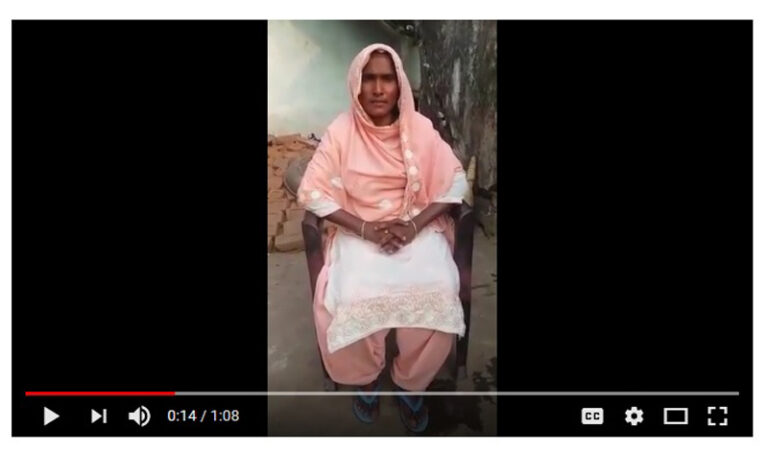
Watch the video:

Her stepdaughter Sunita Soren claimed that she had not eaten anything for the last three days. “She had no Aadhar card, ration card. And there was nothing at home to eat,” Sunita said.

Tisri has a history of middlemen exploiting the poor villagers. Often they take bribes to get any government-related work done. “Budhni even had an Indira Awas, but the roof is fixed. And someone had even withdrawn the money from her account,” alleged Dharmendra Yadav of Tiger Force. Tiger Force is a social organization, meant to fight corruption and Dharmendra is a resident of Gumgi village, near Sewatand.

Significantly, the Mukhiya of Thansinghdih Panchayat Baleshwar Rai also stated that the villagers had informed him about the tribal woman dying due to starvation.

hunger death jharkhand tribal starvationBudhni’s Indira Awas, which has no roof

“When I got the information, I came for an inquiry and all the people told me that she died from hunger. If I had known it earlier, I would have arranged everything,” said the panchayat head Rai.

However, when contacted Sub-Divisional Magistrate (SDM) Ravi Shankar Vidyarthi, he refuted all the statements. “There was food in her house. Block Development Officer (BDO) found rice and potatoes and he has made a video of it too,” he informed eNewsroom.

But villagers alleged that the food grains had been kept at Budhni’s house, after her death.

The MLA of Rajdhanwar, under which Tisri block falls, Rajkumar Yadav, told eNewsroom, “I had raised Santoshi Kumari and Baijnath Mahto’s hunger death case inside the assembly. And the most important aspect in all these cases is that the administration in such cases claim that they have died from cold and not hunger, and they never conduct a postmortem of the deceased.”

No post-mortem was conducted for Budni’s dead body too, informed a source.

Budhani’s death from starvation is not one of case in the state.

Significantly, Tisri is also a native block of the first chief minister of Jharkhand and Jharkhand Vikas Morcha (JVM) chief Babulal Marandi.

Tale of a Judge and innocent villagers of India

0

The so called Indian elites—lawmakers, media professionals, legal eagles and ubiquitous politicians—will endlessly debate if the four sitting Supreme Court justices, J Chelameshwar, Ranjan Gagoi, Madan B Lokur and Kurian Josheph did right or wrong by addressing a press conference on Friday.

These “elites” will also endlessly debate if the chief Justice of India (CJI), Dipak Mishra was right or wrong in ignoring the plea of the four senior most judges after him to set the “apex court’s functioning in order”.

The social media sites—Facebook and Twitter—are on fire with everyone claiming to be knowledgeable enough to give his or her opinion on the issue. Sadly, several social media users are freely using unusable words and imputing motive while advancing their arguments in favour or against the honourable judges.

The Indian judiciary, at its apex level, is surely in crisis and there appears to be no immediate end to it, given “I am right, you are wrong” atmosphere that pervades the Indian behavioural pattern today. Such an unprecedented crisis on Indian judiciary could have been resolved with the spirit of statesmanship, consensus, sanity and dialogue which have vanished from the Indian system, as of now.

An ordinary pen pusher hailing from a remote Bihar village, I have decided to keep out from the debate couched in nasty and indecent languages. Even otherwise, I am not qualified enough to “judge” the honourable judges. Inherently, I treat the Supreme Court as the exalted temple of justice and the justices as the last hope of justice seeking common people of India.

I am sharing with you a story about a Patna High Court judge which shaped my concept and perspective about the justice system when I was in my formative age, living in my village among innocent and illiterate agriculturists and cowherds.

It was in early 1970’s. Gampalia village had a judge in Patna High Court then. Gampalia was only a kilometre away from Daraili Mathia, my village in Darauli block of Bihar’s Siwan district. But Gampalia was known in almost all the villages of Siwan district because it was JUDGE SAHEB’s village. The villagers usually called Gampalia as Judge Saheb ka gaon (village).

Judge Saheb was a deeply religious person. He had the habit of coming to his village in Dussehra or summer vacation every year. He would live in his modest house and did not meet too many people.

My family and Judge Sahib shared a common purohit (family priest), Gajadhar Mishra who used to tell us about Judge Sahib. The limited people who had access to judge saheb were the Purohit, the family barber, servants and close family members. Judge Saheb was fond of meeting school children. Our Purohit had once taken me too to judge Saheb. “Achha se padho, Bhagwan tumeh khush rakhen (Study well. May God bless you with happiness)”, Judge Saheb told me when I touched his feet at our Purohit’s instruction.

Every morning, Judge Sahib would go to the bank of the river Saryu at Darauli, barely two kilometres from Gampalia. He would bath in the river and performed puja for hours in a hut that his aides had got constructed at the river bank. The barber, servants and purohit would accompany him. Our Purohit ji used to say that judge saheb never allowed the policemen or local politicians to accompany him particularly when he was worshiping at the riverbank.

One day, his servants forgot to carry a datun (precursor of toothbrush in Indian villages or a small piece of Neem tree’s stick which the villagers used to brush their teeth) at the riverbank. Judge Sahib asked a servant to go out and pluck datun from any Neem tree around.

The servant went to the Darauli police station’s campus which had a big Neem tree. As he rode on the tree to pluck the datun, the Daroga or police station’s in-charge came out, baton in hand. He began abusing the servant at the top of his voice. The servant pleaded that he had climbed on the tree to pluck a piece of datum for Judge Saheb.

But the Daroga did not listen and lashed the servant mercilessly. Bruised, the servant reached to Judge Saheb without datun. It was not known how Judge Saheb immediately reacted to the situation.

But a few minutes later, thousands of villagers from Gampalia, Daraili Mathia, Kumhati-Bhitauli and Darauli encircled the police station, shouting slogans against the Daroga who had shut himself inside his house to escape the agitated people’s wrath.

Our Purohit ji used to tell, “The villagers had seldom met Judge Saheb. The Judge Saheb too seldom mingled with the villagers. But the villagers had tremendous faith in him. They treated him as next to Bhagwan (God). They were hell bent to punish the Daroga who had beaten judge Saheb’s servant for no reason”.

The irate people—mostly unlettered agriculturists and cowherds—laid a siege to the police station for over three hours. The Daroga stayed holed up in his house. Eventually, the Superintendent of Police (SP), Siwan descended on the spot to persuade the people to go home. Several local politicians too tried to appease the people. But the people were not ready to leave till they punished the “badmash (wicked) daroga”.

On suggestion of some elderly people of the area, the SP went to Judge Saheb and requested him to pacify the people. Judge Saheb, escorted by the SP went to the police station.

The Daroga came out, falling on Judge Sahib’s feet. Judge Sahib politely counselled the Daroga, “You are a young policeman. Never misbehave with innocent villagers. We the judges, the policemen and officials are there to serve the cause of the people”.

Then he persuaded the people to leave the place and go home. Several people wept at Judge Sahib’s compassion and went home.

I listened to our Purohit ji telling this story again and again with great interest. In retrospect, I think that the common villagers who constitute over 70 percent of the Indian population and, to me, they constitute the real India have better consciousness about the Indian judicial system than many of the so called “educated” people using all sorts of unusable words on the pretext of debating the issue.

After suggesting MLAs, not to take commission, I do not get a chance to speak: BJP’s Jharkhand MLA

Giridih: Member of Legislative assembly (MLA) from Gandey Assembly segment, Jharkhand, Jai Prakash Verma, made a startling revelation about his party colleagues. He said, “The party leaders do not give me a chance to speak inside the state assembly after I had talked about how MLAs could play an important role in countering corruption.”

MLAs refuse to take self-correction advice on corruption

“Every member of the house was giving a speech on how to eradicate corruption in Jharkhand. When my chance came, I explained how everyone (81 legislators) could help. I mentioned that if we don’t take a commission and ensure that those working under us are not corrupt, then we could take corruption straight on. I was asked to sit midway,” narrated Jai Prakash Verma, an MLA of Bhartiya Janata Party (BJP).

“I had made this suggestion almost two years back. But since that fateful day, I did not get proper chance to speak inside the assembly,” he added.

Not a newbie in politics

The young leader from Gandey, who is not being heard inside Jharkhand’s Assembly, is not a rookie when it comes to politics. Jai Prakash Verma or JP is the nephew of late Ritlal Prasad Verma, a six-time MP and one time MLA from Koderma and Jamua constituencies, of Jharkhand, respectively.

His personal profile is impressive too. Forty five-year-old JP is a postgraduate (Geography and English) and an alumna of Sainik School, Tailaya. He is a graduate of Chandigarh’s DAV College, the same college that former Indian Cricket team captain, Kapil Dev went to.

I fight against corruption

This first time MLA’s Facebook also talks about helping the poor and fighting against corruption. And Verma claims that he actually practices what he preaches.

“I do not take commission and I have told all the block development officers (BDOs) and Circle Officers (COs) of my area that they should abstain from taking commission from my cadres for developmental works being carried out in my area,” he said.

During the interview, the MLA also accuses officials of delaying his work. “As our cadres do not give any commission, NREP (National Rural Employment Programme)’s Executive Engineer Ramashray Sharma* often creates a problem in our work,” he reveals.

He then adds, “This often delays the MLA funds from getting released for my area. If you will see expenditure record, you will find that Gandey’s MLA has used least amount of funds, which is because officials delay in my works.”

Lavish election campaign corrupts a party

Before signing off, he mentions, “I also believe that parties should not spend much on election rallies as such rallies often lay the foundation for corruption in future.”

Rampant corruption in Jharkhand is not a new thing. Former chief minister of Jharkhand, Madhu Koda has even been convicted in corruption charges.

And the revelation by Verma, of not being allowed to speak inside assembly, just because he wants self-rectificationin order to eradicate corruption from state, is something serious to debate on.

The MLA, has twice, raised serious questions on the functioning style of Jharkhand Chief Minister Raghubar Das and had said that Das does not listen to MLAs. However, on being asked on the same, he refused to comment.

*eNewsroom tried contacting Executive engineer Sharma to seek his comment on the allegation but he couldn’t be contacted on the same

Adani Power Plant in Godda is a violation of Paris Climate Agreement—Babulal Marandi

0

Kodaibank (Giridih): Babulal Marandi, the former chief minister of Jharkhand supremo of Jharkhand Vikash Morcha (Prajatantrik), today claimed that Adani’s proposed power plant in Godda, Jharkhand, is a violation of Paris Climate Agreement 2015.

Godda Thermal Power threat to environment

The Godda Thermal Power Project of Adani Powers will be primarily using coal imported from Indonesia, South Africa and Australia. It is the high usage of coal for power generation that Babulal Marandi is averse to. The Paris Agreement aims at holding the rise in global temperature to below 2 °C above pre-industrial levels and to limit the increase to 1.5 °C above pre-industrial levels. “It further clearly states to develop a system which lowers greenhouse emission. Coal or fossil fuels emit maximum greenhouse gases when burnt. Is it not the thermal plant violating the agreement?” he questions.

According to Marandi, it’s not just environmental issues that the thermal plant has. He mentions, “This thermal plant of Adani will need a lot of water to produce electricity. According to estimates made, it may be equivalent to the water needed by the people of Godda, but Godda is not a water surplus, but water scarcity district. And often people have to face it.” According to him, the biggest issue is that the thermal plant will be producing power for Bangladesh.

Jharkhand’s pain will be Bangladesh’s gain

He then quickly questions, “Tell me, how justified is the government in taking away the lands of local farmers to set up this thermal plant which will not cater to the demand of the localities but that of Bangladesh?” He then adds, “In return, for facing all the adversities, the people of Godda will get to enjoy the pollution caused by this project.”

“The project is not feasible also as, after 20 years people will use only renewable energy, especially solar power than electricity. The largest power generation plant so far is NTPC, which generates electricity which is costlier than that of solar energy,” he said.

Marandi even challenged Prime Minister Narendra Modi to debate on the issue, “I challenge PM Modi to debate with me at Morahbadi Ground (Ranchi), on the benefits of Adani’s power plant for the people of Jharkhand.”

No compensation for land acquired

JVM (P)’s MLA Pradeep Yadav and several other people were imprisoned for opposing the power plant in Godda. Locals had also protested against the forceful acquisition of their land. But not much had been reported in the media.

Marandi also claimed that since independence, a large number of people in Jharkhand have been displaced because of establishment of public sector units, a trend which still continues. “In the last 70 years, 1400 lakh hectares land have been acquired for the formation of PSU leading to the displacement of thousands of people. These poor people were not even given proper compensation.”

He further points out, “Raghubar government has recently cancelled 2100 lakhs hectares of Gair Majrua lands and has transferred them to the land bank, which is being displayed to the corporate as land available in Jharkhand for business. However, it has not been surveyed how many people are living on these lands, and most of the people living with government and administration’s permission only.”

“In Deoghar itself, more than 100 families have been displaced and left to live without a roof over their head, for the construction of the airport. Recently, one of the displaced local has died out of cold,” Marandi alleged. He then adds, “Raghubar Das only works for corporates.”

Of corruption and Raghubar Das

During the interview, he also accused Jharkhand’s chief minister Raghubar Das of being deeply involved in corruption.

“The large-scale irregularities in mining lease, PWD tender and expense for advertisements will send minister and officers to jail if properly investigated. In fact, there should be CBI inquiry into these issues,” Marandi demands.

The JVM (P) chief also attacked Raghubar Das for not removing Rajbala Verma from the post of Chief Secretary. Verma has been sent reminders for more than 30 times by the CBI while investigating the multi-crore Fodder Scam, for alleged discrepancies in withdrawing money from Chaibasa treasury as the collector.

“I have told opposition leaders to stall the budget session of the assembly on the issue of Rajbala Verma only,” he reveals.

Marandi, who began his political career with BJP to become the CM and also a Union Minister, alleged that “In every act of Raghubar Das’ corruption, centre’s hand is in glove”.

The former chief minister of Jharkhand rues that reason for which Jharkhand was formed is yet to be fulfilled.

Where is Vikas?

“In last 17 years, Jharkhand has witnessed all kind of political experiments, right from having an independent CM to a non-tribal one. Now, it can also not be rued that no party has got a majority in the assembly. But if you want to get idea how much development (Vikash) took place in Jharkhand, see the government hospitals, neither block nor sadar hospitals are in good condition. The government schools are in bad condition, as the student-teacher ratio is very bad,” says Marandi, who was once a teacher.

“Residents of Jharkhand are unable to pursue B.Ed or engineering as they don’t have money to pay the tuition fees. In last three years, competent students, who cracked BIT Mesra’s engineering examination, were unable to take admission because of lack of money. About 20 seats remained vacant in the year 2015, 2016 and in 2017,” he adds.

Taking a final dig at the present CM of Jharkhand, he says, “The recent deaths due to starvation in Jharkhand are a proof of the development that the Raghubar government keeps claiming in its advertisements.”

As we wrap up, he is asked, on the possibility of getting into any political alliances for the forthcoming elections, he signs off by saying, “In the interest of Jharkhand, we can forge an alliance with any party, but BJP.”