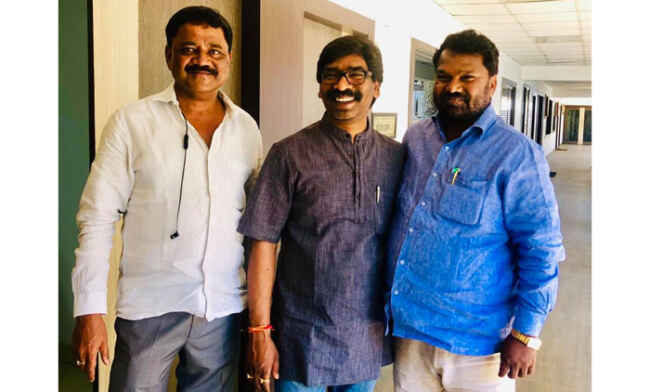
Vasundhara Raje has failed as CM, she has also ruined Rajasthan’s bhaichara: Manvendra Singh

0

Barmer/Kolkata: It took almost three days to pin Manvendra Singh down for a telephonic interview. Singh recently dropped a brick following his announcement to dissociate himself from the Bharatiya Janata Party (BJP). In the process, he has stolen the thunder from Vasundhara Raje’s Gaurav Yatra just a few months ahead of the assembly elections. Son of BJP’s founding member Jaswant Singh, Singh doesn’t mince words while speaking about the raw deal being meted out to him and his father by a political party which had been nurtured by the family. Following are excerpts from the no-holds-barred conversation:

eNewsroom: From being an ardent supporter of BJP to saying ‘Kamal Ka Phool, Badi Bhool’, the journey must have been a difficult one for you….?

Manvendra: Well, it definitely has been a difficult decision to severe links from a party which you have served all these years through thick and thin. But sadly enough, BJP has failed to deliver on any of the promises that it made during the last assembly polls or before the general elections. Also, the slogan, Kamal ka Phool, Badi Bhool, is not actually my statement. It’s the sentiment of the common man which I realized during my Swabhimaan Yatra. The people of Rajasthan are definitely regretting having voted for a party which has failed them miserably.

eNewsroom: What about you and your father Jaswant Singh. Do you think, you people too perhaps made the wrong choice?

Manvendra: (Pauses) We definitely have been given short shrift because of certain politicians within the BJP, both at the state and national level. The way my father has been sidelined after having dedicated his entire life to this political party is quite shocking for us all. So, to be honest, the fault lines had appeared way back in 2014 but it took me around four years to take a final call. You see, it’s not easy to move away from a political party to which you have dedicated your lifetime or your prime years.

eNewsroom: Has the party been unfair to you too, like your father?

Manvendra: Yes. My decision to quit is linked with the way we have been treated. Since 2014, my father and his supporters have been continually targeted and harassed by the BJP.

eNewsroom: Why flag off a Swabhimaan yatra to announce your decision?

Manvendra: This is a battle or fight for our self-respect and there could be no better occasion to announce my decision. But let me tell you, I announced my decision only after gauging the public sentiment of my area. During this yatra, which I had flagged off about a month back, I have been interacting with the masses, who have only one slogan – Sabak Sikhana Hai (We want to teach a lesson). You see, the common man has been treated badly by the Rajasthan’s chief minister, who had made tall promises but has miserably failed to deliver.

eNewsroom: So, do you feel that Vasundhara Raje has failed to succeed as the chief minister?

Manvendra: Of course! The common man had showed a lot of confidence in her leadership. She won all the seats and see, how she has performed. Equally annoying has been her Sphinx-like silence on lynching cases in Alwar. She has not been tuned into the needs of her people. Development has been conspicuous by its absence. On the contrary, Rajasthan has been denuded of its vibrant local culture of bhaichara during her tenure.

Lynching and communal riots were not prevalent in our state. It’s not part of the Rajasthani culture. Raje’s failure to deliver on her promises and her apathy towards social fragmentation will be the cause of her downfall. And let me be clear, it’s not just the Muslims but the Hindus too are unhappy with her.

eNewsroom: Not just you, many BJP leaders have quit the party in Rajasthan. Why?

Manvendra: My dissociation with BJP is an outcome of Raje’s apathy towards me and my father. She has failed to be a leader who keeps her party members together.

eNewsroom: Do you think that the BJP has a chance to win the Assembly Elections?

Manvendra: I don’t think so. The people are looking for a change as they have seen through Raje’s rhetorical pyrotechnics.

eNewsroom: What about the Lok Sabha election next year, do you think BJP will win?

Manvendra: Well, I can’ comment much about BJP’s performance at an all India level, as I don’t travel a lot. But yes, one thing is for sure, the Modi wave is fading in the country.

Next day of launch of Ayushman Bharat by PM, a woman dies because of its procedure in Jharkhand

0

Ranchi: On September 23, Prime Minister Narendra Modi launched a major healthcare scheme, Ayushman Bharat —Pradhan Mantri Jan Arogya Yojna, which has been nicknamed as Modicare from Ranchi like famous Obamacare in the US. But Bhaktu Ravidas, a resident of Jamshedpur, 128 kms from Ranchi, had no idea that it would cause the death of his mother.

On Monday around 7 o’clock, the next morning of the launch of Ayushman Bharat, Ravidas reached AGM Hospital with his mother, Ritu Devi, an eighty-year-old lady for the treatment of diarrhoea.

But PK Sahu, the doctor on duty at AGM hospital, sent Ravidas to make Ayushman Bharat card to begin the treatment. Ravidas insisted that since his mother was having diarrhoea for 10 days, it would be better if the treatment began while he made the card. But the doctor would have none of it and asked Ravidas to get blood and urine tests of the patient also done.

Ravidas left his mother alone and went to make the card. It took him a gruelling 6 hours to get the Ayushman Bharat card made, and when he returned to the hospital, her mother had already breathed her last.

A livid and agitated Ravidas tore the card. Weeping uncontrollably, he said that it was the Ayushman Bharat which took the life of his mother.

Deputy Superintendent of AGM Hospital, Dr Nakul Choudhury said that strict action would be taken against the doctor. He said when a patient reaches the hospital, he or she should be treated first and documents can be made later. It is sheer dereliction of duty on the part of doctor as an elder woman died for lack of care.

The story has been reported at all the vernacular media’s Jamshedpur edition on September 25 including Dainik Bhaskar. However, it did not make it into any major national newspapers.

Jharkhand’s former chief minister and Jharkhand Mukhti Morcha (JMM) leader Hemant Soren, however, tweeted the incident, with the pictures of vernacular media reports.

According to National Health Profile, 2018, Jharkhand has third poor doctor: population ration (1:18518) after Bihar and Uttar Pradesh in India. While as per recommendation it should be 1:1000. But it seems it is not only the manpower and infrastructures Modi government should make available to the health and wellness centers (the new names defined for government hospitals) but it is also the responsibility of government to inculcate sensitivity among doctors on how to take care of patients.

As election approaches, saffron groups smell love jihad in Bengal’s air

0

Kolkata: West Bengal has been a focal point for the right-wing ideologues for some time now. Reports of foot soldiers of the saffron brigade making inroads into Bengal are now frequent in Bengal. The news from the right wing camp being that Vishwa Hindu Parishad (VHP), has been distributing pamphlets in colleges of West Bengal, trying to warn Hindu girls of the dire consequences of so called love jihad, they might face if they marry a Muslim man.

To counter VHP’s campaign of creating an atmosphere of hate and fear in Kolkata, a city which till date is known for its liberal ideology, had a round table discussion organised by Al-Eman Mission, a Kolkata-based social organisation, on Saturday at the Academy of Fine Arts.

The event had people from different communities participating to come up with ideas to counter the campaign of hate in colleges of Bengal by propagating the bogey term of love jihad coined by the saffron brigade to describe the inter-faith marriage of a Muslim man with a Hindu girl. The saffron outfits, till date, have effectively used this terminology, to create a divide between the Hindu and Muslim community, in the Hindi belt to get votes in their favour. With the 2019 General Election approaching, VHP seems to be using the same strategy in Bengal, to polarise votes. In fact, at the recently concluded World Hindu Congress in Chicago, the posters of Sharmila Tagore, who had married former Indian cricket skipper Nawab Pataudi used to exhibit the case of love-jihad. Sharmila, who hails from the prestigious Tagore clan of Bengal had a love marriage with Nawab Pataudi in 1969.

Abdul Aziz, an Urdu writer and member of Milli Etayar Parishad, a social organisation, which aims at building unity and propagating communal peace, began by saying, “Where there is love, there cannot be Jihad. The two are quite opposite in nature. Love conquers all, but Jihad cannot.”

He then went on to explain the meaning of Jihad. ‘It is a struggle or fight against the enemies of Islam. How can love be an enemy?’ questioned Aziz.

However, VHP has decided to go ahead with their plan of circulating leaflets and pamphlets, which comes laden with instructions like wearing sindoor and mangalsutra and celebrating all Hindu festivals to assert one’s Hindu identity. The leaflet also has a solution for girls ‘trapped’ in an inter-faith marriage – make your husband accept Hinduism. These pamphlets are all set to be distributed across Bengal’s educational institutes. Not only that, the VHP cadres will be doing a door to door campaign to make girls wake up to the conspiracy of love-jihad. Around 35,000 cadres of Durga Vahini and 40,000 members of Bajrang Dal, both affiliated to VHP, will be a part of this campaign.

“The members of Durga Vahini and Bajrang Dal will be doing the legwork. Initially, we will start with the sensitisation programme at various educational institutes and will then move ahead with our door to door campaign. We have already flagged off this campaign in some of the districts but in a scattered way. By the end of this month, we will begin this campaign in Kolkata,” informed Sourish Mukherjee, state spokesperson of VHP. He added that his party has already prepared a list of families whose daughters have been trapped. “We will counsel the girls and the parents. We will tell them the danger of such marriages,” said Mukherjee.

The pamphlets and booklets have a detailed report on how to identify cases of ‘love-jihad’, its prevention and what needs to be done, if ‘a Hindu girl falls prey’. The pamphlet even directs families to avail counselling and to contact members of VHP or Bajrang Dal, lodge police complaints and accept these rescued girls and unite them with the rest of the families. “In Hindu families, these girls are not accepted but we counsel the family members to accept them and reintegrate them with the rest of the family,” said Mukherjee.

Speaking to eNewsroom from Port Blair, Sachindranath Sinha, VHP organising secretary for Bengal, Bihar, Orissa and Andaman Island claimed, “For the past five to six years, this has become a major issue in Bengal. Districts with higher Muslim population like North and South Dinajpur, Murshidabad, Nadia, North and South 24 Parganas such things (inter-faith marriages) are being encouraged. We are not against love or not against Muslim or Christian communities. We are against conversion. We are trying to create awareness about it,” said Sinha.

Interestingly, it is not only ‘love jihad’ issue being a common practice in Bengal a worry for VHP workers, but they see an infiltrator angle in it too.

“Infiltrators from Bangladesh are posing a problem. In Port Blair too, most of the golgappa wallas and chaat wallas are from Bangladesh. They leave their families behind in Bangladesh and marry a local girl. The demographic picture is changing fast and its socio-cultural effect can no longer be ignored,” claimed Sinha.

But, Asif Khan, chairman of El-Eman said that divisive agenda of VHP would not be as easily implemented in Bengal. “We too will begin our campaign. We will not let Bengal be converted into another UP,” said Khan. He added, “Supreme Court has decriminalised 377.  Now, men can love men and can freely move around without being harassed by police. Then why Hindus and Muslims cannot move freely. In this way, we will be moving backwards. We will not let Bengal move backwards,” added Khan.

Along with Jharkhand’s Santoshi, 55 died of hunger across India in last three years

0

Ranchi:  As many as 56 starvation deaths have been reported in the last four years in India, of which 42 deaths took place between 2017 and 2018.

And in two Indian states – Jharkhand and Uttar Pradesh (16 cases each), maximum number of hunger deaths have taken place.

A group of social activists have compiled a list of hunger deaths to mark the death anniversary of Santoshi Kumari, who had starved to death in Jharkhand last year. Her family claimed that she had died crying bhaat-bhaat (boiled rice).

The press communiqué issued by the activists stated, “This is a telling reminder of the precarious living conditions of the Indian poor.”

“In a healthy democracy, hunger deaths would make it to the headlines and become a matter of debate and action. Some of the cases reported here did receive some attention, but even those did not lead to the sort of sustained pressure that would force the government to do what it takes to prevent hunger deaths. Most of them barely made it to the ‘news ticker’ of the fast-paced breaking news,” it further read.

On the occasion of Santoshi’s death anniversary, social activists like Siraj Dutta, Reetika Khera led by Jean Dreze compiled a list of reported hunger deaths from 2015, by searching news reports related to hunger deaths on Google.

Hunger deaths mean that the victim died after prolonged hunger because there was no food or money in the house, and that, quite likely, he or she would have survived otherwise.

News reports of “starvation deaths” have been coming in a steady trickle over the past few years in India. One particularly tragic episode was that of eleven-year old Santoshi Kumari in Jharkhand. She died on September 28, 2017 begging her mother for rice as she slipped into unconsciousness. It was later learnt that her family had lost their ration card because it had not been linked with Aadhaar (in mid-2017, the Jharkhand government mass-cancelled Aadhaar-less rations cards).

“Many of them depend critically on social security pensions and the public distribution system (PDS) for their survival. Denial of PDS rations or pensions accounts for most of the hunger deaths. Most of the victims are from disadvantaged groups, e.g. Dalits, Adivasis and Muslims,” wrote the activists.

During their research the activists found out that, out of the 42 hunger deaths in 2017 and 2018, a majority (25) of the cases were related to the Aadhaar issue.

Further investigation revealed that out of these 25 cases, 18 were due to loss of one’s ration card or pension for lack of Aadhaar linking, and failure of Aadhaar-based biometric authentication (ABBA), which is compulsory in several states.While the remaining 7 deaths were due to individuals being denied PDS rations or a ration card for unspecified reasons, which are likely to be related to Aadhaar in some cases at least, mentioned the release.

In Jharkhand, ABBA is compulsory in most ration shops. Uttar Pradesh too, has implemented the National Food Security Act but in a belated and haphazard manner.

“Despite the growing evidence of the counter-productive role of ABBA in the PDS, the central government persists in its determination to make it compulsory across the country,” it added.

Year wise deaths listed in the table:

Number of reported hunger deaths Aadhaar-related deaths Aadhaar in PDS/pension?
2015 7 0 No
2016 7 2 Some states
2017 14 11 Yes
2018 28 14 Yes


The country will go to the dogs if an unapologetic killer is allowed to become a leader: Afrazul’s wife

0

Kolkata: As the disturbing news of Shambhulal Regar getting a ticket to contest election from Agra in Uttar Pradesh reached Malda’s Kaliachak area, Gulbahar Bibi looks visibly agitated. Bibi, the widow of Afrazul Khan, a migrant labourer from West Bengal was hacked and burnt to death in Rajasthan’s Rajasmand district by Regar last year in December, who at present is behind bars.

Regar’s unimaginable brutality had instantly catapulted him into fame as he became a sort of celebrity for the Hindutva supporters, as he justified his killing to counter ‘love-jihad’, a bogey term coined by Right wingers for inter-faith marriages. His supporters even crowdfunded to support his family’s legal battle and even took out a tableau during Ramnavami to celebrate Regar’s act.

 A criminal can’t be allowed to contest elections

Speaking to eNewsroom, a disconsolate Bibi said, “We know that my husband’s murderer was being supported by a section of people. But I had never anticipated that this person accused of murder would be given a ticket to contest the election.” After a pause, she added, “The country will go to the dogs if an unapologetic killer like him is allowed to become a leader. If he goes on to become a political leader then it will become difficult for us to get justice. I will consult a lawyer and make sure that his political ambition is nipped as early as possible after speaking to the gram panchayat.”

On being asked what she wants, she quickly replied, “We want justice. We want him to be hanged till death. As the video shows, which is one of our documentary evidences, he not only tried to instill fear in the common man but also tried to polarize the society. Under no circumstance will I allow this man to be let off so easily. We want justice and shall do our best to have him punished for his heinous crime.”

Seeking support of the intellectuals

Criticising the UP-based political party for having decided to allow Regar contest the approaching Lok Sabha elections, Tanmoy Ghosh, General Secretary of Bangla Sanskriti Manch, a Kolkata-based NGO, which had previously led several protest march, is now demanding justice for Afrazul. He said, “The news of him getting a ticket came as no surprise. He had got immense support from several Hindutva outfits. We are aware of the financial constraints of Afrazul’s family and hence will be filing a PIL soon at the Kolkata High Court, demanding him to be barred from contesting elections. We also plan to mobilize society and seek support from the intellectuals.”

He added, “If required we will approach the opposition leaders to raise this issue at the Parliament. We will definitely not let fringe elements to bring such criminals to the mainstream, as it will set a bad example for India’s democracy.”

PIL can act as a deterrent

Speaking about the legality of Regar contesting elections, Kolkata High Court lawyer, Shabnam Sultana said, “Under the Representation of People’s Act and the Indian Constitution, a criminal is barred from contesting elections. In this case, we have strong digital evidence which proves that Regar has committed a grave crime. I will be filing a PIL on behalf of Bangla Sanskriti Manch and am very hopeful of getting a stay order on his move to contest elections. If required, we shall take up the issue at the Supreme Court.”

Murder politically motivated?

On being asked if the killing of Afrazul (a hate crime) was politically motivated? Ghosh replied, “Of course, the brutal murder had a political agenda. I was shocked to hear Amit Shah boast in one of his speeches that they won the Gujarat elections despite ‘Akhlaque issue’. This definitely amounts to patronizing hate crimes. We definitely don’t expect such comments from the president of a political party.”

But does the contemplation of Regar being given a ticket to contest the election, mean that he will win the election? Political analyst Bishwanath Chakraborty said, “Mark my words, even if Regar contests the election, he will not win. The party giving him the ticket is using him to gain instant popularity. Other major political parties will be least affected by the Regar factor.”

NPA defaulter’s list: More trouble brewing for Modi government

0

More trouble may brew up for the NDA government led by Narendra Modi as the Lok Sabha elections approaches closer. Liquor baron Vijay Mallya’s case is only one of the many scandals for which the answers will be sought from the BJP.

The Rafale deal scam is already troubling the BJP. The ruling party’s harried panelists tried to see a ray of hope when Chief of Indian Air Force Air Chief Marshal B S Dhanoa observed that the Air Force was reeling under a severe shortage of fighter aircraft and the purchase of Rafale fighter aircraft would strengthen the Air Force. The Air Force Chief may have been advised by the government to come to its defence for the purchase of Rafale, as some critics of the deal have asserted. But that does not minimise the gravity of the scandal. The efficacy of the aircraft was never under dispute. It is the ‘higher’ price and the manner of the deal struck by Prime Minister Narendra Modi that is being questioned. Even Air Chief Marshal Dhanoa could not help the government spokespersons in this respect. Asked if the present deal was cheaper than the earlier one, he said that it would ‘be answered by the Ministry of Defence’.

The original deal for the purchase of 126 Rafale aircraft was abandoned by Modi in favour of the purchase of 36 aircraft. The original deal involved the outright purchase of 18 aircraft and the manufacture of the remaining 108 aircraft in India on the basis of transfer of technology. The price per aircraft in the original deal was Rs 715 crore while in Modi’s modified agreement, the price per aircraft was agreed at Rs 1670 crore. Not only that, the contract was taken away from Public Sector Undertaking HAL and awarded to Anil Ambani’s outfit ‘Reliance Defence’ which was incorporated less than a fortnight before the deal was signed by Modi and had no expertise in manufacturing defence aircraft.

Vijay Mallya’s revelation that he had met Finance Minister Arun Jaitley before leaving India seems to have rattled Jaitley. First he outrightly denied having had any meeting with Mallya; then he admitted meeting him informally at the Parliament and added that there was no formal meeting between the two. Who is Jaitley trying to fool? Does a man, running away from the law after committing a major crime, fix a formal appointment with the authority to seek his help for escaping to a safer place? Some BJP panelists came to Jaitley’s defence by alleging Mallya’s cosy relations with Congress leaders. Whatever be Mallya’s relations or dealings with Congress leaders, his escape from the country’s law was facilitated by the Modi government, presumably at the instance of Finance Minister Arun Jaitley, so much so that a ‘detention’ notice was converted into a ‘just inform’ notice at the airport for Mallya.

Perhaps a greater bomb will explode when Raghuram Rajan’s list submitted to the PMO is out – and it has to surface after some time. In his deposition before a Parliamentary Committee, the former Governor of Reserve Bank of India (RBI) revealed that he had sent a list of ‘high profile cases of fraud in the banking sector’ to the PMO urging coordinated action ‘to bring at least one or two to book’. The PMO, however, did not act. Rajan had made it clear that frauds are different from normal non-performing assets (NPAs).

Rajan has not named the fraudsters nor has he specified when he sent the list to the PMO – during the UPA rule or during Modi’s regime. It can, however, be safely surmised that the list was sent to Modi and it was Modi who had scuttled any action against high profile fraudsters. Surely it could not have been Manmohan Singh. Raghuram Rajan became Governor of RBI in September 2013. In less than six months the election process had started. He did not have enough time to fully understand the functioning of the RBI, collect and collate the details of the high profile fraudsters and submit it to the PMO. Even if he did submit to Manmohan Singh as the UPA government was on its way out, he would not have time to scrutinise the list and would leave it for Modi. Moreover, had Manmohan Singh been even remotely involved with the list of high profile fraudsters, loudmouthed Modi would have mentioned it ad nauseam in his speeches in India and outside.

I am traumatized, and living in fear. Anytime, I can be killed: Prof Sanjay Kumar

0

Delhi/Kolkata: Sanjay Kumar, assistant professor of sociology, at Mahatma Gandhi Central University, Motihari (Bihar) who was dragged from his residence and nearly torched by a group of men for having spoken against the Vice-Chancellor of the university, speaks to eNewsroom about his trauma and agony, just after his university swung back to normalcy. Following are excerpts from the conversation with Kumar:

Q: Do you think you were attacked because of your ideology? What is your ideology?

A: I believe in the struggle for an egalitarian society. I am a believer of democratic values and equality. This ideology is not easily accepted by the fascist system. These fascists are desperate and have attacked me because of my philosophy. These fascists become desperate when you expose their corruptions. The VC of our university is an out rightly corrupt, feudal and patriarchal. He orchestrated this attack on me with the help of his right-wing goons.

Q: How much is India in need of the ideology that you follow. How are you going to show your solidarity for this belief of yours, which has led to the attack on you and others like Kanhaiya Kumar?

A: India is very much in need of leaders with such ideologue. All we believers of peace and democratic values, who celebrate the legacies of Ambedkar, Marx need to come together in order taken on the fascists.

Q: While attacking you, the attackers were heard saying, Kanhaiya Banega…? How you connect yourself with Kanhaiya and his movement to get azadi from fear, hunger, and Sanghwad?

A: We all need “azadi” of all kind. We must welcome all who help us in getting the “azadi” irrespective of their ideological differences.

Q: There is an ongoing debate on Urban Naxal. Do you also feel you that you are one of them?

A: Anybody who is against BJP is a naxal or an urban naxal.

Q: Mahatma Gandhi Central University, which was closed sine die since August 20, after assault on you, has started operating now. How do you see to it?

A: Mahatma Gandhi Central University Teachers Association (MGCUTA) along with students; democratic and sensible Champaranvasi since the very beginning have opposed this draconian move (sine die) by the vice-chancellor. This criminal conspiracy of the VC is an assault on the dreams of all the teachers working for quality education. Much ahead of the murderous attack on me (August 17) the VC had said that no admission would take place for the undergraduate courses (which are the major course of MGCUB), this session. However, notification for MBA and MSW was issued. But so far admission has taken place, even for these two courses.

Q: This incident has shocked many. What’s your feeling at the moment?

A: I am traumatized and living in fear. Any time I can be killed. VC along with local goons has made the university a ‘concentration camp’. This Brahmanical VC is hell bent on running the university as per Manusmriti and violating all constitutional measures. He had the audacity to say, “No Supreme Court can save you if I terminate you”.

A rag to riches story cut short by the Kolkata bridge collapse

1

Kolkata: The road that leads to his house in Silpara, Behala, is narrow. And with the rain gods showering their blessings, or is it their sorrow, it is a tricky stretch to cross. Between two rooms is a narrow sitting space. On a regular day it was perhaps merely a link between the two room at each wing. But now, despite— days after the accident it is crowded with media persons prodding the family for more information and to keep abreast with the latest developments vis a vis government help or to see which politician came to pay their condolences to the family.

As you step inside the small room that Soumen shared with his dadu (maternal grandfather), the sight of the octogenarian lying on the bed looking vacantly at the ceiling makes you choke. The family politely asks him to sit up and meet the ‘guest’. He sits up looking gaunt and spent. Just a mention of Soumen’s name and his eyes well up, tears roll down. “He used to do all my paper work. We used to chat about books and songs. He would read till  late in the night. Now it is all over,” his grandfather’s voice chokes with emotion. His eyes bear a haunted look of a man who has lost everything he had. Basanta Kumar Ghosh, used to work with the Kolkata Port Trust. One of life’s ironies that the Majerhat bridge which collapsed and killed Soumen on… was build by KoPT.

Soumen Bag, the 27-year-old young man is the first victim of the Majerhat Bridge collapse. Soumen, a commerce graduate used to work as a medical representative (MR) and had come to live with his grandparents when he was barely one-and-a-half-year old and never went back to live with his parents in Shyambazar. This was his home. His mother stayed with him at her paternal home when he was younger. His maternal family being slightly better off raised him as their own as his parents struggled to earn two square meals on a daily basis. The parents would come to visit whenever they could. They last spent time together in this very house on Independence Day. That’s the last his parents saw him though they spoke nearly daily over the phone. Soumen’s books lie on a table in the room, neatly arranged, next to photos of the gods and goddesses and his late grandmother who passed away three years back.

Majerhat Bridge kolkata soumen bag
Parents of Soumen Bag

“I called on his mama (maternal uncle) number just to check on him after seeing the news on TV. He told me that Babai had taken the day off from work and was supposed to go to College Street. I called on his number. Someone else answered the phone. I rushed here and was told to go to PG hospital. I thought maybe he has lost a limb or so. But once I reached the hospital I knew within two minutes that it was all over,” Prabir Bag’s voice drains off.

The parents and the rest of the family looked visibly exhausted, drained out of all emotion answering numerous queries about Soumen, who used to work as a medicine distributor. They repeat it to the next media person almost mechanically. The mother’s tears had dried up despite the loss of her only child. Who will feed the family or look after them in their old age is playing on her mind. “Amar sob shesh hoy geyche (I have lost everything),” she laments wiping her tears, her voice barely audible. Then she is stoic again, talking about her son as if he is somewhere around, just not visible to the eyes right now. The family has a roadside chop er dokan (tea and snacks stall) at the corner of the road leading to the house, run by his grandfather’s younger brother, Ajit Bose.

His father is hopeful that all this media coverage will help the family get a job to replace the loss of the only earning member. His father never really had a regular income. His in-laws supported him and since the last five years his son had started earning things had started bright for them. His mother wanted to get him married but Soumen declined saying he had a lot of things to do for his family, especially his dadu, and have some saving before he marries. Whether he liked anyone or had any girlfriend they did not know, because Soumen was the sort that spoke little, loved reading Bengali literature though he was a commerce graduate from Sarsuna College.

Majerhat Bridge kolkata soumen bag
Soumen’s collection of books

Just a few days before the accident, while the world celebrated Janmasthami, Soumen celebrated his 27th birthday on September 2. Friends and family cut the cake in that same sitting area between the two rooms and the brother sister duo had non vegetarian food for dinner. A small birthday indulgence allowed to the non veg loving cousins even though the rest of the family adhered to vegetarian food, as is the norm during Janmasthami.

His favourite deity was Goddess Saraswati and he invariable took the lead in organising Saraswati Puja every year. He loved to eat and would frequently succumb to his doting cousin sister’s demands to bring food from outside. “Home cooked food is so boring to eat every day. Dada would bring whatever I demanded and fed it to me himself,” says the little girl, yet to apprehend the loss. He used to help her with her studies. Chowmein or biryani from the eateries nearby were their favourite.

Moumita, a student of class seven, shared proudly that her brother was not like any other regular guy his age. “He has written two books. One which is apparently already published is on Epar Bangla, Opar Bangla” she shared. Meaning the book is on India-Bangladesh relations. And another is yet to be published. Both he supposedly co-wrote with a friend.

The family, all not being well educated had little inkling of all this. “It is the media people who told us,” said Moumita, trying to google and show the details while the internet connection played spoilsport. “He dropped his surname in the book because his friends used to tease him about his surname. Bag, the tiger,” smiled his mother, Anita, at the sweet memory of days of laughter and fun in this ordinary but once happy, lower middle class household.

Fresh inquiry needed in burning of S-6 Coach near Godhra

0

The burning of S-6 Coach of Sabarmati Express near Godhra on February 27, 2002 needs to be investigated afresh. The Hon’ble judges who had constituted the Commission of Inquiry had done the most dishonest job, by ignoring even the discrepancies that exist in the official records. It was the burning of the Coach S-6 with its occupants that was used by the Gujarat government, with Narendra Modi at its head, to organise the massacre of Muslims.

The first report that reached Delhi after the burning of the Coach S-6 was that the Vishwa Hindu Parishad (VHP) had created the trouble. The news of setting on fire a coach of Sabarmati Express at Godhra station was given in detail in Dopahar Samachar of Akashvani (2-15 pm to 2-30 pm) on February 27, 2002. There was a voice cast of then Prime Minister Atal Behari Vajpayee in which he had specifically appealed to the Vishwa Hindu Parishad to desist from violence as nothing could be gained by resorting to violence. By night the colour of the incident had changed and the VHP activists were gradually transformed into the victims.

The train was supposed to carry Kar Sevaks from Ayodhya, where they had gone to take part in a yagya organised by the VHP for the construction of Ram temple in place of where once Babri Masjid had stood. As the train reached Godhra station in the morning of February 27, the Kar Sevaks got down on the platform and created ruckus with tea and snacks vendors, most of them were Muslims and lived in a locality called Signal Falia, about a kilometre or so away from the railway station. After the train started, someone pulled the emergency chain and it stopped. There was said to be heavy stone pelting at the train and the passengers hurriedly closed the widows of their coaches. The train started and it was again stopped after a few minutes near Signal Falia. There was also stone pelting. Then suddenly there was a fire in Coach S-6.

The police swiftly ‘discovered’ that some people near Signal Falia were already standing with cans full of petrol; they poured the petrol into Coach S-6 through windows and set the coach afire. This was, more or less, the ‘finding’ of the Nanavati-Mehta Commission of Inquiry which had concluded that burning of the S-6 Coach of Sabarmati Express near Godhra railway station was a ‘planned conspiracy’.

Now the discrepancies which the Commission ignored: The train driver’s complaint, which is also the First Information Report, timed the incident as happening between 7.47 am and 8.20 am. The offence was registered at 9.35 am with the railway police. But documents filed by the police before the courts said that the event had taken place on the night of February 27. The driver’s complaint mentioned that some persons had been arrested on the spot. In the remand application of the first 30 people to be arrested for the crime, accused numbers 1 to 15 were said to have been arrested on the spot. But the time of their arrests had been given as 21.30 hours (9.30 pm), February 27. This is one of the the most glaring of contradictions.

Trinamool Congress was then part of the Centre’s NDA government headed by Vajpayee and Mamata Banerjee was herself an MP; Nitish Kumar was the Railway Minister. Mamata demanded that the Railway Ministry should release a list of those who travelled and perished in Coach S-6 of the ill-fated train at Godhra. As the government and the Railway Ministry continued to ignore her demand, she threatened to sit on dharna inside Parliament if the list was not released. Then on August 21, the Railway Ministry issued a statement and it appeared in newspapers on August 22.

The statement said that in Coach S-6 of the Sabarmati Express on that day a total of 59 passengers had made reservations, most of these were made from Lucknow and Kanpur. Three of them had cancelled their bookings. The Railway Ministry had ‘after comprehensive investigation’ found that out of the 56 persons who had their reservations in the Coach, four were killed, nine were injured and seven were still missing’. The Railway Ministry further said that its investigation found that ’32 of them were alive and safe’ and that the remaining passengers who had perished in the burning coach ‘appear to have boarded the Coach without reservation’.

Very comprehensive statement. Now, how did Chief Minister Narendra Modi promptly identify the 59 Kar Sevaks claimed by him to have been charred to death in the Coach, arranged their ceremonial but hurried cremations and announced compensation of Rs 2 lakh each to their survivours? No conspiracy! Spontaneous message from Almighty God to hurriedly identify the passengers who did not even have reservations in the Coach!

Now the theory about throwing petrol from outside in Coach S-6 and setting fire to it. It was examined by Government Forensic Science Laboratory, State of Gujarat. A team of forensic experts visited the place on May 3, 2002. In order to recreate the real picture of how the offence was committed on the day of the incident, one coach was kept on the same spot. With the help of different types of containers experimental demonstrations were also carried out by using liquids inside the coach. The following is the gist of conclusions arrived at by the team and released by the Laboratory:

The height of the window of the coach was around 7 ft. from the ground of the place. As such, it was not possible to throw any inflammable fluid inside from outside the coach from any bucket or carboy because by doing this, most of the fluid was getting thrown outside;  There also appears to be no possibility that any inflammable liquid was thrown through the door of the coach;  Conclusion can be drawn that 60 litres of inflammable liquid was poured by using a wide mouthed container by standing on the passage (of the coach) near the seat No. 72 and the coach was set on fire immediately thereafter.

Majerhat bridge is falling down, my dear didi

0

Kolkata: At least five people have been killed on the spot, and many are trapped in the debris, when Majerhat bridge, located in South Kolkata collapsed on Tuesday afternoon.

This is for the third time that a bridge has collapsed in the state capital of West Bengal. The first bridge that had collapsed was the Ultadanga flyover in 2013, followed by Vivekananda Road flyover in 2016.

Bengal Chief Minister Mamata Banerjee, who is in Darjeeling for an official tour, said, “We have just got the news about a section of Majerhat bridge has collapsed. We are monitoring the relief and rescue work from here. Respective officials including the Urban Development Minister and the Mayor along with officials of our disaster management team have been directed to offer prompt rescue and relief to those injured or killed during the mishap.”

She then quickly added, “Our primary concern at the moment is to rescue those who have been left trapped or killed during this tragedy and to provide relief to those affected. Of course an enquiry will be initiated to know what led to the collapse. But first thing first, which is the rescue and relief work.”

Watch the video


However, the commuters, who have been using the bridge, are in no mood to be pacified. With the pictures and videos of the mishap going viral, people took on the social media to vent out.

“Repeated confirmation on WhatsApp about the now fallen Majerhat bridge is saddening. It served us well and if it hadn’t been for the metro construction closeby, I have a feeling it wouldn’t have fallen,” wrote Gautam Arora, of DP Electronics, Kolkata, on his Facebook wall.

While, Saheli Mitra blamed the use of second grade materials to build the 40-year-old bridge, built by the Port Trust. She wrote, “This is the bridge that we use atleast 5 times a day…was wondering how long shall we tolerate the political party-contractor nexus, where second grade materials are used to build the bridge, zero maintenance, and the metro coming up by cutting trees after trees.”

Senior PRO, Sanjoy Mukherjee, of Kolkata Port Trust, refrained from taking the repeated calls made to him and sent a curt message, stating that he would be calling back to speak on the issue. Later, he shared a press statement stating that the KoPT didn't have any official records of Kolkata Port having built the bridge. The statement read, "Kolkata Port is deeply concerned about the mishap and the loss of life. Our security team of PSO and 50 CISF personnel of KoPT have been already deployed. KoPT does not have any records of Majerhat Bridge being built by Kolkata Port."

Meanwhile, according to eyewitnesses present on the spot, a number of bikes have been seen trapped under the bridge, which both the official rescue operation team along with the locals who had rushed to the spot minutes after the bridge collapsed, are trying to rescue.

The bridge collapse has led to the temporary suspension of train movement through Majerhat as a precaution. A signal post of the Majerhat railway station has also been damaged by the debris of the collapsed bridge.

(This story has been updated after the KoPT issued its official statement)