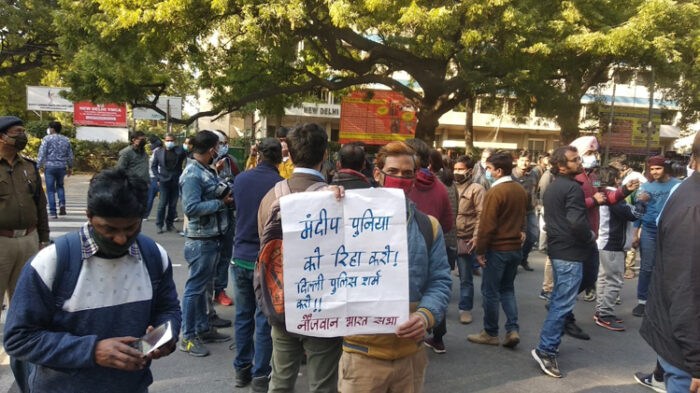
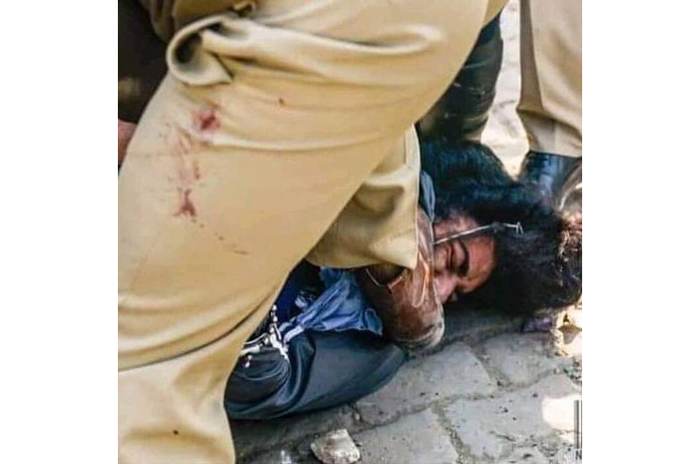
मनदीप पुनिया की गिरफ़्तारी से आहत हूँ। हाथरस केस में सिद्दीक़ कप्पन का कुछ पता नहीं चल रहा। कानपुर के अमित सिंह पर मामला दर्ज हुआ है। राजदीप सरदेसाई और सिद्धार्थ वरदराजन पर मामला दर्ज हुआ है। क्या भारत में प्रेस की आज़ादी बिल्कुल ख़त्म हो जाएगी? आज मैंने ट्विटर पर ट्विट किया है। अगस्त 2015 के बाद आज पहली बार ट्विट किया है। वही पत्र यहाँ डाल रहा हूँ ।
जेल की दीवारें आज़ाद आवाज़ों से ऊँची नहीं हो सकती हैं। जो अभिव्यक्ति की आज़ादी पर पहरा लगाना चाहते है वो देश को जेल में बदलना चाहते हैं।
डियर जेलर साहब,
भारत का इतिहास इन काले दिनों की अमानत आपको सौंप रहा है। आज़ाद आवाज़ों और सवाल करने वाले पत्रकारों को रात में ‘उनकी’ पुलिस उठा ले जाती है। दूर दराज़ के इलाक़ों में FIR कर देती है। इन आवाज़ों को सँभाल कर रखिएगा। अपने बच्चों को व्हाट्स एप चैट में बताइयेगा कि सवाल करने वाला उनकी जेल में रखा गया है। बुरा लग रहा है लेकिन मेरी नौकरी है।जेल भिजवाने वाला कौन है, उसका नाम आपके बच्चे खुद गूगल सर्च कर लेंगे।जो आपके बड़े अफ़सर हैं, IAS और IPS, अपने बच्चों से नज़रें चुराते हुए उन्हें पत्रकार न बनने के लिए कहेंगे। समझाएँगे कि मैं नहीं तो फ़लाँ अंकल तुम्हें जेल में बंद कर देंगे। ऐसा करो तुम ग़ुलाम बनो और जेल से बाहर रहे।
भारत माता देख रही है, गोदी मीडिया के सर पर ताज पहनाया जा रहा है और आज़ाद आवाज़ें जेल भेजी जा रही हैं। डिजिटल मीडिया पर स्वतंत्र पत्रकारों ने अच्छा काम किया है।किसानों ने देखा है कि यू ट्यूब चैनल और फ़ेसबुक लाइव से किसान आंदोलन की ख़बरें गाँव गाँव पहुँची हैं। इन्हें बंद करने के लिए मामूली ग़लतियों और अलग दावों पर FIR किया जा रहा है। आज़ाद आवाज़ की इस जगह पर ‘सबसे बड़े जेलर’ की निगाहें हैं। जेलर साहब आप असली जेलर भी नहीं हैं। जेलर तो कोई और है। अगर यही अच्छा है तो इस बजट में प्रधानमंत्री जेल बंदी योजना लाँच हो,मनरेगा से गाँव गाँव जेल बने और बोलने वालों को जेल में डाल दिया जाए। जेल बनाने वाले को भी जेल में डाल दिया जाए। उन जेलों की तरफ़ देखने वाला भी जेल में बंद कर दिया जाए। मुनादी की जाए कि प्रधानमंत्री जेल बंदी योजना लाँच हो गई है। कृपया ख़ामोश रहें।
सवाल करने वाले पत्रकार जेल में रखे जाएँगे तो दो बातें होंगी। जेल से अख़बार निकलेगा और बाहर के अख़बारों में चाटुकार लिखेंगे। विश्व गुरु भारत के लिए यह अच्छी बात नहीं होगी।
मेरी गुज़ारिश है कि सिद्धार्थ वरदराजन, राजदीप सरदेसाई , अमित सिंह सहित सभी पत्रकारों के ख़िलाफ़ मामले वापस लिए जाएँ। मनदीप पुनिया को रिहा किया जाए। FIR का खेल बंद हो।
मेरी एक बात नोट कर पर्स में रख लीजिएगा। जिस दिन जनता यह खेल समझ लेगी उस दिन देश के गाँवों में ट्रैक्टरों, बसों और ट्रकों के पीछे ,हवाई जहाज़ों, बुलेट ट्रेन, मंडियों,मेलों, बाज़ारों और पेशाबघरों की दीवारों पर यह बात लिख देगी।
“ ग़ुलाम मीडिया के रहते कोई मुल्क आज़ाद नहीं होता है। गोदी मीडिया से आज़ादी से ही नई आज़ादी आएगी।”
New Delhi: As a huge controversy erupted around the farmers’ tractor parade, members of civil society have alleged that the Bharatiya Janata Party-led central government is “trying to break the farmers’ movement in the garb of Republic day incident”. Observing that the whole exercise shows “same pattern as adopted to break anti-CAA-NRC movement”, the group demanded a fair inquiry into the violence that took place during farmers’ tractor parade on R-Day and also the withdrawal of FIRs against farmer leaders and journalists.
The group comprising well-known economist Dr Atul Sood, senior Advocate Prashant Bhushan, secretary of the Gandhi Peace Foundation – Kumar Prashant , Professor Apoorvanand, Anhad’s founder and activist Shabnam Hashmi and Co-convener of the Nation For Farmers, Dinesh Abrol addressed the media at the Press Club of India in New Delhi.
Fake propaganda to criminalize farmers’ movement
Asserting that the farmers’ agitation has been “peaceful” since the beginning, Atul Sood alleged that the government is attempting to “defame, delegitimize and criminalize” it.
Sood said that since the government failed in its earlier attempts, “So it used 26th January as an opportunity to propagate the very fake narrative through mainstream media — first, that they are not farmers but terrorists or Khalistanis, second, that they are from any particular community or state and third, that there are anti-national elements among them.”
“Whenever any protest or movement takes place against the policy of this government then it does not want to give any reply but defames those who question. By criminalizing farmers, the government wants to break farmers’ movement and divert attention from the main issue,” Dr Sood added while maintaining that the government has no answer on the objections over the “three black farm laws”.
Similar pattern used in anti-CAA-NRC movement
A day after R-Day, Ghaziabad administration had issued a notice to the farmers to vacate the protesting site at the Ghazipur border. As the police and paramilitary forces were deployed there in large numbers, farmers refused to vacate the site. Nand Kishor Gurjar, BJP MLA from Loni also reached there along with his supporters to remove the farmers on Thursday. But instead thanks to an appeal by an emotional Rakesh Tikait, leader of Bhartiya Kisan Union, thousands more farmers also joined them from western Uttar Pradesh.
While on the Singhu border clashes erupted as hundreds of ‘locals’ reached there demanding farmers vacate the site. Some famers and police personnel were injured in the clashes.
Citing the developments taking place at both borders in the aftermath of the R-Day incident, eminent activist and writer, Apoorvanand said, “Now whenever one section of the public protests against the government, another section is mobilized just as it happened during the anti-CAA-NRC protests. This is a dangerous trend. This is hooliganism.”
Objecting to the allegations made by Delhi police commissioner SN Srivastava’s claim that farmer leaders delivered provocative speeches, Apoorvanand said, “Since the government has reached a conclusion without an inquiry, a civil society fact-finding is needed.”
Link between BJP and miscreants
Bhushan maintained that the Samyukt Kisan Morcha pursued the designated route permitted by the Delhi police. He said that the Morcha had already informed the police about a group (referring to a group of protesters led by actor Deep Sidhu) that was not part of the Morcha was adamant to go onto Outer Ring Road.
“On night of 25th January, that group had announced that they would go on Outer Ring Road. How did the police allow them to go on Ring Road and Red Fort on 26th January (R-Day), a day when normally tight security is observed?” questioned Bhushan.
“Later, it was found that Deep has very close relations with the BJP. He was the campaign manager for BJP MP Sunny Deol. He has had photos taken with Narendra Modi and Amit Shah at 7 Race Course. Still these people went scot free because these are BJP people,” said Bhushan.
Demand for inquiry
Extending their solidarity with the peasants, Dinesh Abrol demanded, “The connection between the government and those who unleashed the violence has been exposed. Now, it is necessary to counter the fake narrative being built up by the godi-media and the government. A fact-finding enquiry is required because fake cases of UAPA and other sections are being slapped on innocent farmers. For whatever happened at Red Fort, Home Minister Amit Shah must resign.”
FIRs against farmer leaders, journalists should be withdrawn
Activist Shabnam Hashmi asserted, “Farmers are not fighting for themselves in this chilly winter but for every citizen of this country. Government can jail us but this is the farmers’ movement. Nobody can crush it. We want all cases against farmer leaders and journalists to be withdrawn.”
After the R-day incident Delhi police has booked many farmer leaders including Yogendra Yadav, Rakesh Tikait under UAPA and section 153 (A).
Police in three BJP ruled states—Uttar Pradesh, Madhya Pradesh and Karnataka have also booked some senior journalists namely Rajdeep Serdesai (India Today), The Caravan Magazine’s editors Paresh Nath, Ananth Nath, executive editor Vinod K. Jose, National Herald’s group editor-in-chief Zafar Agha, senior consulting editor Mrinal Pande and Congress MP Shashi Tharoor for their alleged ‘provocative’ social media posts on R-Day.
Farmers’ movement needs new Dimension
Secretary of Gandhi Peace Foundation, Kumar Prashant said that he was present at ITO when clashes between the police and farmers started on 26 January. “If the police vehicles were damaged, more tractors of farmers were also damaged. Who broke them? It is important to note that Amit Shah only visited injured policemen but not injured farmers. Is he not the Home Minister of farmers who were injured? ” Prashant asked.
He emphasized that “farmers need to give new dimension to the movement.”
Ranchi: Bandhu Parhaiya and Kabutri Devi, an elderly couple from Matnag village, have not received their pensions since June 2020. Bandhu, who can barely see due to cataract, finds the pension amount inadequate and demands Rs 2500 per month.
Tetri Devi from Kochla village in Barwadih block is not getting any pension. She is tired of running from pillar to post in government offices to find out about her application.
Anti Devi from Nawadih village, Chungru panchayat, has not received her pension for the last five years. Her head and voice shake uncontrollably as she tells the problems she faces in her old age.
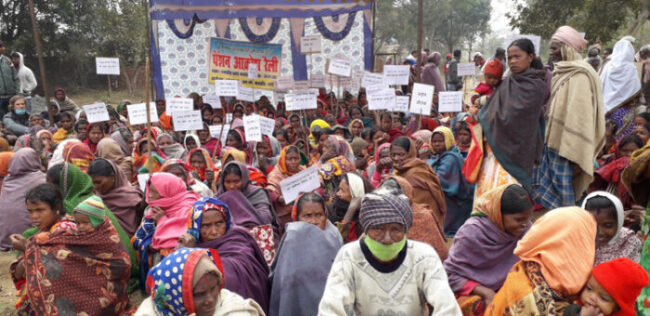
Elderly people, widows and disabled persons of Barwadih block took to the streets in large numbers on Friday in Latehar district to protest against the non-payment of social security pensions for as long as six months. After a rally through the town, they sat on dharna at the Block office to voice their demands with spirited speeches and slogans.
The participants belonged to some of the poorest communities in Barwadih, including Particularly Vulnerable Tribal Groups (PVTG). For many of them, especially those living alone, pensions are a critical lifeline despite the meagre amount of Rs 1,000 every month.
Joining them were hundreds of widows and elderly persons who get no pension at all. Most of them have applied, often multiple times, but they have no idea of the status of their application.
On 28 November 2001, the Supreme Order issued a strict order that pensions should be paid promptly by the 7th of each month. Twenty years later, long delays are still rampant.
The main demands of protesting people were: (1) Prompt payment of pensions by 7th of each month, as per SC orders; (2) Monthly pensions of at least Rs 2,500 per month; (3) Universal coverage; (4) Immediate sanction of all pending applications.
It may be recalled that Chief Minister Hemant Soren has made bold announcements about social security pensions in recent months. On several occasions, he promised to increase pensions to Rs 2,500 every month – this promise was also part of the Jharkhand Mukhti Morcha manifesto in the 2019 Assembly elections. On 4 February 2020, in Dumka, the CM promised timely payment and even said “पहले गरीबों को पेंशन, फिर डीसी को वेतन” (pensions before the DC’s salary). On 29 December 2020, he promised universal coverage of social security pensions in Jharkhand.
During the dharna, a startling story emerged about the reason why old-age pensions have been held up for 6 months in Jharkhand, as follows. In Jharkhand, old-age pensions are paid at the rate of Rs 1,000 every month, of which Rs 300 every month comes from the central government under the National Social Assistance Programme (NSAP) and the rest from the state government. However, NSAP money was used during the national lockdown to pay two installments of Rs 500 to elderly persons under Pradhan Mantri Garib Kalyan Yojana (PMGKY). As a result, money ran out for the central contribution of Rs 300 every month, and pension payments stopped for months (they cannot be made until both central and state contributions are available). The problem is now being rectified through the “supplementary budget”.
Meanwhile, acting on the demands of protesters, on 29 January, DC Latehar Abu Imran issued immediate instructions for all the pending payments to be initiated.
Days after the Lal Qila incident on 26 January in Delhi, India is all set to witness a repeat of the aftermath of the infamous Reichstag fire in Hitler’s Germany. Prime Minister Narendra Modi-led BJP-RSS government and its UP and Haryana counterparts have started hounding out the leaders of the farmers’ movement against pro-corporate farm laws. Stringent terror laws are being invoked. Armed Police, paramilitary forces have been deployed to evict farmers from the borders of the national capital.
Meanwhile, ruling party leaders are instigating Hindu villagers to drive away the Sikh-dominated peasant assemblies at the borders of the national capital. They are calling the Sikh farmers anti-nationals and their movement a Khalistani-Pakistani conspiracy to threaten the security of India and its Hindu majority.
Some Sikh youth had hoisted their religious flag on a bare flagpole on the rampart of historic Lal Qila premises in Delhi on the 72nd Republic Day. It also resembles the separatist Khalistani flag. But they did not pay any disrespect to Indian national flag or replaced it with their own. The Tricolor continues to fly at the top of the Red Fort, the citadel of Mughal power-turned epitome of Indian sovereignty. It has been a prerogative of prime ministers of postcolonial India to hoist the national flag on the lower flagpole on 15 August, the Independence Day.
The RSS, the fountainhead of the majoritarian Hindutva politics and the mother of the ruling BJP had neither joined the composite national struggle against the British Raj nor accepted the Tricolor as the national flag for many years after the freedom. It still salutes Bhagwa Jhanda or Saffron flag that connotes Hindu supremacy and its followers openly want to replace the Tricolor with their own. Journalists including this writer had incurred their wrath when we declined to stand up in the honour of the RSS flag. Now the irony of time is unmistakable.
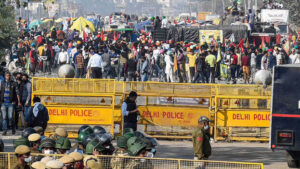
January 28 picture of Ghazipur border, heavy security were deployed I Courtesy: keralakaumudi.com
Nevertheless, the saffron gangs are spewing venom against Sikh farmers and asking their supporters to snatch away the Tricolor from the hands of the ‘traitors’. The pro-Modi TV channels are harping on the same narrative round the clock and exhorting ‘nationalists’ to close ranks. Clearly, they are preaching a recipe for communal riots, a sure-shot strategy to deflect popular attention from economic miseries and social injustice.
The German parallel
The German parliament house was put on fire on 27 February,1933 and the Nazi party quickly blamed communists. Hitler cracked down on assorted ‘anti-nationals’ and ‘Jews lobby-led conspirators’ by arresting them en masse including the Left wing MPs and non-Nazi labor and peasant leaders. He immediately amassed dictatorial power to bury the country’s fragile parliamentary democracy and divided opposition.
The communist leaders who had been put on the dock for their purported crimes were acquitted later. Except Marinus van der Lubbe, a young Dutch communist who was said to have acted on his own, guillotined later. Many contemporary accounts described him as a mentally unstable youth who was looking for a dramatic uprising against the Nazi takeover.
William Shirer and many other journalists and historians later said that the young man, a ‘lone wolf’ in today’s anti-terror parlance, might have started a small fire. But Nazis availed the golden opportunity and stoked the fire with gallons of fuel to gut down the huge building. Hitler and his men killed two birds with one stone: the end of both the multi-party democracy and the communists-socialists who had won substantial electoral support despite their mutual acrimony.
India today has already evoked some chilling parallels with Nazi Germany, especially after the second coming of Modi in 2014. The comparison is not far-fetched. Both the ideology of RSS and the hysteric Lynch mobs that hate Muslims and worship Modi a la followers of the Nazi führer, are professedly similar.
Deep Siddhu: The Indian Marinus?
The Sikh youths at Lal Qila were hot-headed and irresponsible. They may be the agent provocateurs as the majority of farmer leaders have labelled their leader, Deep Siddhu. A minor actor-turned activist, Siddhu is no rustic rabble-rouser but an English-speaking ambitious upper middle class youth from Punjab. His interview with journalist Barkha Dutt two months back has revealed that of late he is a votary of radical restructuring of Indian Centre-state relations. But he is also an admirer of Jarnail Singh Vindranwale.
The latter was killed during military action at the centre of Sikh religion, the Golden Temple in the early eighties after he became the main proponent of separatist Khalistan movement and took to arms. The demand for more equitable powers between states and the union governments is a strong but thorny strand of Indian mainstream politics since the Nehru era. But it also runs parallel to religious, linguistic and regional fault lines in India and many other countries and has triggered sectarian violence, civil wars and separatist wars more under the dictatorial rules.
Siddhu is clearly an attention and opportunity- seeking youth who has failed in film career and now wants to pitch in politics. He had already warmed up his access to Prime Minister Modi and his home minister Amit Shah via the film star-turned BJP MP from Punjab, Sunny Deol. He claimed to have no relation to BJP and spoke against its majoritarian politics at the cost of the states with minorities like Punjab. Now, his dramatic advent at the Red Fort as a champion of Sikh pride has only portrayed him at best as a pathetic pawn in the hands of the BJP government and at worst, a paid provocateur in its service.
Import of the farmer’s protest
Last winter PM Modi faced street protests across the country against the religion-based Citizenship Amendment Act (CAA) But they were forced to roll back under prolonged Corona lockdown. Peasants of Punjab and Haryana have renewed the resistance against three pro-corporate farm laws since June- September. They have put a siege on the national power centre for the last two months demanding the abrogation of these laws. The new acts cap the regime’s series of moves were passed by bulldozing the parliamentary procedures and opposition parties, all in the name of reform but only to serve its crony capitalists.
The regime could not evict the mammoth but peaceful assembly of the farmers. They did not budge despite the loss of around 150 lives under the chilly open sky and refused to climb down on their demands as the deadlock continued at talks. The regime was looking for opportunities for a crackdown. It did not want rickety opposition to gain strength from the agitating farmers that had planned a march to the parliament at the opening days of the budget session.
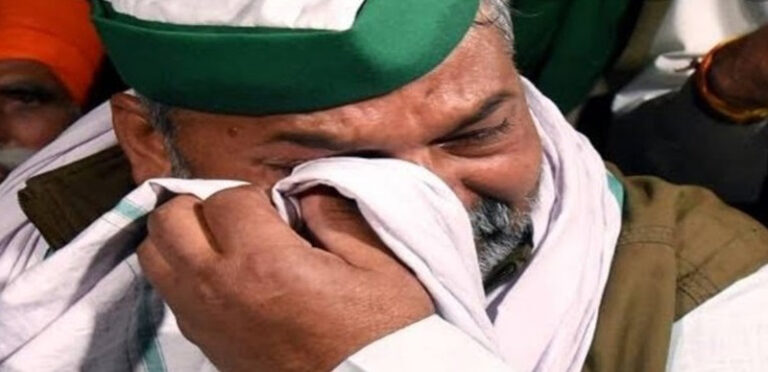
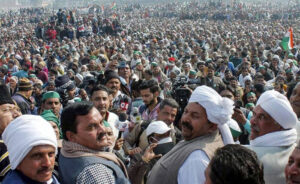
Farmers Mahapanchayat in Muzaffarnagar after the crying video of farmer leader Rakesh Tikait gone viral I Courtesy: Outlook.com
Farmers on roads have proved themselves formidable and the real opposition on roads and a prolonged nightmare to the ruling corporate-communal cabal. Modi-Shah duo apparently could not afford a violent showdown considering the sentiments of Sikh and Hindu Jat jawans in army and paramilitary forces as well as the tumultant violence that the Operation Bluestar had triggered and led to the assassination of Indira Gandhi.
The 26 January violence, particularly the Lal Qila incident provided the regime what it was looking for: an opportunity for rousing emotions of Hindu majority. Particularly, that of the youth who hardly know or care for the difference between pluralist democratic nationalism of our freedom struggle that the Tricolor embodies and RSS-BJP brand of Hindu nationalism that stands for majoritarian supremacy.
Tikait holds ground
But the tearful defiance of Rakesh Tikait, a Jat farmer leader from Western UP with considerable following among Jats in surrounding states seemed to have halted the planned onslaught in the intervening night between 27-28 January. Insulted by BJP leaders who reportedly taunted him as an accomplice of anti-nationals, Tikait refused to end the assembly at Ghazipur border and court arrest which he had thought of earlier.
As his soulful cry for the peasant honour went viral, farmers who had gone home, somehow dispirited after 26 January incidents, rushed back in numbers. A war of nerves continued as both police and farmers spent a sleepless night. The farmers have prevailed so far and their depleted ranks at Singh and Tikri borders have witnessed a ripple effect of Ghazipur.
As the parliament begins its session some kilometres away, the rustic democrats and patriots are still keeping the vigil on roads. For you and me, for our children, for the future of the idea of India.
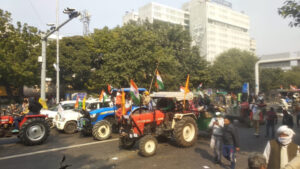
New Delhi: On the 72nd Republic Day celebration, the public of the Republic was on the street. Be it scrubby, gruff farmers or their daughters, wives, sons and brothers, all were all atop tractors heading towards Delhi for the proposed tractor parade.
The mood was light, the farmers were chirpy, as music blared while they headed towards Delhi via pre-decided routes from Tikri, Singhu and Ghazipur borders. The mood was celebratory, farmers chanting “Jai Jawan Jai Kisan” and dancing to songs like “Aisa desh hai mera” and Sare Jahan se Achcha.
But as the farmers entered the outer ring road from Ghazipur border, clashes erupted between them and police. Tear gas was fired by the police to stop them from going ahead as the peasants took on a different route from the one which was permitted to them. Scuffle broke between some farmers and policemen during which some farmers got injured.
Anguish over tear gas shelling
Speaking to eNewsroom, some farmers reacted sharply over police action.
“Is this tricolor Pakistani flag? Are we terrorists? So, this police shelling tear gas at us,” a farmer asked while showing tricolor on his tractor.
Showing a head injury of a farmer colleague, a farmer said, “Police have shelled tear gas at us while we were coming peacefully from Ghazipur border. What else we can expect from this government?”
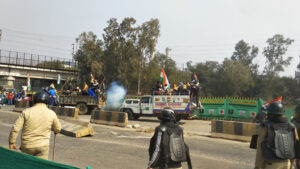
Shelling of tear gas on farmers by police near ITO
Women farmers were also accompanied with male farmers. Women like Sarbjeet Kaur from Uttarakhand, who were accompanying their Male counterparts reacted, “We have come here for our rights and put forward our before the government – withdraw the black laws. But look, instead of listening to us, we were welcomed with tear gas.”
Shilpi Arora while driving her tractor said, “Now Modi government should listen our demands – repeal the farm laws.”
Sarvesh, a farmer from Uttar Pradesh’s Meerut said, “If the modi government doesn’t withdraw the law, then we will also continue to protesting.”
Chaos at ITO
As the protesting farmers atop horses, tractors and onfoot marched towards ITO, Delhi Police tried to contain them there, so that they couldnt reach the RED fort.
During the clash that took place near Delhi’s ITO, saw some farmers take a detour Deen Dayal Upadhyaya road to reach Red Fort. The move turned futile as one of the farmers got killed barely 500 metres away from the BJP headquarters along the same street. While the police claimed that the farmer Navneet Singh (25) died after he lost control of the tractor that overturned on him, however the farmers maintained that Singh lost control of his tractor after he was shot at.
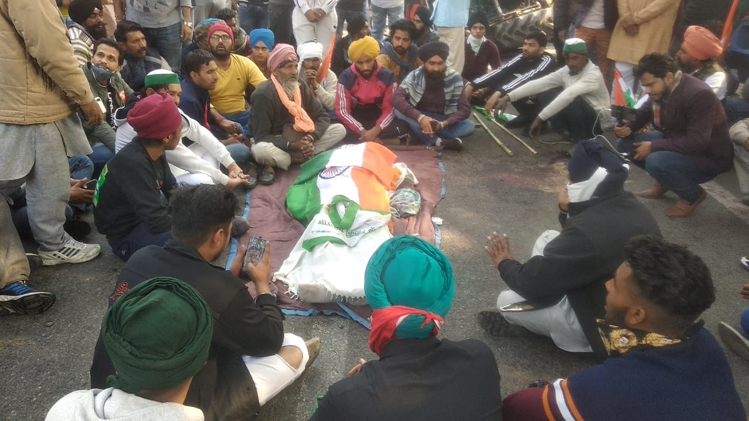
The angry farmers took his body wrapped in tricolour and kept it near ITO flyover. Fearing that the doctors would “change the autopsy reports” the farmers were not willing to let the ambulance take away the dead body.
“This incident happened in front of me. First police opened up fire on his tractor’s tire then on his head. His tractor overturned and he succumbed to death,” a farmer Harpreet Singh told eNewsroom.
“Delhi police didn’t even respect tricolor on Republic day. They open tear gas at us,” he anguished while complaining about police action.
Another angry farmer said, “This is dictatorship.”
Farmers tractor parade at ITO
As the angry protesters swelled on the streets, police took refuge of batons and tear gas to stop the farmers. Meanwhile thousands of farmers atop on their tractors managed to reach Red fort to hoist national flag.
The clash that followed saw the protesters breaking barriers and climbing poles to enter the Red Fort to hoist the Indian tricolour. The chaos that followed marred the celebratory mood of Republic Day.
Though, Delhi police claimed that protestors turned violent.
“Protesters turned violent at some places. Many police personnel were injured & public properties also damaged. I appeal to protesters to return through the designated routes & maintain peace”, Delhi Police PRO Eish Singhal quoted as saying by ANI.
Anti-social elements create chaos
Samyukta Kisan Morcha spearheading the movement for two months disassociated itself from that chaos the ensued and alleged that the peaceful farmers’ demonstration had been infiltrated by anti-social elements. In a press statement issued by them, Morcha said, “We dissociate ourselves from all such elements that have violated our discipline. We appeal strongly to everyone to stick to the route and norms of the Parade, and not indulge in any violent action or anything that taints national symbols and dignity. We appeal to everyone to desist from any such acts.”
However, that didn’t deter the farmers, who been campaigning for months at Delhi borders, from making themselves heard. The farmers even now are firm on the complete withdrawal of the three Farm laws. Around eleven talks between the farm unions and cabinet ministers of Modi government took place, but fail to come to any conclusion.
Farmers are protesting against the centre’s three new contentious farm laws, which they believe will allow for the corporate takeover of farming and hurt their incomes. Eleven rounds of talks between the centre and farmers’ unions have failed so far, with the protesters insisting on a complete repeal of the laws rather than the ‘1.5-year stay’ offered by the government.
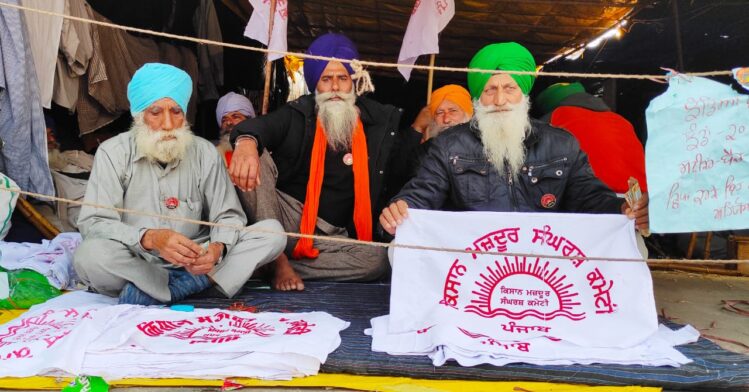
Singhu Border/New Delhi: Fifty-four-year-old truck driver, Devender Singh travelled from Pathankot to Singhu border to express his solidarity with the ongoing Farmers’ Protest. Stationed at the protest site, he mentioned that he has opted to put his regular job on hold for the time being to participate in the ‘Tractor Parade’ on Republic Day.
Speaking about the need of the rally, he stressed, “By organising the tractor rally we want to draw lines between what’s true and false before the world. We want to tell everyone that we are farmers, not terrorists. We have come out on the streets to highlight our plight. We want a peaceful tractor rally. This will strengthen our movement and also propagate the message of farmers’ unity.”
Despite Delhi Police permitting Farmers’ unions for the rally with a word of caution on Sunday, farmers are excited for the tractor parade under the leadership of Kisan Ekta Morcha, an umbrella organisation of over 40 farmer unions.
However, with the police alleging that over 300 Twitter accounts had been created in Pakistan to create unrest at the tractor parade, over 40 thousand police, CRPF and ITBP personnel are going to be deployed at Ghazipur, Singhu, Chilla and Tikri borders and the surrounding area of the national capital, to maintain law and order when the tractor parade happens.
“We want to have a peaceful but strong agitation which can force the government to roll back the controversial farm laws. Our peaceful protest so far has been a befitting reply to this government which has been ignoring our demand for the past two months. These laws are not for farmers but to benefit handful capitalists. The spark from Punjab has ignited a revolution across the country. People are going to remember the Kisan Tractor Parade for long,” said Santok Singh Sindhu, committee member of Kirti Kisan union while speaking to eNewsroom.
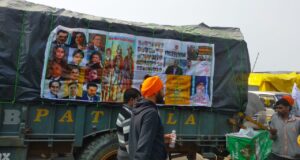
A (godi) media poster at Singhu border
Anguish over false propaganda
On being asked about the allegations of the farmers’ movement being funded by anti-nationals and the possibility of some unrest being triggered by Pakistan during the R-Day tractor parade, farmer Seva Singh, who hails from Faridpur, maintained that the allegations were false. “This is propaganda being made by Godi Media and the government to weaken our movement. It’s the farmers’ family that has been contributing money to support this movement. Let me be clear, the movement has absolutely nothing to do with foreign or illegal funding,” said Seva, while preparing food at a protest site langar along the Singhu border.
The anger over a section of media was evident, as Fatehgarh’s Gurpreet Singh, has gone a step ahead with displaying the logos certain TV news channels logos and pictures of certain anchors plastered over his trolly. Pointing at those, an anguished Gurpreet, said, “We are farmers, but these channels and reporters try their best to defame us regularly. They even label the hands that feed the nation as those of terrorists, anti-nationals and Naxalites etc. This Godi media is sold out.”
Angry with allegations being levelled on the farmers, Vikas, a farmer from Panipat alleged, “All this has been engineered by PM Narendra Modi and Home Minister Amit Shah because this farmers’ agitation has become a national movement.” He further questioned, “Modi ji should stop and think – the bread that he eats, reaches his table because of the farmer. But both the saffron party and his Godi media is busy defaming our movement.”
Last week, Jaskaur Meena, a BJP MP from Dausa, had called the protesting farmers’ terrorists. “Terrorists are sitting there and the terrorists have AK-47 with them. They have pitched the Khalistan flag,” she said.
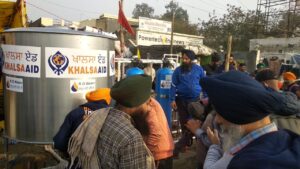
Khalsa Aid team at the site
Overwhelming Support and NIA notices
Known for its humanitarian relief work, Khalsa Aid India has been regularly providing essentials like food, water, clothes, mattresses and sanitary items to the protesting farmers.
“We have also set up shelters and washing machines at various protesting sites along the Delhi border. We have installed RO water purification machines to contain the menace of packaged drinking water bottles,” Amarpreet Singh, director of Khalsa Aid told.
Over the National Investigation Agency (NIA) notice to them, Amarpreet said, “We got notice as a witness in a third-party case. We have been doing relief work in India for several years now, but we never got such a notice. However, today when we are standing next to our farmers, we have got this notice. We are cooperating with them. Even we don’t want any miscreants to join this protest.”
Besides Khalsa Aid, Life Care foundation provides medical assistance round the clock to the farmers.
“Here we are providing all kinds of emergency health services. A team of professional doctors and paramedical staff is available 24X7. We will be here till the movement is on to provide all kind of medical support,” said Sadiq Mohammed, a member of Life Care.
Women Solidarity
Women comrades in the ongoing protest have been an interesting add on. Sixty-five-year-old Pal Kaur from Tarn Taran Sahib districts, while preparing the langar food, explains why the women joined the movement.
“Our people have sacrificed their lives for this country’s freedom. We have come here for our right,” Pal said.
Extending her full support to the farmers, Dr Uma Gupta, of Delhi University said, “No law is above the people of this country. The government should understand why the farmers of this country are on roads. It seems the government’s intention is not right.”
One demand: Laws must be withdrawn
Questioning the government’s proposal to suspend the controversial laws for one and a half year, farmer Jagmeet Singh Pullar from Sri Muktsar Sahib district of Punjab said, “We haven’t gathered here for temporary solutions but its complete withdrawal.”
“Many farmers have been martyred on this protest site. We don’t know how many more lives this government wants to be martyred before listening to us,” said an anguished Jagmeet.
Raising slogans against the Modi government, Harvinder Singh Patiala said, “Modi government is imposing a capitalist agenda. This is not just the farmers’ issue but everyone’s issue.”
Citing that crores of farmers are associated with farming and the country’s economy depends on agriculture he asserted, “laws are not in our favour. We won’t go back until these laws are not withdrawn. For this, we are even ready to sacrifice our lives.
Determined to win
Hailing Guru Nanak Dev ji, Gardar Singh, a kabbadi sports person from Punjab said, “Our win is sure.”
While, 70-year-old Satvir Meena from Haryana’s Sonipat said, “This Modi government will bow down before us soon. It is evident from the history whosoever fought with the farmers had lost his credentials.”
Can the two salutations go together? It depends on which side of the great indian political ring you are now placed, particularly, if you are a Deshi. Right now, the ring itself has been shifted to Bengal as the state is gearing up for assembly poll by May 2021.
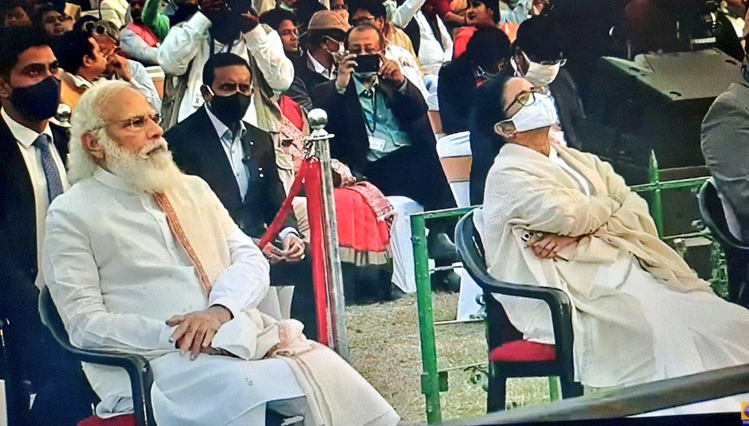
On 23 January, we witnessed the latest show-down between Prime Minister Narendra Modi, the mascot of the BJP-RSS and state chief minister cum Trinamool Congress (TMC) supremo Mamata Banerjee. The occasion was the 125th birth anniversary of ‘Netaji’ Subhas Chandra Bose, the legendary leader of Azad Hind Fauj or Indian National Army (INA) that took support from the Axis power in WWII to liberate India from the British Yoke. Venue was the premises of Victoria Memorial in Kolkata, dedicated to the queen of British empire at its zenith and now controlled by the central ministry of culture.
As soon as Bengal’s big sis was invited to speak, some of Modi-bhakts greeted her with the chants of Jai Shri Ram! It was clearly meant for taunting her as she had taken it as an affront earlier and even chased away BJP supporters. This time too, a visibly angry Mamata called it an ‘insult to an invited dignitary’ and refused to address. She ended her protest with Jai Hind! Jai Bangla! The two friends-turned foes hardly exchanged a glance, let alone a smile.
Modi could have stopped his minions by raising his index finger or wave of hand. He often makes such gestures either to warn the opposition parties or dismiss his detractors. But he chose to sit nonchalant.
What Jai Hind stands for
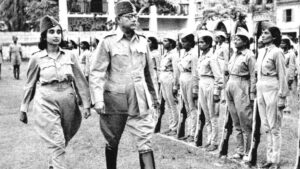
Bose, a Bengali icon with a pan-Indian appeal and a well known figure across the Indian subcontinent had coined the call– Jai Hind or Hail India. A mix of two Hindi and Urdu words respectively, it simply resonated his ideals of Hindu-Muslim unity as well as recognition of plural backgrounds of the INA soldiers. Indians from diverse regions, religions, castes and language groups placed their loyalty to a common homeland without any religious tinge and took oath to fight together for its freedom. It became popular among rank and file of all castes and creeds as well as a war cry against the Brits.
Netaji Subhas Chandra Bose with his INA members I Courtesy: dailyo.in
INA perished in the whirlpools of the war fortunes of great powers despite reaching the borders and shores of India but triggered a seismic tremor in Indian psyche that ultimately led to our freedom. Jai Hind became the words of popular greeting both among the ruling elites who believed in secular nationalism and the masses who followed them. Bose’s end is still a mystery and highly contested one. But that has only lingered his legend as a tragic hero. In post-colonial India, many believed in his second coming as the redeemer of the hopes of the freedom era and the unifier of a divided land after the murder of Gandhi.
What Jai Shri Ram stands for
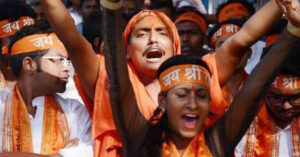
In contrast, Jai Shri Ram (Hail lord Ram) was coined in the late eighties as both the war cry of the Hindu revivalists led by Rashtriya Swayamsevak Sangh (RSS) and byword for their camaraderie. It has nothing to do with the devotion of Hindu faithfuls to the god-king of the epic Ramayana whose reign had become a byword for a benevolent and just rule and was revered across faiths in South and south-east Asia.
The war cry in his name has become a blood-curdling call for vengeance against Muslims in India and the mantra to trigger mass hysteria among Hindus, particularly in the Hindi heartland since 1992. Further, it has been morphed into an assertion of victory since Modi became the PM and master rooster of the BJP in 2014, the RSS political wing. More he has gained absolute power, the more the saffron cry connotes a heady invincibility that demands immediate submission of the religious and political minorities including the civil society. Fall in line, else, face the Lynch mobs or police hounds.
Nevertheless, the criers of Jai Shri Ram need to appropriate and subsume Jai Hind to get an aura of wider respectability and acceptability since the RSS did not join the anti-British struggle. So the Sangh Parivar is hell-bent to usurp Gandhi sans his calls for Hindu-Muslim Amity and non-violence despite the fact that his murderer was its fellow-traveller and now being worshipped in Modis India.
Amvedkar is also in the A- list sans his call for annihilation of castes and seperate Dalit identity beyond Brahminical Hindu order.
Courtesy: PTI/Scroll.in
Politics on appropriation: Bengal’s icons
Similar RSS-BJP exercise is on with Swami Vivekananda, Rabindranath Thakur (Tagore) and Subhas Bose, all Bengali icons who also enjoy pan-Indian reverence and beyond the borders. Swami, the reformer monk had bridged Vedanta philosophy to modernity and spoke against any race or religion’s superiority. Today he has been turned on his head as the hero of Hindu supremacists.
Tagore, the philosopher-poet deplored not only Hitler-Mussolini and Japanese militarism but also the dangers inherent in nationalism. He detested ritualistic rigor of Brahminical Hinduism as well as bigotry of all religious communities while promoting pluralism and interfaith dialogues, particularly, Hindu-Muslim Amity. But RSS-BJP has been trying hard to make a critic of Islam and Christianity. His poetic images of Sonar Bangla (Golden Bengal), has now become part of BJP’s poll campaign. Bose who followed Vivekananda in spirituality and was loved by Tagore is the latest target.
Bose and his legacy: BJP eyes a special effect
On Subhas Bose’s birthday, Modi spoke at length on Netaji’s legacy and the nationalist hero’s relevance in India under his watch as well as his personal inspiration. He virtually made Netaji an ambassador for his ‘Atma Nirbhar Bharat Abhiyan’ or campaign for self-reliant India to make local corporate brands global. It’s also a new slogan to attract the global capital which may flee Covid-hit China and other countries in a corollary to his earlier Make in India campaign.
Modi even related Boss’s ‘parakram’ or bravery as the INA leader to current Indian army’s military might from ‘LOC to LAC’ or against Pakistan and China respectively. But he mentioned the icon as a devout Hindu who used to read Bhagwad Gita, the Hindu holy book. But he did not bother to mention Bose’s secular public life and composite nationalism encapsulated in the INA salutation– ‘Jai Hind’ salutation.
Modi’s silence on Bose’s pluralist politics and focus on Hindu-Muslim unity in undivided Bengal and India was deliberate and part of an orchestrated campaign. It was more evident during the light and sound presentation on Netaji. It focused on his clashes with Gandhi and other Congress leaders including his fellow traveller- turned rival, Jawarlal Nehru.
Clearly, the narrative suits BJP-RSS to target Congress today as well as stoke the Bengali sentiments that Bose was deprived in his life and death. Ironically, Mamata too shares it but wants to use it against ‘outsider’ Modi and his party.
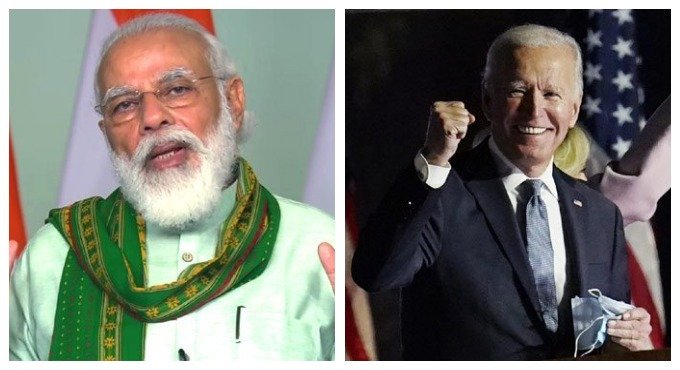
“Abki Bar Trump Sarkar”, shouted an exultant Narendra Modi at the Howdy Modi event held in Houston, Texas, in September 2019 which was also addressed by then United States President Donald Trump. Besides the leaders of Trump’s Republican Party, nine to ten Democrats were also reported to be present.
Alas! Modi’s wish could not be fulfilled. Trump was ousted in disgrace by the electorate and Joe Biden was installed in the White House. And that is not a good news for Modi and his RSS-dominated outfit. Nor does it augur well for the organisers who were feeling on cloud nine after the ‘Howdy Modi’ event. About 50,000 people were said to have attended the event, many of them owing allegiance to the RSS/BJP, though head of the BJP’s Overseas Affairs Department Vijay Chauthaiwale had claimed that the event was organised neither by the BJP nor by the (Modi) government.
Joe Biden does not want those with RSS/BJP links in his administration. According to a report in The Tribune, Biden has appointed around 20 Indian-Americans in his administration but Obama administration staffer Sonal Shah as well as Amit Jani, who worked on the Biden campaign team, have so far been excluded, allegedly due to their RSS-BJP links which was brought into the limelight by over a dozen Indian-American organisations.
“Joe Biden’s team has people like senior diplomat Uzra Zeya, who had played a role in the Devyani Khobragade case, or Samira Fazili, who had joined protest rallies in the US against the CAA, NRC and the Kashmir lockdown. But those with RSS-BJP links have not found a place as secular Indian-American organisations have maintained the pressure on the Biden-Harris transition team to keep such individuals on the sidelines”, writes The Tribune quoting sources.
It is an embarrassing situation for Modi. Hoping to spread abroad the RSS ideology with the help of the United States, he has practically mortgaged India’s sovereignty to America through several bilateral defence agreements. The first such agreement was negotiated when Manohar Parrikar was the Defence Minister. After year-long discussions with US Defence Secretary Ashton Carter, both of them had cautiously announced in Delhi that India and the United States have ‘agreed in principle to share military logistics’. The two, it appeared, had decided to release only bits of negotiations periodically for fear of the possible strong reaction of the people of India towards allowing the US, or any other country for that matter, to use Indian territory for its military purposes. The two countries had finalised a ‘Logistics Support Agreement’ that allows the two militaries to use each other’s land, air and naval bases for supplies, repair and rest. Both sides claimed that this had become inevitable to ‘counter the growing maritime assertiveness of China’.
It was repeatedly emphasised by both sides that there was no question of stationing US troops on Indian soil. ‘As and when a situation arises, like an earthquake or a natural disaster, that is when it is directed at’, Carter had announced. Parrikar said, “It is a concept of logistics support” to provide “support for each other’s platform where they need fuel and supplies”.
Modi did what no other Prime Minister had done. America had been coveting Indian territory for use of its armed forces ever since India got independence. Nehru resisted it diplomatically all his years as Prime Minister. He did not succumb to the pressure even when the Chinese assertiveness had ceased to be a mere perception but become real as that country had advanced its troops on Indian territory. Indira Gandhi virtually snubbed America during the Bangladesh war when that arrogant super-power threatened to destroy India with its legendary nuclear-powered Seventh Fleet. Even Atal Behari Vajpayee considered it terribly against the national interests of India to allow Indian territory to be used by a foreign power for its military activities. The Chandra Shekhar government had, though, allowed the US armed forces the refuelling facilities in India during the 1991 Iraq conflict and there were widespread protests within the country.
Prime Minister Manmohan Singh in the UPA government was inclined to accede to the US request for closer military cooperation. However, Defence Minister A K Antony, reportedly with the full backing of Congress president Sonia Gandhi, stood firm against any military relationship between India and America, and was jeered at by pro-American sections as a Leftist.
Kolkata: Politburo member and former Member of Parliament Md Salim claimed that the Left has played its role in ’20-20′ last year and when the result for 2021 Bengal assembly polls will be out, then it will be completely different from what the media has been projecting.
“Since 2019, we have been working to better our position in Bengal. For one year, BJP-TMC had locked them up, while we and our student wing have been working at the ground level since the lockdown was announced.”
“We have worked during lockdown and amphan. Our youth, students and Leftists have reached out to those in distraught. We went to people in villages, in cities, at every mohalla, whether it was to distribute mask, sanitizer or ration during the lockdown and amphan,” said Md Salim while answering one of the questions posed by eNewsroom’s on how Left parties and specially CPM is working to better their voting percentage in comparison to the 2019 Lok Sabha polls?
“Soon after 2019, people had calculated 2021, but there is 2020 in between, which people had forgotten. The media had removed 2020 from the calendar,” he said.
Accusing the ruling party of getting into a clandestine agreement with Amit Shah, he stated, “Just to make sure that Rajiv Kumar did not go to jail, TMC struck a deal with Amit Shah of 20 seats (2019 Lok Sabha). Those days are gone.” He paused and said, “In Bengali, there is an adage – bishey bishey bishok hoye (poison cuts poison).”
Salim claimed, “We know Bengal and the heartbeats of its people. The culture here is not that of RSS. Bengal belongs to Khudiram, it can’t be of Nathuram.”
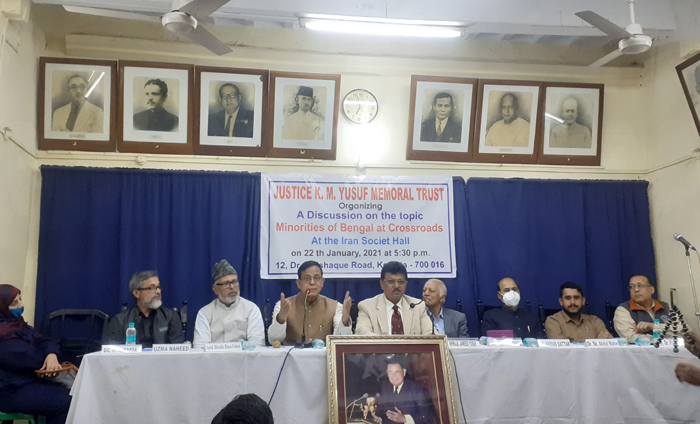
Earlier, speaking at a seminar—Minorities of Bengal at Crossroads, Salim spoke at length on the issue.
Stressing on the fact the world of 2019 (Pre-corona) and 2021 (post-corona) is not the same,he mentioned that today the even the Prime Minister with having the 56’ inch chest could not claim that he can control entire country.
सुनिए ईन्यूज़रूम के सवाल और मोहम्मद सलीम के जवाब:
Commenting on the recent WhatsApp leak of Arnab Goswami, he said, “You can see for yourself how media before running any news talks to the government and get guided from there.”
While answering the question concerning a recent comment of CPIML general secretary Dipankar Bhattacharya, where he had asked the Left parties to consider BJP as the main enemy and not TMC.
“Dipankar himself clarified that media has twisted his statement,” said Salim and added, “We are working on a Mahagathbandhan which includes all the left parties, democratic parties, NCP, RJD, Sharad Yadav’s JDU (Secular). All the schedule caste, schedule tribe and minorities parties and those parties who do not want to be with RSS-BJP or TMC. With all them together, we we are making a rock solid coalition.”
He added, “Leaving aside, RSS affiliated organizations, we will fight together. RSS has two affiliated organizations —one named BJP and other is TMC.
Talking about coalitions he mentioned how BJP now has only Apna Dalas its ally. “When TMC came to power it has the support of 22 parties. Today, they are alone, even their own people are leaving them. On the contrary we have grown. When we were in power, we had 9 parties, now we have 16 parties with us.
While saying, TMC is melting away like ice-cream in this winter and will vanish in summer, he added, “Whatever you are seeing, every week (like tele-serials), in installments, they (BJP) are taking away TMC people, soon they will have all Trinamool people.”
Earlier, speaking at the seminar—Minorities of Bengal at Crossroads, organized by Justice K.M. Yusuf Memorial Trust, Salim expressed happiness about Muslims being at the crossroad, for it means there are many roads open for the minorities.
“For me it is a matter of happiness. As being at a crossroad, means that there are several roads open for the minorities. Earlier, the situations were created in such a way that the minorities had to blindly follow a path. Now, you have a democratic choice to choose.”
Speaking on the plan of Assaduddin Owaisi’s party, AIMIM fighting Bengal assembly polls, Salim declared, “Any political party can fight from anywhere. And we should not put it into insider and outsider frame. ”
“Do not get trapped into RSS’s narrative. BJP-RSS is putting you inside gethoes, you do not have to get gethoised. They have the narrative of Hindu-Hindi-Hindustan, which means only one religion, one culture can be in India and rest are outsiders. That is what culture nationalism is all about. But we believe in composite culture for India, when our Constitution was framed in 1950, it was not made on the basis of our culture but on the need for justice and equality.”
He pointed out, “Netaji (Subhash Chandra Bose) knows this, so he said to make a slogan which does not have a religious touch then Jai Hind came into existence.”
The seminar which brainstormed one of the most relevant issues of Bengal election, participated by several prominent names of Bengal and outside including Ex- Minister Dr Abdus Sattar, senior journalist MW Haque, academician Dr Sk Abdul Matin, agricultural scientist Dr MA Hassan, social activist Uzma Naheed and social-medical activist Dr Fuad Halim.
The veteran politician summed up his speech at the seminar by saying: “Do not see the different posters and banners to decide, whom to vote, but look at your children and think, who will provide then employment and how the women of your family will be secure?”
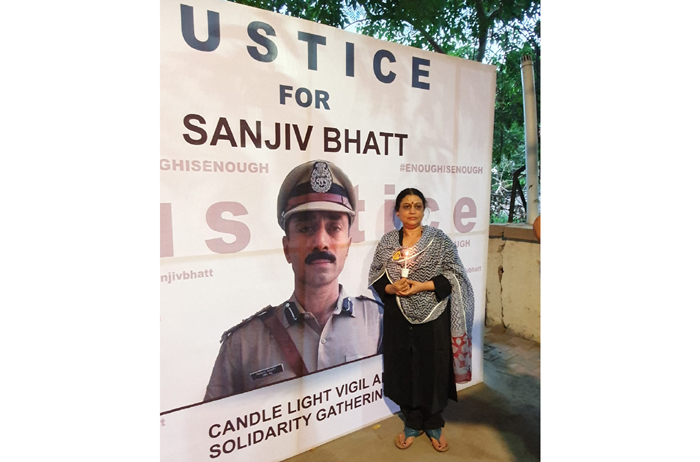
Kolkata: The Indian American Muslim Council (IAMC) and Hindus for Human Rights (HfHR) along with leading politicians, civil rights activists and organizations from India and the United States urged Supreme Court of India in an online press conference to grant immediate bail to former Indian police service (IPS) officer Sanjiv Bhatt. The two organizations and the leading personalities from India term the conviction of Sanjiv Bhatt in a murder case, wrong and based on fraudulent evidence.
The personalities include Member of Parliament Shashi Tharoor, renowned documentary filmmaker and human rights defender Anand Patwardhan, human rights activist and artist Mallika Sarabhai and Magsaysay Award winner Sandeep Pandey. All criticized Bhatt’s conviction, and claimed that it would not stand under judicial scrutiny, urged the Supreme Court to set him free immediately in order to uphold the rule of law.
The Supreme Court of India has scheduled a bail hearing for Bhatt on January 22. Under Indian law, courts can grant bail to those convicted of various crimes, including murder, pending their appeal at higher courts. Bhatt was convicted in June 2019 for the death of a man in 1990. His defense was not allowed to cross-examine prosecution witnesses during the brief trial, nor was it allowed to present its own witnesses or submit evidence. India’s human rights groups have called it a sham trial.
Shashi Tharoor, a member of Parliament and formerly an Undersecretary General at the United Nations, said he was “outraged by the injustice meted out” to Bhatt, whose “conscientious service to society” and “indomitable capacity for speaking truth to power” had put him in jail.
“Sanjiv’s case is a reflection of the grim times that we live in, where constitutional values and fundamental privileges that have been granted by the constitution to all Indians appear in many cases to be diluted and in many cases perhaps even supplanted by illiberal forces,” Tharoor said. “All Indians with a conscience like Sanjiv Bhatt’s must stand up and fight back against such challenges that threaten to undermine the very foundation of our republic.”
Filmmaker and human rights defender Anand Patwardhan said Bhatt had been jailed “for no other reason than the fact that he opposed the massacre in 2002” and spoke against it. Patwardhan said the civil society “should build a movement for Bhatt’s release.”
Human rights activist, classical dancer and actor Mallika Sarabhai said there was a “definite agenda” not only in the retribution against Bhatt but in the case of most critics of the Modi government.
“I hope that today we will be able to appeal to the better sense of our great courts to say what is being done to Sanjiv is wrong and needs to be corrected immediately,” she said.
Gandhian activist and Magsaysay Award winner Sandeep Pandey said Bhatt was the “most courageous” of all police officers as he filed an affidavit stating that Narendra Modi had “chaired a meeting in which the police officers were told to go soft on the Hindutva brigade which was rampaging against the Muslims.”
Pandey said that “manipulation of cases” was a “common story” in the Modi government.
Renowned activist S. R. Darapuri, who is a former Inspector-General of Police in Uttar Pradesh, said he could related to Bhatt’s predicament as they both were “upright and righteous” police officers who had both been “at the receiving end of State oppression.”
Saurin Shah, Ahmedabad-based lawyer who defended Bhatt at his flawed trial, gave a detailed chronology of the case. In October 1990, Bhatt was posted at Jamnagar, Gujarat, when local police arrested 133 rioters, one of whom died 18 days after release. Importantly, none of the 133 people, including the person who died later at a private hospital, had made any allegations of police torture or brutality, even when they met a magistrate. The medical record at the jail where the rioters were imprisoned do not mention any injuries to anyone.
The alleged murder victim, Prabhudas, was twice examined by the jail doctor and at the local government hospital, and none recorded any complaint of torture or injuries.
Commending Bhatt as a “brave officer” who “spoke truth to power,” Raju Rajagopal, co-founder of Hindus for Human Rights, recalled that Bhatt had witnessed the “fateful decision” by Modi, who was at that time Gujarat’s chief minister, that the “law enforcement shall stand down to give Hindu nationalist organizations free rein to attack” Muslims. Bhatt had been “incessantly hounded by the authorities since that time,” Rajagopal said.
“In 2018, he was interrogated on a decades-old case, was tried on completely bogus charges without any opportunity for the defense to call their witnesses, and was put him away for life.”
Rasheed Ahmed, Executive Director of IAMC, said the Indian government must stop “politically managing Sanjiv Bhat’s case and let the law take its course under the supervision of independent judges not the judges who are either scared of government or have themselves becomes political.”
“There is no ambiguity that Sanjiv Bhatt’s conviction and incarceration are politically motivated and that the charges against him are baseless,” Ahmed said. “The courts clearly know it but the political masters want him silenced so that their own crimes stay in the dark rooms out of the public eye.”
Ahmed said that Bhatt deserved a “fair trial and an “independent judiciary”.