



People of Punjab had a harrowing experience during the militancy which lasted over a decade. However, one facet of that period that old timers still remember with reluctant approval. At some stage during the prevailing anarchy, the militants had imposed a code of marriage on the people of Punjab – No more than 11 persons were allowed to be included in the baraat.
This code they enforced in a peculiar way. Generally during the marriage seasons, there used to be a surprise check of the vehicles carrying the baraatis. The militants, or their representatives, made the head count. If the number of baraatis exceeded 11, they first declared that those in excess of 11 should voluntarily get down. The offer was initially ignored by the baraatis. The militants then picked up arbitrarily those in excess, brought them down, stripped them off their clothes except undergarments and ordered them to walk in that condition to their homes. The vehicle with the remaining 11 baraatis would then be allowed to move on.
After the militancy was checked, life in Punjab returned to the old norm. A marriage ceremony is a near disaster in the middle and lower middle classes, particularly for the bride’s family. There is too much extravagance in the name of tradition and imaginary fear of society. In a marriage that I recently attended, the number of baraatis alone was around 200 and dozens of dishes had to be prepared for over 400 invitees. Besides, gold rings and other valuable items were given as gifts for the elders of the groom’s family along with furniture etc, for the bride which is the standard practice for the society. After attending the marriage, a teenager, studying to become CA, remarked that she felt like becoming a militant to control this wastage.
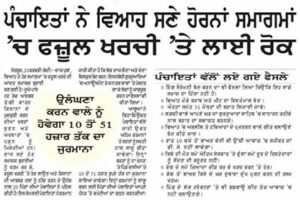
Now 20 village panchayats of Sangrur district have taken the initiative to restrict the profligacy in marriages. According to a report in a Punjabi newspaper, the major decisions of the panchayats are as follows:
- There will be no ring ceremony because it is not part of our society.
- Liquor and non-vegetarian food will not be served in the marriages.
- The baraat will consist of not more than 31 persons including women.
- The family of the bride will accord a simple reception to the baraat whether at their home or in a gurdwara.
- There will be no bawdy songs nor a display of weapons at the marriage.
- No speaker or DJ will play in loud voice after 10 PM.
The panchayats have decided to impose a fine of Rs 10,000 to Rs 51,000 on those defying the panchayat decisions. It was also decided that each of the 20 panchayats would constitute its own committee to oversee the implementation of the decisions. The panchayats also decided to take whatever measure is necessary to create awareness among the people.
It will be interesting to watch if other panchayats in other regions also frame and enforce such codes.

