



Kolkata: In West Bengal, it’s been a tradition for puja pandals in and around Kolkata to always resonate the present social issues through their themes.
Despite the pandemic, this year too puja committees has several surprises for the pandal hoppers as even this several themes have been developed based on socio-economic problem to the Indian Premier League (IPL) to cyclone Amphan.
The heart-wrenching visuals of migrant workers walking miles barefoot with their children on their laps or on shoulders with empty stomachs to reach their villages and hometowns have inspired artisans to pay tribute to them.
Barisha Club of Behala has installed the idol of a migrant worker with her children in place of Goddess Durga. This step has been taken to highlight the plight of the migrant workers who had been forced to leave cities during the lockdown.
Thousands of them were seen walking by foot to their places due to lack of jobs money and jobs to sustain themselves in the cities. The statue, installed by the Barisha Club Durga Puja committee, shows a saree-clad mother with a child in her arms.
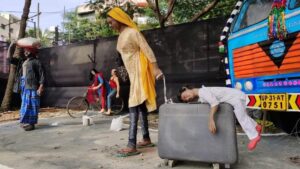
Not just Goddess Durga even but other deities like Saraswati and Lakshmi have also been replaced with women migrant idols. One of the migrant worker’s daughters will be seen with an owl representing Laxmi and the other with a duck, signifying Saraswati. The four are accompanied by a little kid with an elephant’s head, signifying Ganesha.
Together, the mother and her children will be seen walking towards the image of Goddess Durga – a halo with 10 hands.
“The pandal is based on the theme of the life of migrant workers and what they have faced during coronavirus lockdown,” said Sudip, President of the puja committee.
Another committee member, Dumpy said, “Goddess Durga epitomises strength and determination. Our budget has completely gone down due to the Covid-19 pandemic and Barisha Club is known for its theme; so nothing could be better than portraying the hardships of these migrant workers.”
Talking about the theme ‘Tran’, which means relief, artist Rintu Das said, “The family represents Goddess Durga and her children, including Ganesha and Kartikeya. The goddess is the woman who braved the scorching sun and hunger and penury along with her children. The woman is a migrant worker and a mother who is searching for food and water for her children.”
Rintu Das also added that depicting realistic theme is always a challenge but this year the challenge of the migrant workers is nothing in comparison of just depicting it.
Tapabrata Singh Roy, a resident of Behala was seen weeping while watching the final touches given to the idol.
“Not just migrant workers many lost jobs and now are hardly managing to make both ends meet. Seeing this I am reminded of several friends who have committed suicide after losing their jobs as they knew they cannot run their families. Along with retrenchment salary cuts is also an issue. Don’t know what the mother has in store for us. Though we are gearing up for celebrations there are so many people who don’t even know whether they can get their meals,” mentioned Singh Roy, a retired school teacher.
In September, the government of India said that of the four crore migrant workers in the country, over 25 per cent or 1.05 crore have returned to their respective states due to coronavirus pandemic and ensuing lockdown. Uttar Pradesh topped the list with 32.50 lakh labourers having returned to their homes, followed by Bihar where the number is 15 lakh.
The stress has been even more on women who have not only lost incomes but have also been forced to stay confined inside four walls with their families.

