


Kolkata: According to the Centre for Monitoring the Indian Economy (CMIE) the current data of unemployment in India is at a record high of 27.1%, four times than that of US.
Unemployment rate went up to 25.5% in April, from 8.7% in March highest since August 2016 when demonetisation happened. Now, due to lockdown situation unemployment rate is increasing.
Daily wage earners are living in stressful conditions both in the rural and urban areas. The rate of unemployment in rural India stands higher at 26.7% as against urban 25.1%.
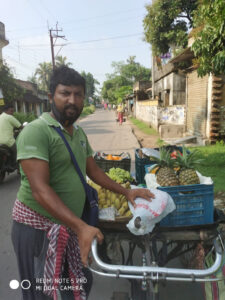
To make ends meet, many, who have been rendered jobless are finding different means to earn livelihood. Take the case of Muhammad Reza, an app-cab driver, who is now selling fruits near Park Circus post lockdown.
“Within a couple of days into the lockdown, I found it difficult to make ends meet. My brother, who is a fruit vendor, gave me the idea to sell fruits. Due to the ongoing Ramadan month, we are getting customers, helping me run my family. But, I don’t know what will happen after that,” said Reza.
Asked about any government support, the cab driver-turned-fruit seller stated the West Bengal Online Cab Operator’s Guild sent several letters to the government but they are yet to receive any support.
Another cabbie turned fruit seller Naosad Ali Laskar said that he too started selling fruits near Garia as his entire family is dependent on his income.
“I along with my widowed sister started selling fruits near Garia to make ends meet. When I drove cabs I had enough money to sustain my big family but now it is almost hand-to-mouth situation. So, my sister and I have turned fruit sellers. If the lockdown is not lifted soon, we will die of starvation,” said Laskar.
The driver added, “App cab is now permitted to ply with passengers having medical emergencies. But that is too few in numbers. So, when I get such call I make some extra money. I take out my cab, maintaining all the safety protocols. I hope this lockdown is lifted soon.”
West Bengal Online Cab Operator’s Guild secretary Indranil Bandhopadhyay said that through their union they have opened centres across the city that will reach dry ration to the poor and needy drivers, who still haven’t managed any alternative venture.
“The app-cab drivers are very poor. Though few cars are plying but the number is very less. Most of them are jobless. So, we have opened centres and are trying to give relief material to people who need it. We have also given financial assistance to stranded migrant workers in Ghaziabad, who were unable to come back to Bengal. I hope the state government stands by these poor drivers in their hour of need,” urged Bandhopadhyay.
Bandhopadhyay also said that 200 app cabs are operating in the city right now which can be booked through 9804886028. Text messages can also be sent to 9432324341.
“We are provided service for medical emergencies. Those who have to go out for chemotheraphy or dialysis or any other medical help can call or text on the above mentioned numbers. Around 200 of them are in operation. The rate is Rs 20 per km and the waiting charge is 100 for an hour,” stated Bandhopadhyay.
Lockdown blues
Sanjib Sao, who has been earning his living plying people on his rickshaw in Salt Lake, has been forced to sell fruits, post lockdown. Though the man from Bihar enjoyed pulling his cycle rickshaw and even invested recently to turn it into a vano (a rickshaw which runs on battery), the earning has not been as bad he had envisaged as a fruit seller. “I earn anywhere between Rs 150-200 a day after deducting all the investments, which is okay in these difficult times,” says Sao.
Fish seller, Joydeb Mandal of Rajarhat, who has a shop in Baisakhi Market in Salt Lake, has also learnt to innovate with times. Admitting business has not been the same post Coronavirus pandemic, he has learnt to serve better his regular clients and keep them in good humour. “Now, my customers call me over phone and order fish. Since they are not frequent to the market, they also demand other items like milk and vegetables, which I have to deliver. All this is free service as I do not want to lose my clients.”
While many are adapting other ways to survive the lockdown blues, Haren Mandal is worried about his survival. The man from Ara in Bihar, who used to run a cart selling puri bhaji at BJ Market in Sector II, Salt Lake, started selling lentils (saag) for a living. But he had to fold up his business as he had very little sale to keep his kitchen fire burning. “I am waiting for the lockdown to end soon. I can’t operate since food carts are still not allowed to open. I do not know what is in store for me in future,” said Mandal.