



Mumbai/Ranchi: The death of a Covid-19 patient in Dharavi, Asia’s largest slum on Wednesday has not only worried officials in India’s financial capital but also the residents of the slum too.
Besides the death of 56-year-old resident of Dharavi, another 52-year-old man who is civic worker living in Worli but posted in Dharavi has also tested positive from the highly contagious virus.
The slum is spread over some 6 sq km of land (520 acres) but houses 1.5 million people. The huts are separated by narrow lanes and most of the residents live cheek by jowl with other residents. Social distancing is virtually impossible.
“I reside near the building where one person has died from corona virus. The building has been sealed, but it has increased our worry that it will affect us too,” Jalil Ansari, a native of Giridih rued to eNewsroom over phone.
The inhabitants of most of these slums are migrant labourers, who work here in hundreds of small scale industries mainly making readymade garments, leather goods and pottery items. There are more 20,000 workers from Jharkhand who live in the tin-shed homes of Dharavi.
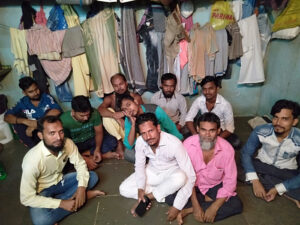
Another worker from Jharkhand, Rupesh Kumar expressed his fear and the grim situation he is facing: “We are living in fear. There is the everyday challenge of fighting with hunger as our owners have disowned us, but we now have round the clock worry that we may get infected from the virus. It has made our life a living hell.”
Since the lockdown began – from the midnight of March 24 – only 10 to 20 per cent of the migrant workers from Jharkhand could move out. The rest are still stuck there.
Jharkhand’s social activist, Sikandar Ali, who works among migrants said: “I have visited and stayed with many of the migrant workers who belong to my native place. It is not possible to maintain social distancing in that area. Around 6 to 8 people live together in a room which is about 10X8 square feet. They do not have toilets, and go outside to public toilets.”
Independent report suggests that over 70 percent of Dharavi residents used community toilets.
While Jharkhand’s CPI-ML MLA Vinod Singh, who raises issues of migrant workers regularly told eNewsroom, “We know that the workers who are in Dharavi are facing a very difficult situation. But we are in touch with them as well as with the area MLA Varsha Gaikwad, who along with some NGOs are providing essentials items to them.”
“As we are in the middle of the lockdown and all the borders have been sealed, I would request all the workers in Dharavi to stay inside their homes and go out with precautions. We are trying to get food to them inside their houses,” added the Bagoder legislator.
As of 8:30pm on Friday, Maharashtra has the highest number of Covid-19 cases (335) and highest fatalities (16) in the country, according to mygov.in/covid-19/ site. In Mumbai alone 181 cases have surfaced and nine deaths have taken place in the maximum city.
India now has 2433 Covid-19 cases and so far 62 people have died from it across the country.

