

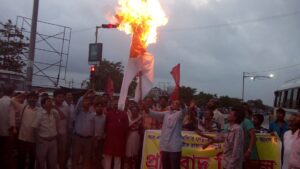
Kolkata: Putting up a resistance against the centre’s decision to revoke Article 370, CPIM, organised a protest rally in Kolkata on August 7. This is the second protest rally organised by the Left since the centre revoked Article 370 on Monday, August 5. The first rally was organised on Monday itself, with all Left parties like CPIM, CPI, CPI-ML, RSP, SUCI and DYFI participating in the protest rally.
Leading the rally were prominent Left Leaders like Chairman Biman Bose, CPIM General Secretary Surjya Kanta Misra, former MP Mohammad Salim and many more.
The leaders along with the participants of the rally were seen carrying huge placards and banners condemning the centre’s decision to revoke Article 370, there were a few banners which also demanded the release of political leaders put under house arrest in the Kashmir valley.
Interacting with the media, Md Salim said, “We demand the immediate release of all the leaders affiliated to various political parties to be immediately released from house arrest. We are in particular worried about comrade Yousuf Tarigami, who is also under house arrest.”
While Bose said, “Revoking of Article 370 is unethical. We resist this decision of the centre. We have been hitting on the streets to express our opinion and putting forward our demand, which is the cancellation of the centre’s decision. And we will keep doing it till the centre does the needful.”
On being asked about the great divide that the centre’s decision has created with political parties by large and Trinamool Congress (TMC) walking out of the Parliament when the bill to revoke 370 was passed, Salim scathingly attacked TMC. He said, “BJP and TMC are the two faces of the same coin. TMC which has been saying that they are not supporting the centre decision chooses to walk out means that by walking put they have some how shown their support to the government decision. Had they voted against the bill, then our vote count would have been higher and better.”
However, on being asked about Pakistan’s move to condemn the revoking of Article 370, the Left leaders maintained that they would be speaking about their movement in India and would not comment on the same.
So far, it seems, it is the Left parties mostly who hit the street on the issue. Similar protests have taken place in many places of West Bengal and in India.