



Kolkata: More’s the pity, since the last few months, a lot of gossip on an object has been on the incredibly unlikely possibility that it could be an alien spacecraft. But ultimately a team of Bengali scientists dispel that speculation and their radio observations confirm interstellar comet 3I/ATLAS is a natural object.
The observations were conducted by a dedicated team of three Bengali scientists, comprising Dr. Sabyasachi Pal from The Midnapore City College, alongwith his scientific colleagues Mr. Arijit Manna and Dr. Tapas Bag from the Satyendra Nath Bose National Centre for Basic Sciences. Their critical findings have been published in the Astronomer’s Telegram on January 2, 2026.
From Alien Rumours to Evidence: What 3I/ATLAS Really Is
After on July 1,2025 astronomers at the Asteroid Terrestrial-impact Last Alert System (ATLAS) detected this interstellar object 3I/ATLAS, space-fans are having some rumours of Alien Spacecraft! But they confirmed it’s a comet. There’s no scientific evidence that life has been detected anywhere in the universe beyond earth. Still, imagining aliens is sometimes fun!
Lots of scientific focus has been shifted towards that object to get more of it. On October 24, 2025 Observations by the MeerKAT radio telescope in South Africa reported its first radio detection, received from that interstellar object 3I/ATLAS, when it was just 3.76 degrees from the sun in the sky. Researchers confirmed that it’s the third interstellar object they’ve detected after 1I/’Oumuamua (noted in 2017) and 2I/Borisov(noted in 2019).
Speculation about aliens still continues! Researchers dedicated to the Robert C. Byrd Green Bank Telescope, the largest fully steerable telescope in the world, at the Green Bank Observatory in West Virginia, previously asked that there’s no technosignature from that object, so that it couldn’t be an alien spacecraft. A technosignature is any observable signature or physical evidence, that’s a detectable sign of artificial technology, such as artificial radio signals, unusual light patterns, unnatural planetary emissions. That may indicate the presence of an intelligent extraterrestrial civilization. But there’s nothing to examine. It’s clear that 3I/ATLAS is a natural comet.
NASA asked before that the comet poses no threat to Earth and it will remain at a distance of at least 1.6 astronomical units (about 150 million miles or 240 million km). Still the mysterious movement of that comet creates huge curiosity among space enthusiasts. It’s true, there was no solid evidence behind the story of being an alien spacecraft; even regarding this matter there was no serious research and no publications in the serious science journals.
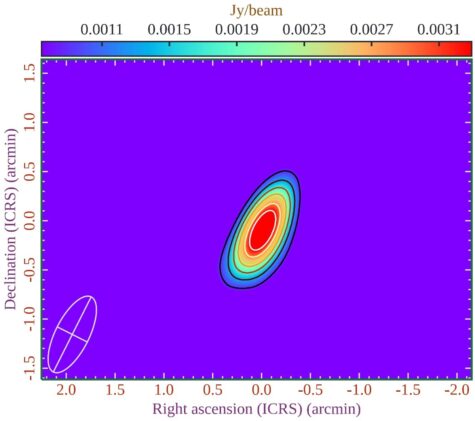
Bengali Scientists Capture First Radio Image of Interstellar Comet
These three Bengali scientists have done the first ever confident detection of radio continuum emission from interstellar comet 3I/ATLAS at meter wavelengths using data from the upgraded Giant Metrewave Radio Telescope in Pune, India. The interstellar comet 3I/ATLAS reached its closest approach to Earth on 19th December 2025, at a distance of about 1.8 astronomical units. They conducted low-frequency radio observations of the comet using the upgraded Giant Metrewave Radio Telescope (uGMRT) Band-5 at a central frequency of 1239 MHz on the day of the closest approach and two days before and two days after. The preliminary data analysis suggests the successful detection of comet 3I/ATLAS on 17th and 19th December 2025, with a significance greater than 10σ with flux densities on 17th and 19th December of 3.86 ± 0.38 millijanskys and 0.81 ± 0.05 millijanskys, respectively. Millijansky (mJy) is a unit used in astronomy to measure the flux density (brightness) of celestial objects—especially in radio, infrared, and sub-millimeter observations. Interestingly, the comet was not detected on 21st December 2025.
They find that comet 3I/ATLAS was significantly bright before its close approach (17th December) and became considerably faint at the closest approach (19th December), followed by a non-detection afterwards (21st December). This study represents a key step toward probing cometary radio emissions at meter wavelengths. The detection confirmed the presence of measurable radio continuum emissions, likely arising from dust-related emissions and/or plasma processes associated with the interactions between the cometary environment and solar wind.
Team leader Dr. Sabyasachi Pal informed, if an object were artificial or technological in nature, its radio emission would be expected to show specific patterns, signals, or anomalous features. But these observations clearly demonstrate that the radio emission from 3I/ATLAS is entirely consistent with natural cometary behaviour. Such detection confirms that it is an active natural comet capable of producing radio emission via known physical mechanism, thereby resolving speculation about unusual or non-cometary behaviour while it opens up new questions about the dominant emission processes.
Dr. Pal added, this research not only dispel misconceptions about 3I/ATLAS but also opens a new window for understanding future interstellar objects. This story sets up strong instincts that such objects can be studied effectively in the radio domain. The detectable radio emission from that comet suggests that dust production, plasma environments, and solar-wind interactions in extrasolar comets may be broadly similar to those in solar system comets, implying common physical mechanism during planet formation across stellar systems.
uGMRT Observations Confirm 3I/ATLAS Behaves Like a Natural Comet
Still the interpretation of the emission mechanism should be treated cautiously as the analysis is currently continuum only. Spectral line diagnostics are still in progress. Plasma and dust contributions can not yet be fully disentangled. There are multiple follow up observations or missions like multi-epoch radio monitoring across frequencies, spectral line searches, coordinated campaigns for future interstellar comets, they have to prioritise.
Despite having so many nuances, confidently taking a radio image of an interstellar comet for the first time is undoubtedly a huge gift for us. This study marks a significant advancement in our ability to detect and characterize visitors from other star systems, steering the conversation from speculation to solid science. Dr. Pal is also very optimistic, Studying such comets is essentially a quest for our own origins. The answers to where Earth, Water, and Life began may lie hidden within these tailed cosmic visitors.

