



Kolkata: The Union Government might be trying its best to suggest that an era of peace has dawned over Jammu and Kashmir, but the 132 migrant workers (of which 5 are from Assam) who were rescued from Kashmir have a different story to tell.
“What Kashmir? There is nothing left to talk about Kashmir. At present, it is in very bad condition. There are constant strikes. Vehicle movement is very restricted in the valley,” rued Komol Sarkar, a resident of North 24 Pargana, who has just returned to his home state West Bengal along with other 131 migrant labourers.
Sarkar has been going to Kashmir for the past eight years to work. But his time, he had to return to Kolkata on Monday evening, November 4, as he was feeling unsafe in the valley after five migrant workers from Bengal were shot dead by terrorists on October 29 in Kulgam.
Faju Sheikh, who had reached Baramula on October 12, is relieved to be back home. He said, “After that incident, we were living in constant fear. We all kept wondering, about our family’s fate if we too were killed by the militants. This sense of insecurity made us send out SOS to various people to help us get back home.”
The relief from fear, anxiety and uncertainty was visible on the faces of migrant labourers who reached to Kolkata from Kashmir. This evacuation of migrant workers is a first of its kind after the militant act in Kashmir.
Faju Sheikh, who had reached Baramula on October 12, is relieved to be back home. He said, “After that incident, we were living in constant fear. We all kept wondering, about our family’s fate if we too were killed by the militants. This sense of insecurity made us send out SOS to various people to help us get back home.”
Among the returnees, many had gone to the valley, a month back, while some had reached Kashmir and it seemed like they had been sent back from the station itself. However, on reaching Kolkata station many of the returning labourers, who had been in Kashmir for a longer period, were worried about their payments, as they hadn’t got their salaries.
Most of them were working in playwood factories in Kashmir.
Mayor of Kolkata and Trinamool Congress (TMC) leader Firhad Hakim was present at Kolkata Railway Station to receive the migrants and have them sent back to their respective home. Speaking to the media, he said, “I am here to ensure that each migrant labour reaches his home. Along with Bengali workers, 5 from Assam had also been rescued. We are ready to extend any help that they need to go back to their homes.”
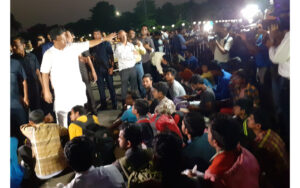
On being asked about another bombing that took place in Kashmir, he said, “Democracy has been killed. We are being told that Kashmir is fine, then why all this is happening?” When asked about BJP’s allegation that TMC is doing politics on Kashmir issue, Hakim answered, “Choro Ko Sab Nazar Atey Hai Chor. Since they believe in doing politics of blood and hatred, they feel that others also indulge in the same practice. We don’t indulge in politics of hate or blood.”
The mayor informed that maximum workers are from Uttar Dinajpur, Dakshin Dinajpur, Malda, Cooch Behar, Murshidabad area of Bengal, while 5 among the 132 rescued workers were from Assam. Bengal government has also arranged buses to send the labourers to their respective destinations.
Meanwhile, Samirual Islam of Bangla Sanskriti Mancha (BSM), who had been in constant touch with the labourers, since the killing took place, told eNewsroom, “We request the Bengal and central government to prepare a register for the migrant workers, so at the time of emergency they can be traced out.” BSM officials informed that they helped government in locating the labourers in Kashmir.
He added, “There is also a need to provide jobs to labourers, as it is a matter of survival for them. And they had gone outside the state because of getting lack of work here.”

