



Kolkata: While voters across Bengal—and beyond—have long been inundated with high-decibel advertisements from the Bharatiya Janata Party across television screens, mobile phones, and newspapers, the ruling All India Trinamool Congress (TMC) is quietly charting a different course—one that enters homes, not just headlines.
TMC Flips Campaign Playbook With Interactive Gaming Leaflets
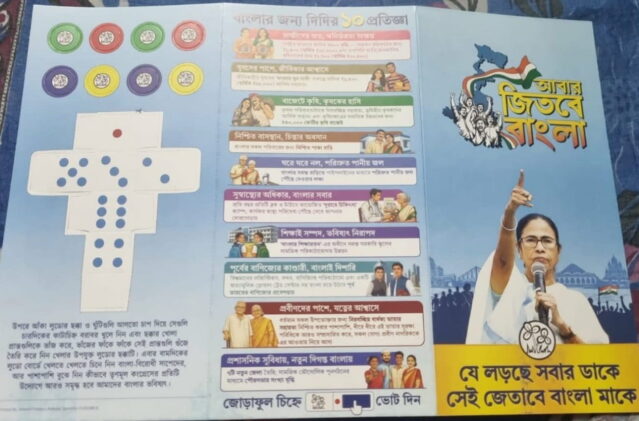
In a striking departure from conventional campaign tools, the party has rolled out a ‘Snakes and Ladders’ themed leaflet, transforming a familiar household game into a potent political message. Designed for door-to-door outreach, the leaflet is not merely symbolic—it is fully playable, complete with a cut-out dice that can be assembled from the paper itself.
BJP Leaders Cast as ‘Snakes’ in Trinamool’s Welfare Game
The visual metaphor is both simple and sharp. The “snakes” on the board are depicted with faces of prominent BJP leaders, including Narendra Modi and Amit Shah, signaling downfall and setbacks. Regional figures such as Suvendu Adhikari, Dilip Ghosh, and Samik Bhattacharya also feature as part of the descending traps. At the highest rungs of the board—where players risk the steepest fall—the imagery becomes more pointed, with Modi and Shah symbolising the sharpest political decline.
In contrast, the “ladders” represent welfare schemes of the Mamata Banerjee government. These include initiatives targeting women, youth, students, and housing beneficiaries. The most significant upward leap is tied to the popular Lakshmi Bhandar scheme, reinforcing its centrality in TMC’s political messaging.
How Gamified Politics Ensures TMC’s Message Stays in Homes
Unlike traditional election pamphlets—often limited to text-heavy appeals or leader-centric messaging—this innovative format blends engagement with recall value. The front side of the leaflet prominently features Mamata Banerjee’s image, while the reverse carries detailed information about government schemes.
“This is not a leaflet people will throw away,” said Mohammed Reyaz, a professor of mass communication. “Across Bengal, both the elderly and children play games like Ludo and Snakes and Ladders. It is an integral part in most of the middle and upper middle class homes in Bengal. Such formats create recall value and ensure the message stays within households.”
Beyond ‘Khela Hobe’: TMC’s New Grassroots Strategy for 2026
The use of play as political metaphor is not new for the TMC. During the 2021 Assembly elections, the party’s electrifying slogan ‘Khela Hobe’—accompanied by football imagery linked to Mamata Banerjee—had captured public imagination and political discourse alike. And it was such a success that party now celebrate Khela Hobe Diwas on August 16 every year.
Even earlier, before unseating the Left Front’s decades-long rule, TMC leaders relied heavily on direct household outreach, including festival greetings delivered door-to-door—a strategy that helped build intimate voter connections.
What the ‘Snakes and Ladders’ campaign reflects is a continuity of grassroots politics with a creative twist. At a time when political communication is increasingly dominated by expensive media campaigns, TMC appears to be doubling down on physical, interactive, and community-driven engagement. By turning a simple game into a political narrative—where progress is tied to welfare and decline to opposition—the party is not just delivering a message; it is embedding it into everyday life.

