Kolkata: In an age when misinformation travels faster than facts and scientific reasoning is increasingly drowned out by noise, a quiet but significant initiative in Kolkata has sought to reclaim public space for science. A collaborative effort between the Indian Science News Association (ISNA)—one of India’s oldest science communication bodies—and Radio Kolkata, an internet radio station run by Vijaygarh Jyotish Roy College (VJRC), has laid the foundation for a sustained science popularisation programme aimed at society at large.
The collaboration marks a new phase in ISNA’s long-standing mission to foster scientific temper and public understanding of science, while simultaneously positioning community radio as a powerful, accessible medium for knowledge dissemination. The joint initiative, titled “ISNA’r Angone” (Within the ISNA Arena), will be broadcast regularly through Radio Kolkata, creating a bridge between scientists, students, and the wider public.
Science Communication in a Time of Crisis
The urgency of such an initiative is difficult to overstate. We live in an era where every second generates an overwhelming volume of data, much of it unverified or deliberately misleading. Fake news often outpaces fact, and scientific truth is routinely buried under layers of disinformation. In this context, science communication becomes not merely an academic exercise but a democratic necessity—serving as both a shield against distortion and a torch for truth.
This broader concern framed the collaboration ceremony, which was consciously aligned with the global discourse on environmental sustainability. The programme was envisioned around International Mountain Day, underlining the critical role mountains play in sustaining life on Earth. Mountains provide freshwater to nearly half of humanity and host around half of the world’s biodiversity hotspots. Yet, due to pollution and climate change, these fragile ecosystems—and the communities dependent on them—face unprecedented threats.
Dr. Swati Nandi Chakraborty, Principal of Asansol Girls’ College, initiated the discussion by focusing on the year’s theme: “Glaciers matter for water, food, and livelihoods—in mountains and beyond.” Her remarks drew attention to melting glaciers and the looming crisis of water security, connecting environmental science directly to everyday human survival. Former Associated Press photojournalist Bikash Das complemented this perspective by sharing visual narratives from mountainous regions, demonstrating how photography can powerfully communicate scientific and ecological realities.
ISNA: Carrying a Scientific Legacy into the Digital Age
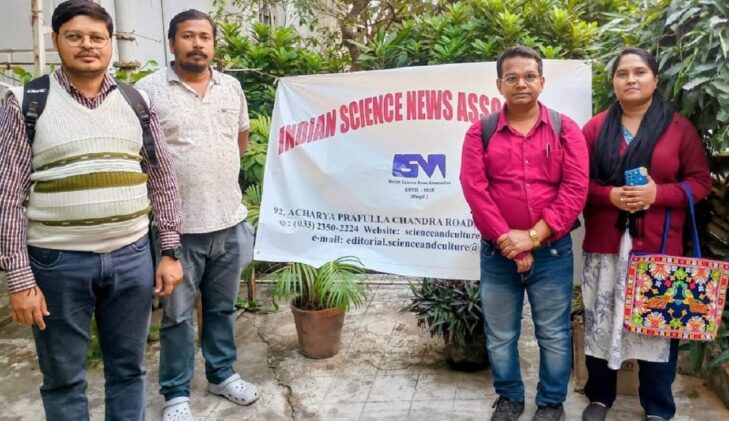
Founded in 1935 on the initiative of Professor Meghnad Saha and Acharya P.C. Ray, ISNA was conceived as a platform to disseminate science news while nurturing a culture of scientific thinking in India. From its inception, the Association has published the journal Science and Culture, reflecting the idea that science does not exist in isolation but grows within a broader social and cultural framework.
The first Council of ISNA itself reflected the intellectual stature of the organisation, with Acharya P.C. Ray as President and figures such as Dr. Shyama Prasad Mookherjee, Sir U.N. Brahmachari, Prof. M.N. Saha, and Prof. N.R. Sen playing key roles. Over the years, its Annual General Meetings were attended by towering personalities including Netaji Subhas Chandra Bose, S.S. Bhatnagar, and Humayun Kabir.
This historical continuity has not prevented ISNA from adapting to contemporary needs. Since the COVID period, the Association has been publishing two regular e-papers—Bigyan Kahan and Scientifica Communica—expanding its digital footprint. As noted by ISNA Vice-President and senior journalist Prasanta Kumar Bose, the collaboration with Radio Kolkata represents another forward-looking step, enabling science communication to reach audiences beyond conventional academic circles.
From Classroom to Community: Radio as a Democratic Medium
The partnership gains particular significance through Radio Kolkata, an internet radio platform launched by the Department of Journalism and Mass Communication at VJRC. On air since November 2021, the station reflects an innovative academic initiative that combines student participation with community engagement. Designed for the digital age, Radio Kolkata is accessible to anyone with a smartphone or internet-enabled device, breaking barriers of geography and class.
Dr. Sima Mukhopadhyay, Programme Producer at Radio Kolkata, highlighted the station’s diverse lineup, which includes agriculture-based programmes like Chashbas, health-focused content such as Swasther Sathi, and science-oriented discussions under Jigyasa. The addition of ISNA’r Angone strengthens this ecosystem, embedding rigorous science communication within a participatory media framework.
During the collaboration ceremony, Dr. Rajyasri Neogy, Principal of VJRC, emphasised the broader social potential of the initiative. Drawing parallels between environmental challenges in mountain regions and those faced by coastal communities, she pointed out how marginal fishermen—often compelled by economic hardship to overexploit marine resources—could benefit from scientifically informed awareness programmes. She expressed hope that ISNA’s expertise, combined with Radio Kolkata’s reach, could help communicate such messages effectively to vulnerable communities.
More importantly, Dr. Neogy addressed a growing concern within academia: the declining interest among students in pursuing basic sciences. She argued that early and engaging exposure to scientific ideas—outside rigid classroom structures—could rekindle curiosity and help address this crisis.
Why Science Must Speak the Language of the People
ISNA President Dr. Bikash Chakraborty reinforced this argument by underlining the importance of popularising scientific achievements and developments among the general public. Drawing an analogy with sports icons like Sachin Tendulkar, he observed that while children often develop early role models in sports, identifying or nurturing a passion for science is far less straightforward. Without accessible narratives and inspiring communication, many potential scientists drift away before discovering their interests.
Dr. Chakraborty strongly advocated for science communication in Indian languages, arguing that sharing science in one’s mother tongue naturally leads to deeper engagement and wider participation. This emphasis aligns with ISNA’s long-held belief that science must be rooted in the cultural and linguistic realities of society.
Echoing this sentiment, Dr. Manas Chakraborty, former professor at the Bose Institute, reflected on ISNA’s foundational philosophy. He reminded the audience that the idea of scientific culture—where science and culture are inseparable—was embedded in the Association even before its first meeting in 1935. The new collaboration, he suggested, has the potential to carry that legacy forward by functioning as a living bridge between institutions and society.
As ISNA’r Angone prepares to reach listeners through Radio Kolkata, the initiative stands as a reminder that science communication is not merely about transmitting information. It is about nurturing curiosity, combating falsehood, and empowering citizens to engage critically with the world around them—an endeavour that remains as vital today as it was nearly nine decades ago.