

Kolkata: Muslims facing discrimination while renting a flat in most of the Indian cities no longer takes anyone by surprise. Even metro cities like Mumbai and Delhi have had cases where Muslims have alleged that they have been denied accommodation simply because of their religious identity. A number of cases have even been reported across India.
Kolkata too had been witnessing this kind of a trend, where people were refusing to rent out their apartments or flats to Muslim youths. Call it prejudice or an increasing trend of intolerance, a phenomenon now-so-common across India, was slowly beginning to grip the cosmopolitan, progressive bhodro Bengali culture.
“It’s pretty common – minorities, Muslims in particular, being denied accommodation in certain pockets of the city. The problem escalates, if one happens to be a single or an unmarried couple,” pointed out Dwaipayan Banerjee, founder of Sanhati Abhijan – a civil society for People’s Unity.
To ease out this discrimination, Sanhati Abhijan has even started a Facebook page called Open A Door, with single agenda – No room for housing discrimination and communal profiling in West Bengal. This citizen’s initiative intends to create a database of house or flat owners in Bengal and various other cities (at a later stage) that will never discriminate their tenants on the basis of their religion or marital status.
When four Muslim doctors were told to evict their flat, they had also posted on the Open A Door’s Facebook page and from where the matter had got highlighted. Later, Sanhati Abhijan did all the work and stand strongly behind the four doctors.
It is they only who had initiated talks to Durga Puja committee and sought their intervention. They had also directly interacted with the person who had an objection to having a Muslim tenant in his neighbourhood and resolved the issue.
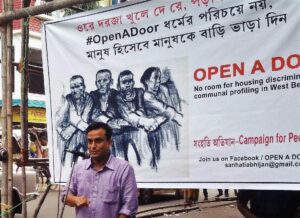
“We are not an NGO, as we are being termed, we are a people’s collective, which aims at reducing the communal divide, which has further deepened in the past few years,” added Banerjee, a research scholar at Centre for Studies in Social Science, Kolkata. He maintained that the organization is working towards uniting people.
“We want our society to give out a strong message – We don’t believe in the communal divide. We are a new organization have members from across the society, who believe in propagating unity, peace and love in the society. Since our collective’s inception, we have been organizing dramas, cultural programmes and a number of interactive meets to propagate peace and unity,” said Banerjee.
“We have had a couple of interaction between landlords and people wanting to rent a flat, to eliminate the prejudice. We are even preparing a database of people who don’t discriminate while renting out their flats or houses. We have now decided to take a personal initiative and intervene in cases where people complain of discrimination as in this case of the four doctors and mobilize the locals to eliminate discrimination,” he added.
Adding to this, another active member of the group, Bhaskar Majumdar, said, “Discrimination on the basis of religion, gender or marital status is against the spirit of Kolkata. But given the political environment of the country, everyone is being forced to think along the communal lines. We, the members of this citizen’s initiative are looking forward to dissolving the communal divide which has sprung up off-late.”
Reacting to the role that this group has been playing, Dr Mohammad Aftab Alam said, “This actually reinstates our hope in secularism and the true spirit of India.”
After their success of reinstating Muslim doctors in the same flat, people have requested Sanhati Abhijan to work for the LGBT community also, who faces the same discrimination while searching for flats, a request, which the organisation has agreed to debate on in the next meeting.