



Kolkata: Sumita Das is a practicing doctor while Samim Ahmed is a professor and Kashturi Basu is a full time social activist and documentary filmmaker. The common thread that binds them together is the fact that they all are the convenors of the ‘No Vote to BJP’ campaign in West Bengal. The trio are among the 45 conveners of the campaign, who have been assigned to make the campaign reach the grassroot of Bengal. And within two months of the campaign being flagged off, the call for citizens – comprising students, activists and professionals reached out to almost every part of Bengal.
Why No Vote to BJP?
A convention took place on January 4, where concerned citizens, mostly from the left background, who have been active in several pro-people movements in Bengal participated and acknowledged that the Bharatiya Janata Party is a threat to secularism and democratic rights of the people.
“We were concerned about the fact that despite so many secular people being in Bengal, BJP managed to get a large number of votes in 2019. We felt that we had to reach out to as many people as we could and show the real face of BJP and its propaganda, and how the saffron party fools people,” said Dr Sumita.
Adding to that Kasturi said, “Our campaign is targeted to those floating and undecided voters, who are first-time voters or who had voted BJP in 2019. We will speak to them, try to convince them to move away from the influence of the BJP.”
An ideological campaign, not just for election
While Kasturi stressed, “No Vote to BJP campaign will not end with the election. We are not satisfied even if BJP comes second in the Bengal elections. This is not a one-liner campaign, it is an ideological battle against RSS-BJP. No other platform is targeting RSS. Why the BJP is fascist? It is because of the RSS. So we are mentioning RSS at most places and printed lakhs of posters and are talking about it openly.”
The angry filmmaker stated, “RSS has no place in Bengal, it should not be given one. It has a bloody history. It should be thrown away into the bay of Bengal.”
Active on real and virtual domain
“It is not just on social media. Initially, people thought that it was just a social media campaign. It also is not just about the people of Kolkata people. In sixteen districts we have more than one committee, like in Kolkata, Howrah, South 4 Pargana, Barasat, Ranaghat, Siliguri, Jalpaiguri. It is very organic and grounded. We have reached twenty districts of Bengal,” informed Kasturi.
Dr Sumita mentioned, “We are telling people how BJP is not good for students, how they are not good for labours and farmers and especially for women too.”
Apolitical nature
And it is just ‘No Vote To BJP’, but other groups like Bengal and Fascism, Sharamjivi Adhikar Abhiyan Yatra are sending out the same message to people and doing an extensive campaign. To connect with more and more people, volunteers are making innovative campaign videos, setting discourse, distributing leaflets, holding citizen conventions, conducting street corner meets as well as meetings at haat-bazaar.
According to the volunteers, the campaigner has been impactful and now political parties are noticing it.
Kasturi even claimed, “It has become so powerful that right from BJP state president Dilip Ghosh, to CPM’s Sujan Chakraborty and even chief minister Mamata Banerjee all mentioned about No Vote To BJP Campaign.”
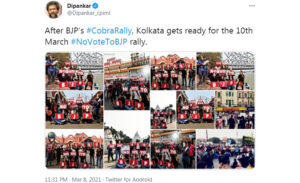
CPIML’s general secretary, Dipankar Bhattacharya tweeted about the campaign on March 8.
“But it is a completely apolitical campaign. We are not telling anyone whom to vote for. If people want to press the NOTA button, they can do so,” Kasturi mentioned.
A video by No Vote to BJP campaign
BJP is hiding NRC before the election
But we are bringing it out, telling people that it is on their agenda and BJP is not going away from NRC, the budget has passed, the law has been made, NPR has started. It is not a simple issue but the biggest crisis that the people of Bengal can face.
She also rued upon the role of opposition parties in Bengal, “See the opposition parties (Bengal’s opposition), they are doing lip service on NRC (citizenship) issue. But we are setting the agenda and we are highlighting it.”
“We do not want NRC, we do not want new education policy, we do not want communal politics, we do not want new labour code and farm bills, and we do not want RSS in Bengal,” Kasturi added.
No vote to BJP, now a mass movement
“We have reached every block of Bengal and tomorrow, people from every district are expected to be present at our scheduled rally cum sabha that will be hosted at the Ramlila Ground, Kolkata,” informed Samim Ahmed. Tomorrow, people will see how strong the movement has become, he added.

