Nemra, Ramgarh: Garlanding, reciting poetry, and displaying pictures of their beloved leader, Shibu Soren, have become an everyday sight in Nemra village, Ramgarh. The ancestral home of Jharkhand’s Chief Minister Hemant Soren lies 81 kilometers from Ranchi, but since August 5 — the day Dishom Guru was cremated — all roads have led to this lush green hamlet. Here, the chief minister has been staying, meeting villagers, and performing rituals for his father’s departed soul.
For the past eight days, Hemant Soren has walked the narrow village paths his father once knew so well, talking to farmers, listening to grievances, and quietly filling the void left by a leader who, for decades, was the voice of Jharkhand’s marginalized.
How Nemra’s Son Became Dishom Guru
Shibu Soren’s story began with tragedy. At just 13, he lost his father, Sobran Manjhi, a teacher, to the bullets of zamindars. That moment propelled him into public life, a journey that ran parallel to the great social churn of post-Independence India. While he did not lead the Dhaan Katni Andolan, he later spearheaded a far greater struggle — the movement for a separate Jharkhand. In 1973, he founded the Jharkhand Mukti Morcha, a political home for the aspirations of Adivasis and other marginalized communities.
In his 81 years, Shibu Soren wore many hats — three-time chief minister, three-time Union minister, eight-time MP, Rajya Sabha member, and MLA. Yet titles and power were never what defined him. What made him Dishom Guru was his unwavering connection with the last person in society’s line — the landless farmer, the forest dweller, the worker fighting for his dignity.
A teetotaler and vegetarian, he often held night classes in the 1970s, teaching by lantern light, and was known to punish those who drank. His politics was as much about principles as it was about power.
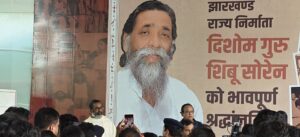
Hemant’s Turn at the Helm
Hemant Soren’s own political journey, like his father’s, began in the shadow of loss. In 2009, his elder brother, Durga Soren, passed away at just 39 from kidney failure. Then an engineering student, Hemant abandoned his studies and stepped into public life.
Today, serving his third term as chief minister and as JMM’s executive president, Hemant faces the challenge of carrying forward his father’s unfinished battles — for Jal, Jungle, Zameen. Those who knew Shibu Soren say there are thousands of villages like Nemra in Jharkhand — places of extraordinary beauty whose identity must be preserved.
During his daily visits to villages around Nemra, Hemant has made his intention clear: “Nemra will remain Nemra,” he told the media, meaning the village will retain its essence, though equipped with all basic amenities.
“Shibu Soren fought for Jal, Jungle, Zameen (water, forest, and land). Now Hemant Soren must truly work on his father’s ideals and vision. Full implementation of the PESA Act, protection of forest rights, removal of the land bank, and enactment of the anti-mob lynching law should be his government’s priorities. Mining in Jharkhand must not be left uncontrolled,” writes Ranchi-based journalist Vinod Kumar, author of Samar Shesh Hai — a book on Shibu Soren.
‘Jab Tak Suraj Chand Rahega…’
“I am a Brahmin, and I should have an interest in education — but he had more interest than I did,” said a septuagenarian visitor at Nemra. “He told everyone to study. He believed only education could improve lives, especially for Adivasis. And he never let anyone leave his home hungry. He has touched and changed thousands of lives. That’s why I say — jab tak suraj chand rahega, Shibu tera naam rahega.”