



Vadodara/Kolkata: Have you met a genius, recently? If not then get set to meet Ashraf Kesrani, the boy from Vadodara who has recently created history of a sort. But then securing good percentage is nothing new for him. Asharf has 92 percent in his secondary examination and 93 percent in senior secondary examination. Following which he bagged the 14th rank in Gujarat Medical Council entrance 2013 for Bachelor of Medicine and Bachelor of Surgery (MBBS).
And guess what? Ashraf did it all without getting enrolled in any of the coaching centres, which often medical aspirants throng. Throughout his MBBS continued doing great result. In the fourth and final year he had secured the first rank. Following which, Ashraf, a Baroda Medical College appeared for the All India National Eligibility cum Entrance Test (NEET) for Post Graduate course, along with 143147 doctors only to emerge as a national topper. This year only 79633 doctors could qualify for the PG course.
A humble Ashraf told eNewsroom, “I always had a feeling that I can also top. But I had never anticipated that my dream will come true. The news of securing an All India Rank one is indeed a good feeling.” What more, the 25-year-old doctor, has not only secured 1006 marks out of 1200 in NEET PG entrance but has also become the highest scorer in the history of NEET examination. This year second topper has got 985 marks. Last year NEET PG topper Rachit Agrawal has secured 975 marks.
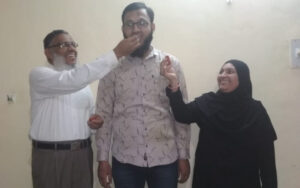
Ashraf further said, “I come from a middle class family. And my father Muhammad Hussain works in my uncle’s shop. My uncle, Fazal Muhammad has supported our education.”
Eldest among siblings, Ashraf has two brothers and a sister. This genius loves to play cricket and his favourite player is Virendra Sehwag.
Ashraf had wanted to do PG from AIIMS, Delhi but as NEET PG does not cover AIIMS, so he wants to do pursue his PG from Maulana Azad Medical College (MAMC), Delhi.
Given that most IITians and IIM pass outs move over to the United States or other countries in search of a better future. On being asked if he had any such plans, he said, “I have no plan to work outside India. In fact, I came into medical field to serve India, to serve the people of my country.”
Significantly, Ashraf is the second boy from Gujarat who has made it to the top of the All India Ranking. Earlier last week, Shahid Memon from Koday secured the second ranking in Charted Accountant (CA) examination.

