Kolkata: Raju Sabar of Sandri village, in Purulia is going to appear for his school final examination next year. Son of a daily wage labourer, he is thankful to his dada Swarnabha Dey and his friends from Kolkata, who are a regular visitor to their village now. Sandri’s population is mainly dominated by people belonging to the Sabar tribe.
The Sabars are tribals of Munda ethnicity are predominantly found in Jharkhand, West Bengal, Odisha and Chattisgarh. The primitive tribe formed the core of many of the books penned by Magsaysay Award winner Mahasweta Devi, who had fought a tough battle to work for the betterment of this tribe, which had been branded as a “criminal tribe” by the British.
Two years after the death of Mahasweta Devi, Sabar’s were back to leading the same life, when Dey and his friends intervened to provide education to them. Dey and his friend are all set to have a residential secondary school established in Sandri village to help children like Raju to get a chance to get educated. They have even set up the Sabar Welfare Trust, under which they have even purchased land worth INR 6,78,000 to set up the residential school. However, the entire cost of building the residential school has been estimated to be around INR 20,00,000.
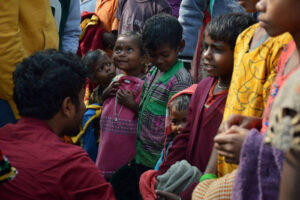
On being asked, who they managed to collect this huge a fund, Dey revealed to eNewsroom, “We have been crowd funding to help realise our mission. For the past two months we have been doing it. However, we have used Facebook as the medium to crowd fund. The response has been overwhelming. People have donated generously for the cause.”
According to him, the entire money to purchase the land and having it registered came from crowd funding. “Our appeal to people for donations will continue till we are able to raise the entire amount to have a fully functional residential school,” he said.
The techie, who has been visiting Sandri village, maintains that the tribe still faces social stigma and ostracism. “They are not allowed to mix with other tribes and thus they live a very reclusive life,” Dey added.
Despite Right to Education and other poor-friendly laws having been implemented in the country, the Sabar’s continue leading a difficult life. A time, when people are talking of a digital India and Bullet trains in India, the situation has not changed for the Sabars. They continue being land less labourers, working in shifts in brick kilns along with their kids. “It is for such kids that we are setting up this school. The parents have agreed to leave their children with us to study, while they work in the brick kilns,” said Dey.
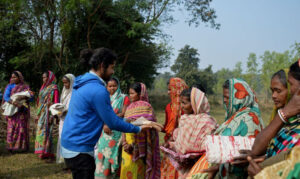
On being asked, how it all began, he said, “We came to Purulia for friendly reality check, and we discovered that they were in serious need of help.” He then added, “I must say Mahasweta Devi is my inspiration. I met her on a number of occasions. She has blessed us,” said the techie who works for Tata Consultancy Service.
Initially the group comprising six members went to do on-ground research. “But then we fell in love with the simplicity of these tribals. There was no planning,” said Dey. Now the group has roped in its seventh member, Nirmal Sabar, the first graduate of Shabor tribe.
The group used to visit them on weekends to provide free tuitions to Sabar children whose parents cannot afford private tuitions. “Those who have an income of Rs 3,000 a month can afford to send their children to schools located at a distance. But most cannot. So we used to give them free tuitions and that is how an idea of a residential school came to our mind,” informed Dey to eNewsroom.
The school will start with 25 students and would follow the curriculum of West Bengal Board. It will enroll students from Class V to X. Hostel facilities will be available only for boys.