



Ranchi: When the migrant special train from Telangana reached Hatia, Ranchi on May 2, Jharkhand became the first Indian state to receive a migrant special train amid lockdown.
Since then over 60,000 migrants have arrived Jharkhand in 50 special trains. The state has issued No Objection Certificate (NOC) to 110 such trains.
However, on May 15, Railway Minister Piyush Goyal made an allegation that along with West Bengal, Chhatisgarh and Rajasthan, Jharkhand also has not permitted migrant special trains to enter their state.
Later, Hemant Soren, Chief Minister of Jharkhand tweeted three times and refuted the allegation made by the railway minister. While an official of Chief Minister Office (CMO) also told eNewsroom how state had been accommodating since day one to bring back its migrant workers. The officer specifically mentioned about the initiatives taken by Hemant Soren government for the migrant special trains.
At least seven lakh migrants across India from Jharkhand, have registered themselves with the state government in hope of being brought back to their state.
Received first migrant special train
“Chief Minister Hemant Soren was the first to speak to Piyush Goyal, Railway Minister about our migrant workers. Also, in letters to Prime Minister Narendra Modi and telephone calls made to Home Minister Amit Shah, CM has continually reiterated about necessary arrangements to be made to bring back migrant workers via train,” informed the officer.
He further pointed out, “The first special train was thus initiated by the constant pressure created by the state government. This train brought in migrants stranded in Telangana to Ranchi. Since then there has been a steady flow of migrant workers via trains and buses to Jharkhand from other states.”
Bigger Mission than Vande Bharat
But with around 7 lakh workers registered on the state portal expressing their desire to return home, the state government has been set a Herculian task, which is of a much bigger scale than the Vande Bharat Mission.
“Yet Railway Minister has made uninformed allegations on the Jharkhand Government for not giving NOC (clearances) to other state governments to send trains,” said the official.
Asked permission for special charter flights for migrants
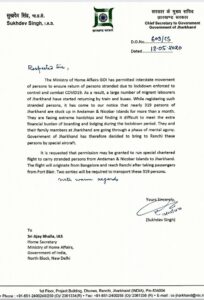
Goyal’s allegation seems to have backfired as Jharkhand government come up with a letter dated May 12, in which it had sought permission from GOI for special charter flights to bring in its migrants.
“Four days back, Jharkhand government through Chief Secretary, had sent a special request to the Union Home Secretary to bring back 319 workers of Jharkhand from Andaman and Nicobar Islands. Jharkhand government is ready to bear all the expenses of the special chartered flight to bring all of them back to Ranchi,” said the officer quoting the letter.
But he added, “Even after 4 DAYS, no reply has been issued by the Union Home Secretary & Government of India on this.”
To solve the humanitarian crisis, niyat and nistha is need
While Hemant Soren said to reports in Ranchi, “’Niyat (intent) & nistha (commitment) is absolutely necessary on behalf of all stakeholders to ensure the safe and quick return of all migrant workers to the state with dignity’. It’s time to showcase a humane approach to solve this humanitarian crisis.”
When the first migrant special train had reached Hatia, the chief minister was present at the station. He had personally supervised meals and checked other arrangements made for the migrant workers.
All the migrants reaching the station were welcomed with red roses and were then sent to their respective districts after medical check-ups.
This practice is continued for every migrant worker returning to Jharkhand.
Besides these, to stop future migration of workers from Jharkhand, Soren government has started three schemes related to rural belt of the state, which will help the returnee migrant labourers. And working on several such proposals for the betterment of migrants, Hemant Soren stated recently in an interview to a news channel.


Good approach… Neestha and niyat… If Hemant Soren has taken the initiative then he must fulfill the promise… This will not just be a gratitude towards the people of his state but to himself. The people of Jharkhand has voted him to power and he must retain that trust. In short where there is will there is a way…