

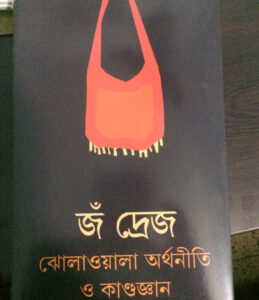
Kolkata: Developmental economist Jean Dreze, who is presently leading a campaign – Ration Bachao in Jharkhand, was in Kolkata to release the Bengali translation of his book Sense and Solidarity: Jholawala Economics for Everyone – Jholawala Arthaniti O Kandogyan. Using the opportunity to talk about his movement against the Direct Benefit Transfer (DBT) for food subsidy stated that the poor people of Jharkhand, were left with no option but to face the rotten system in Jharkhand.
“Poor people are being treated like guinea pigs by the state administration in Jharkhand. These people have to go to the banks to avail their subsidy. They have to endure hardships as there are no proper transport facilities and the banks are quite far away. Even if they reach, at times they are told that the money is yet to be credited. It is creating a lot of problems for these poor people,” said Jean Dreze while replying a question on the implementation of National Food Security Act in Jharkhand.
He then added, “They are spending a fortune to get rice from the fair price shops at a subsidised rate. And in case they buy from these shops then they are threatened with their names being struck out from the list.”
Speaking on the need for action driven research, Jean mentioned the fact that activism is important not just to know about the functioning of the democratic institutions but also to know how a society particularly those for whom, the activism is done, reacts to it.
Elaborating about his book, he said that the chapters have been divided chronologically so that readers do not have any problem in understanding its content. The book is divided into ten sections: drought and hunger, poverty, school meals, health care, child development, food security, employment guarantee, corporate power, war and peace and set of miscellaneous essays written at various times. “You can go to net and see the contents of the book. If you like it then buy,” said Dreze who has co-authored many books with Nobel Laureate Professor Amartya Sen.
When asked about the need for research in the era of Post Truth, Jean asserted and said, “Research is important, but along with it, speed is also important. Academic research take longer period and by the time it findings are out, the scenario changes. So research for action is the only way to counter false propaganda.”
Coming to the translation, particularly the use of English words for example ‘inclusiveness’ Anirban Chattopadhyay, editor of Ananda Bazaar Patrika said, “The word ‘inclusiveness’ in English has a universal meaning. But when it comes to Bangla, the meaning varies. As a result, more inputs had been given so that the readers get a feel of the actual word.”
Appreciating the writing style of the book, he said, “I would rather say that Dreze’s writings are deceptively simple. But in reality these simple sentences are not simple.”
At the interactive programme jointly organised by Institute of Development Studies and Pratichi Institute, he finally summed up by saying, “The outlook has to be quite liberal. Activism and academics must go side by side in a democratic manner.”