



Kolkata: Rehana Ahmed, mother of brutally murdered Faizan Ahmed, IIT Kharagpur’s third-year student, wrote to Chief Minister Mamata Banerjee, asking her to ‘intervene’ in the matter so that her son’s case does not face any ‘hindrance’.
In the mail, sent through her lawyer Aniruddha Mitra on June 16, Rehana writes, “The partially decomposed body of my only child, Faizan Ahmed, a Mechanical Engineering student of IIT Kharagpur, was found in a hostel room on October 14, 2022, inside IIT Campus.”
It further reads, “Although at the first sight of his dead body, my husband and I had no manner of doubt that he had been murdered, the IIT Kharagpur, as well as the District Police authority, persisted with the story of suicide. The first post mortem report was inconclusive.”
“A second post mortem, conducted by renowned Forensic Expert, Dr Ajay Kumar Gupta, on May 27, 2023 under order of Hon’ble High Court, confirmed that Faizan had been brutally murdered.”
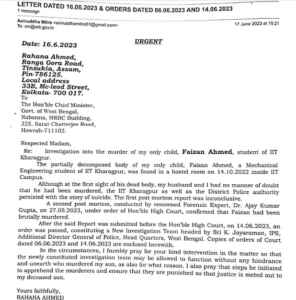
“After the said report was submitted before the Hon’ble High Court, on June 14, 2023, an order was passed, constituting a New Investigation Team headed by K Jayaraman, IPS, Additional Director General of Police, Head Quarters, West Bengal.”
In the end, Rehana pleaded, “In the circumstances, I humbly pray for your kind intervention in the matter so that the newly constituted investigation team may be allowed to function without any hindrance and unearth who murdered my son, as also for that reason. I also pray that steps be initiated to apprehend the murderers and ensure that they are punished so that justice is meted out to my deceased son.”
The 23-year-old IITian secured 11th AIR in Joint Entrance Examination, 2020 and got admission to IIT Kharagpur. He was also a member of the Aerial Robotics Research and RoboSoccer teams.
Before leaving Kolkata, Rehana had told eNewsroom and had rued that Mamata Banerjee did not care about her son’s case. She had appealed Didi to intervene. “I still want that Didi should look into the case, so our son can get justice,” Rehana had said while boarding Kamru Express Train with her son’s remains. She stayed in Kolkata for 23 days with her son’s body.
Sources said IIT Kharagpur may create hurdles in the inquiry conducted by the new SIT, appointed by Calcutta High Court, hence the mother fighting for justice wrote to the chief minister.

