Ranchi: Jharkhand is the numero uno Indian state when it comes to people being lynched to death by a random mob. In the last year or so, it has witnessed an abysmal rise in cases of mob lynching. While Muslims have been the major victim of lynchings, other community people like Dalits, Tribals and in some cases Hindus too become a victim of it.
The most recent was Giridih’s dairy farmer Usman Ansari and Ramgarh’s Alimuddin Ansari being lynched. The former was lucky enough to survive the attack, but Alimuddin succumbed to his injuries.
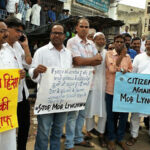
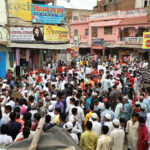
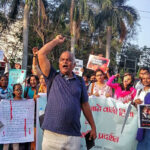
Just before these incidents, 16-year-old Junaid was stabbed to death in a Ballabhgarh-bound train’s compartment. And for many others, including the Jamshedpur lynching of Gauta and Ganesh, Kashmir’s Ayyub’s incidents brought people on the roads of Ranchi and Giridih yesterday and today, respectively. At both places, Sajha Manch played an important role and brought several other organizations under one umbrella, to protest.
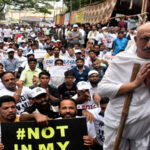
However, the way of protesting was different in both the cities. At the state capital, they organized the Not In My Name campaign, while in Giridih, they formed a human chain. Ranchi’s protest had one of the protestors dressed as the father of the nation, Mahatma Gandhi, who with his folded hands was requesting people to maintain peace.
Protest at Giridih was attended by former MLA Vinod Singh, Rajesh Yadav and Rajesh Sinha whose party, CPI-ML had organised a protest march across the state on July 3, for the same.
Along with the two cities of Jharkhand, Madhya Pradesh’s state capital, Bhopal too had citizen protest against mob lynching on Friday. Here, girls had participated in large numbers. All pictures have been arranged.