


Giridih/Kolkata: Soon, the 17th Lok Sabha will complete its tenure and the Election Commission of India will announce poll dates to elect new Members of Parliament for the next term. Giridih district comprises two parliamentary constituencies, Giridih and Koderma, both belonging to the ruling National Democratic Alliance at the center. But yet again Giridih neither gets connected to—Kolkata nor Patna.
Around 25 lakh people of Giridih are only dependent on buses, and private vehicles to reach the nearest metro city and capital of Bihar, or to take trains from other stations like Dhanbad, Madhupur or Parasnath travelling more than 50 kilometres.
Giridih has four stations- Giridih, New Giridih, Parasnath and Hazaribagh Road. Among them, Giridih Station has been there since 1871, but it never got developed to see a super-fast train.
Ironically, residents of Giridih who have no trains to reach Kolkata and Patna from their city, take it from the nearest stations—Dhanbad, Madhupur, and Parasnath— but the three stations also did not get stoppages of Vande Bharat trains, which were inaugurated in large numbers in recent times.
On March 12 as well, Prime Minister Narendra Modi launched 10 new Vande Bharat trains but none will stop at stations close to Giridih.
People made a double-engine govt but Giridih did not get an engine to connect cities
After 2014, when the Bharatiya Janata Party-led NDA government came to power, the BJP urged people to vote for them in state assemblies to establish a Double Engine Ki Sarkar—a government of the same party at both the state and center. If we use ‘engine’ as a metaphor, even having Double Engine Sarkar between 2014-2019, Giridih did not get an engine, which could connect its people to India’s first capital and Bihar’s capital.
After 2019, during the 17th Lok Sabha, a new term called Vishwaguru was coined for India, claiming Indians are getting prosperous and competing with developed nations.
Giridih remain a BJP stronghold but is deprived of a railway facility
But during this period too, the two MPs- Chandra Prakash Choudhary and Annpurna Devi, from AJSU and BJP respectively could not help connect the district with Kolkata and Patna. For the last three decades, most of the time BJP has its MP from the two coal and mica minerals rich areas. But even after every political situation going in its favour Giridih never got prominence on Indian railway’s map.
The only remaining intercity train between New Gridih and Ranchi began its operation in 2023. On March 12, the same train was extended to Asansol.
The Chamber of Commerce, which worked in this regard and met Railway Minister of India Ashwini Vaishnav expressed satisfaction in getting intercity between Giridih-Ranchi.
“At least this much has happened. We got an intercity train and it got extended till Asansol. We will continue our effort for trains between Kolkata and Patna,” Pradeep Agrawal, regional vice-president, FJCCI and member of ZRUCC (Eastern Railway) told eNewsroom.
However, people who are not satisfied and rather frustrated with politicians, who get their votes. “Now going to Kolkata from Giridih is like going to Australia,” reacted a staff of a Chartered Accountant firm, which has offices in both Giridih and Kolkata.
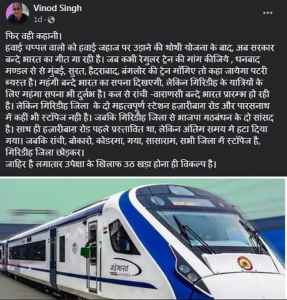
Some opposition leaders also highlighted the issue. Bagoder MLA Vinod Singh posted on Facebook that while there is so much hype about the Vande Bharat trains, still there is no stoppage of any Vande Bharat in Giridih district.