



[dropcap]H[/dropcap]aving visited Edinburgh multiple times, it’s undeniable that this city holds a significant place on the global cultural map. The vibrant festivals celebrating diverse art forms, the ever-changing weather, the warm and friendly locals, and the quintessentially Scottish atmosphere make Edinburgh feel like a world apart. This city, steeped in history, has always had a knack for surprises, especially regarding its connections with India, particularly my work base city, Kolkata—a fact that continuously enriches my understanding of global cultural interweaving.
In this culturally rich city, the first Indian Student Association in the UK was established. This was a surprising revelation, considering that many renowned cultural cities worldwide often hold hidden gems within their archives. The more I travel globally, the more my knowledge of #BaharBharat amazes me about Bharat. For instance, during a trip to Rio de Janeiro, I stumbled upon unexpected Bengali connections, which I later detailed in my articles. These historical threads, seemingly minor, weave a complex tapestry of cross-cultural exchanges that define our global heritage.
The Edinburgh Indian Association (EIA), founded in 1883, is a testament to these intricate connections. Initially established as a society for Indian students studying in Edinburgh, the association quickly became a vital platform for social events, debates, and cultural exchanges between Indians and Scots. It remained a student association until the 1950s, then it was taken over by members of the Indian diaspora in the city.
One pivotal moment in the EIA’s history came in 1911 when the association fought for and won its independence from university authorities. This legal victory marked a significant step towards self-determination and autonomy for Indian students in the UK. The EIA lost this court case, but perhaps despite this loss—or because of it—the students were able to run the affairs of the EIA without any serious inputs from the Trustees of the EIA. 11 George Square was owned by the University but there is no evidence that it tried to dictate what the students did or said, so to that extent, they had self-determination and autonomy.
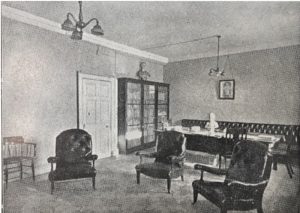
From 1911 to the 1950s, the EIA rented rooms at 11 George Square which became a vibrant hub featuring a debating hall, a dining hall serving Indian cuisine, a library, and recreational facilities like a billiard room and a ping pong table. When I visited this time, the square was bustling with a festival, and it took a bit of time to locate the building.
I was informed by my friend, Professor Roger Jeffrey, Honorary Professorial Fellow at the School of Social and Political Science, University of Edinburgh, who was in India earlier this year with whom we had a productive meeting during his visit, exploring the potential for future collaborations that the EIA was not just a social club; it was a radicalising force that nurtured future leaders. Professor Roger still conducts tours showcasing this building and discussing its historical and academic significance.
Its members went on to play crucial roles in movements such as the British Guiana East Indian Association, the Non-European Unity Movement in South Africa, and the Indian National Congress. This highlights the profound impact that Edinburgh had on shaping leaders who would go on to influence global politics and social movements.
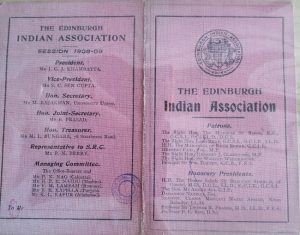
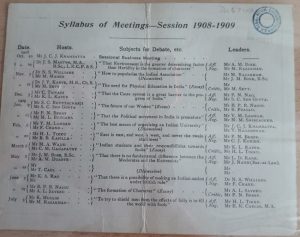
Edinburgh alum Kesaveloo Goonam Naidoo’s recollections of the EIA provide a window into its vibrant intellectual life. The association hosted illustrious visitors like Nobel Laureate Sir CV Raman and the controversial Right Srinivasa Sastri, whose visit sparked intense debates among Indian students. It also hosted Sir P C Ray, also an alum of the university, possibly a founder member (though we have no evidence of this: he came to Edinburgh in 1882) when he returned on a visit in 1920. These interactions not only enriched the cultural and intellectual milieu of Edinburgh but also mirrored the broader struggle for India’s independence.
As the Home Rule movement gained momentum in India, the EIA became increasingly active in political discussions, drawing the attention of Scotland Yard. This surveillance underscores the significant role that diaspora communities played in anti-colonial movements, acting as crucial nodes in the global network of resistance against British imperialism.
Reflecting on the legacy of Edinburgh Indian Association from a 21st-century perspective, it becomes evident that Edinburgh has been more than just a picturesque city with a rich cultural heritage. It has been a crucible of ideas, debates, and movements that have shaped the modern world. The historical ties between Edinburgh and India, exemplified by the EIA, remind us of the importance of cross-cultural connections in fostering intellectual growth and social change.

