



Kolkata: The city, witnessed on Friday, what it is known as—standing for each other or more precisely raising a concerted voice against the hijab ban in Karnataka.
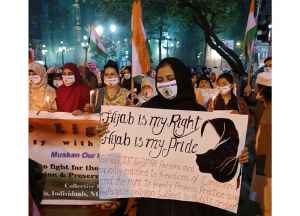
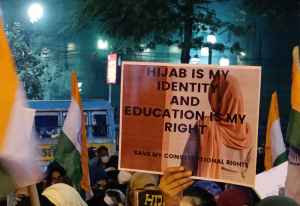
Hundreds of hijabi and non-hijabi women were seen holding candles and the tri colour assembled near the Statesman House. The huge turnout comprising Muslim and women of other faith had gathered to register their protest against the incidents that took place in Karnataka, where girls wearing hijab are not being allowed to attend classes.
It includes, doctors, teachers, students, homemakers, activists, mothers with kids who all participated in the two-hour-long protest at central Kolkata.
They were echoing in one voice unanimously that they have the spirit of Muskan Khan, who stands tall against saffron-clad boys’ to remove her hijab at her college in Karnataka
One of the hijab-clad speakers, Zainab asked the participants, “Do you wear hijab by choice or being forced for it?” A unanimous voice answered, “By choice.” She further said, “Hijab issue which has been raised, to amend the constitution.”
Another speaker who was wearing hijab, Noor Mehvish said, “Banning hijab is the hate project, and this hate project had started in India since Gujarat riots 2002.”
She also reminded of the Sulli and Bulli Deals, through which prominent female Muslim voices were auctioned online. She stressed upon how the Muslim identity of women was being targeted each and every time.
“We want education, and we will get it if we have to fight for it. The fight will be a constitutional one,” pointed out Nousheen Baba Khan, a social activist.
“You fear when somebody questions you, and if women question, you fear more,” she added.
Tuhina Ghosh Sengupta, who also led the protest, spoke and claimed, “We may be divided by religion, but we all are women and we are women power. What can today’s woman not do? They fly aeroplanes too.” Lastly she warned, “We want to tell everyone, do not try to dictate us. It will not be good for you.”
There were other non-Muslim participants too like Ramanpreet Sodhi and Meghamala Mukherjee who not only participated, held placards but also wore the hijab in solidarity with their hijabi friends.
“Seeing the crowd, I was in tearing eyes, as there was a large number of female faces who were hitting the street, for the first time, they were not even come out to protest during CAA-NRC,” Wali Rahmani, a youth leader present during the meet, told eNewsroom.
“They are here today because now they feel the decision will hit the education of girls, and they are worried about their future,” he added.
Significantly, the protest was scheduled to march from The Statesman House to Gandhi Statue (Mayo Road), but it was not allowed to turn into a rally citing Covid-19 restrictions.
We had written to the Kolkata police for permission, but they had not replied. Now they have stopped us from conducting the protest march and have asked to conclude the event at the origin site only,” another organiser Rafay Siddiqui told eNewsroom.
In last few days, students of Jadavpur and Aliah University had also hold protests against hijab ban. However, Friday’s candle light protest was bigger in participation.
Wali, who was also among the organisers, claimed that soon a bigger protest would be organised in the city on anti-hijab row.

