



Ranchi: Hemant Soren, the present Chief Minister-designate and executive president of Jharkhand Mukti Morcha, describes himself as a disciple of Birsa Munda and Baba Saheb, a proud father, and a concerned citizen on Twitter.
And perhaps it was these traits that helped Soren Junior pitch himself as the key challenger to Chief Minister Raghubar Das during the recently concluded Jharkhand Assembly election.
Soren, while campaigning during the Assembly polls, often shared from the podium how his three trips across the state helped him understand the suffering of the common man under the Raghubar Das-led Bharatiya Janata Party (BJP) regime.
The CM-designate does have a point, as it was one of these yatras – the Sangharsh Yatra – that established Hemant as the pan-Jharkhand face for the CM’s post. The yatras, through their night chaupals and public meetings, played a critical role in projecting him as the pan-Jharkhand leader who would stand not just for tribals but for all people, making the election a battle between arrogance and humility, a snobbish attitude and friendliness, and above all, presenting a pro-people CM figure in stark contrast to the anti-people stance of the BJP government.
Perhaps the sober, humble, and much more approachable image of the 44-year-old leader made him emerge not just as the challenger and star campaigner for both the party and the gathbandhan, but also as a successful candidate. Hemant Soren contested from two seats and won both.
It was around the Sangharsh Yatra in January this year that the then Leader of Opposition agreed to a one-on-one interview with eNewsroom. Despite being exhausted after back-to-back meetings and walks, Hemant gave an interview at length, which was a sharp contrast to the attitude of former CM Das. When questioned about the amendments made to the Chota Nagpur Tenancy (CNT) and Santhan Pargana Tenancy (SPT) Act by me during a press briefing, Das had retorted, “Do you people have no other work to do?” It was only after being reminded that it was the job of a journalist to question that he replied.
After the Sangharsh Yatra came the Badlav Yatra, where Hemant, while addressing public meetings, would provide solutions and alternatives to the issues faced by the masses. During the assembly polls, he did 147 rallies in just over a month. To save time, he chose locations close to helipads for addressing people.
During his campaign in Giridih, he addressed a rally alone, with the party candidate, Sudivya Kumar Sonu, not able to remain present with him. Sonu, around that time, was addressing another rally alongside JMM president Shibu Soren.
Those who know Hemant would agree that his political journey has not been easy. Hemant, an engineering student from Birla Institute of Technology (BIT) Mesra, had no intention of being the political successor of Shibu Soren, the man responsible for carving out Jharkhand from Bihar. The sudden death of Durga Soren made him step in.
However, those familiar with the Sorens will agree that Hemant inherited his father’s fighting spirit and indomitable character. The political journey for the family began when Shibu’s father, Sobaran Soren, was killed by moneylenders for initiating a movement against moneylenders and landlords who exploited tribal farmers. It has taken at least five decades for the family to reach their current position.
The fact that Hemant tweeted the previous night, “On my way back to Ranchi from Delhi late last night, I remembered meeting Santoshi’s mother, whose listless eyes spoke of how her daughter died saying ‘bhat bhat.’ I remembered the countless youths who asked me why, despite studying hard, they couldn’t get jobs,” keeps the hopes alive for many who voted him to power.
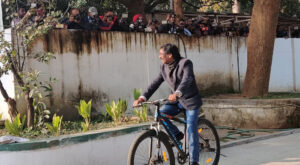
Even today, the Sorens lead a simple lifestyle. A photograph of Hemant, along with his wife Kalpana in their earthy kitchen, went viral and resonated with many. The CM-designate loves cycling and was a sportsman too, until he took the political plunge. His political career has been free of major controversies, during which he has served both as Chief Minister and as a Rajya Sabha member.
The rise of Soren Jr. depicts his evolution as a seasoned politician who has managed to keep the alliance together and secure a higher number of seats than the required 41 in the Jharkhand Assembly. He has strategically kept Jharkhand Vikash Morcha (JVM) in his fold. When he met JVM’s chief, Babulal Marandi, he touched his feet and took his blessings, following which Marandi even announced unconditional support to the Mahagatbandhan alliance.
The fact that Hemant tweeted the previous night, “On my way back to Ranchi from Delhi late last night, I remembered meeting Santoshi’s mother, whose listless eyes spoke of how her daughter died saying ‘bhat bhat.’ I remembered the countless youths who asked me why, despite studying hard, they couldn’t get jobs,” keeps the hopes alive for many who voted him to power.

