

Why should boys have all the fun! Girl’s mantra in RU election

Date:

Share post:

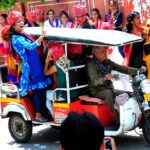
Jaipur: The Rajasthan University Student Union Polls or RU Election had a completely different approach in 2017. The recently concluded election campaign, will be remembered for the bold and bindass acts of girls. They were so much in command of their votes that male candidates had to go down on knees to seek their votes. The young ladies, needless to say, enjoyed every bit of the campaign as they danced, sang and even perched on to the car roofs, hopped onto the autos and even Tuk-Tuk to campaign for their candidates. However, one thing which did not change was the littering. Post campaign, it seemed like the entire city and specially around colleges was covered with pamphlets. Have a glimpse of what the University witnessed today. The riot of colours and charisma captured by our photojournalist Chandra Mohan Aloria will leave you amazed.


Related articles

History Is Made in Homes, Not Just Parliament: The Untold 1947 Partition Story of Maulana Azad’s Bengal In-Laws

Maulana Abul Kalam Azad is remembered across India as a freedom fighter, scholar, journalist and independent India's first...

Don’t Tell Bengal What to Read, Eat, or Think

From the November 17 College Street bookstall attack to the policing of food and public spaces in Kolkata, political intolerance is quietly eroding Bengal’s unwritten social compact. Defending the freedom to read, eat, and think cannot remain a Left-versus-Right turf war—it requires refusing to normalise intimidation

A Love That Outlived Loss: Unlearning a Generational Misunderstanding Through Sonia Gandhi’s Belonging, and Beyond

Stepping away from political noise and early reviews, a reader approaches Sonia Gandhi’s memoir Belonging: A Journey of Love through an anti-establishment lens—uncovering a deeply human story of grief, life inside Indira Gandhi’s household, and raising Rahul and Priyanka without cynicism.

Who Gets to Name Terrorism? Power, Knowledge and the Politics of Violence

When national security becomes the primary lens through which political dissent is judged, what happens to due process and democratic citizenship? Reviewing Irfan Ahmad’s Terrorism in Question: Decolonizing Anthropology and the Study of Islam, this essay examines how states acquire the power to classify political action—tracing the thread from post-9/11 counterterrorism and the SIMI ban to the 2013 Muzaffarnagar violence and the ongoing bail battles of Umar Khalid and Sharjeel Imam