Kolkata: In Polling Booth No. 118 of the Shyampur Assembly Constituency in Howrah district, the number of Hindu and Muslim voters is almost equal. Yet, when the Election Commission of India released the final electoral roll for West Bengal, only Muslim voters in the booth were marked “Under Adjudication.”
The anomaly came to light after Partha Das, a psephologist, posted about it on X. Soon after, several netizens responded, claiming similar patterns in their respective wards — alleging that Muslim voters alone were flagged despite comparable demographic compositions.
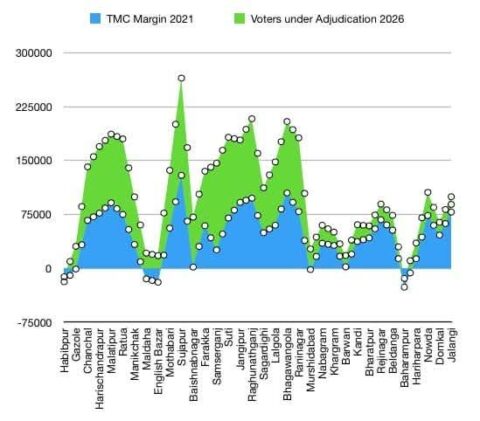
The issue has snowballed into a larger controversy following the publication of the final list on February 28, which placed nearly 60 lakh voters under adjudication across the state. A substantial number of them are concentrated in Muslim-majority districts such as Murshidabad and Malda. Together, the two districts account for nearly 20 lakh voters under adjudication.
Passports Ignored, Muslim Voters Flagged: Is SIR Targeting Selectively?
The experience of Mohammed Reyaz, an assistant professor, has further fuelled concerns. Ahmed said his entire family — except his mother — possesses valid Indian passports. During the verification hearing, all relevant documents were submitted.
“Except for my mother, all of us have been put under adjudication,” he wrote on Facebook.
Following his post, several acquaintances shared similar experiences. Many said they had submitted passports and other official documents during the hearing process, yet their names appeared in the adjudication list.
For many, the passport — considered one of the strongest proofs of citizenship — being disregarded raises troubling questions about the criteria being applied in the Special Intensive Revision (SIR) process.
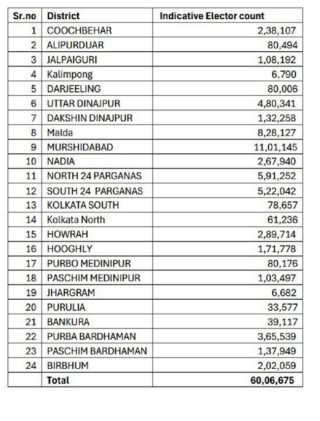
60 Lakh Under Adjudication: Why Minority Districts Dominate the List
The publication of the final list has triggered fresh protests across Bengal. Activists and civil society groups argue that more than half a crore voters placed under adjudication risk being disenfranchised ahead of the upcoming Assembly elections.
Demonstrations have resumed in parts of Kolkata and several districts, with protestors alleging selective targeting of minorities and marginalised communities.
Jawhar Sircar, former state Chief Election Commissioner and ex-Rajya Sabha MP, told eNewsroom, “The Chief Election Commissioner has not hidden his motive to harass Muslims and Dalits by deleting as many names as possible, as part of the Hindu Right’s agenda. His legally dubious SIR operation was first carried out in Bihar and is now specifically targeting West Bengal.”
Sircar further alleged, “The BJP has submitted Form 7 applications to delete Muslim voters in targeted localities and districts. However, no such action is reported from pockets where Hindu immigrants without valid citizenship papers are present in large numbers.”
From Booth 118 to Statewide Outrage: Allegations of Electoral Bias Grow
Mahasweta Samajhdar, journalist and social activist who has opposed the SIR process from the beginning, described the development as deeply alarming.
“The entire process seems to be a conspiracy. BJP and the Election Commission have colluded to exclude non-BJP voters so that the BJP may win the Bengal election. The judiciary also appears compromised.”
Mahasweta and others will have a protest march till the state Election Commission on March 5, asserting: “We want every citizen to have voting rights.”
Meanwhile, Chief Minister Mamata Banerjee announces a March 6 dharna in Kolkata as allegations of “selective targeting” and “disenfranchisement” intensify ahead of the 2026 Assembly polls.
International Spotlight on Bengal: IAMC Condemns Voter Roll Purge
The controversy has drawn international attention too. The Indian American Muslim Council (IAMC), a US-based advocacy organisation, issued a strong condemnation of the SIR exercise in West Bengal.
In a statement, IAMC said the process has resulted in the deletion or suspension of voting rights of over 12 million citizens, with Muslim and marginalised communities bearing a “disproportionate and deeply alarming share” of the burden.
IAMC President Mohammed Jawad stated, “We are gravely concerned that the SIR has functioned as a targeted operation against Muslim voters and marginalised communities. What is unfolding in West Bengal is a constitutional crisis. When over 12 million voters, concentrated mostly in Muslim-majority districts, are stripped of their democratic rights without explanation or recourse, we are witnessing the systematic dismantling of minority citizenship in India.”