



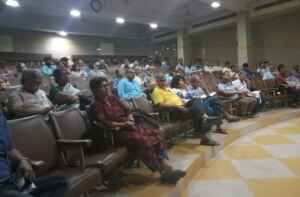
Kolkata: An anti-ragging convention held in Jadavpur University after a series of ragging related deaths that have occurred in and outside Bengal in recent times, on September 11.
The convention which was organised by an Anti Ragging Peoples’ Convention Preparatory Committee demanded justice against the institutional murder of ragging-affected Swapnadeep Kundu of Jadavpur University and Faizan Ahmed of IIT-Kharagpur, and that exemplary punishment be given to the killer(s). Also making public the investigating reports of the killing of the said students.
The main call of this convention was — to build up peoples’ awareness and unite to permanently eradicate the practice from educational institutions.
There was a long panel of speakers at the convention.
Prof Anupam Basu, ex-director of NIT Durgapur and ex-prof IIT-Kharagpur said that the ongoing ragging culture is the reflection of our degradation of social values. He supported the very first point of the said draft proposal. He also presided over the convention.
“Ragging has been continuing as a semi-feudal way since the British period. And only an organised student movement can prevent it. The university’s authority has been remaining reluctant to curb it. It is very necessary for the authority to build up live communication with the students and make a continuous process of sensitisation among them. The students of all streams should also come forward unitedly to stop this practice,” Prof Kunal Chattopadhyay of Jadavpur University.
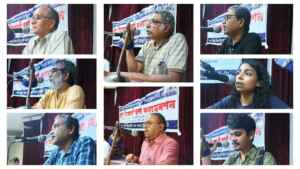
Ranjit Sur, a human rights activist stressed to make efforts to rectify the distorted mindset of the raggers. A practice of healthy socio-political culture by the students’ union is very important. The political parties are only making turmoil on this issue, he added.
Nilanjan Dutta, a human rights activist also emphasized for sensitisation of the students and sought for proper role of institutional authorities in this regard.
As per Dr Sayantan Banerjee, AIIMS, Kalyani, ragging can be curbed and stopped by creatively involving the senior students in anti-bullying programs. The universities and institutions should come together to address this issue. He also pointed out that Me Too like movement is needed against ragging.
Dr Arnab Sengupta (HOD, Dept of Physiology, SSKM Medical College and Hospital) said that the ragging practice can be curbed if the concerned authority remains properly committed. The occurrence of ragging means the authority is reluctant, he said. In this JU case (Swapandip murder) — the authority, the students’ and the teachers’ organisations, none have followed their duties and responsibilities. He said.
Prof. Sanjib Acharjee of Jadavpur University opined with the view of Dr Arnab Sengupta and stated that the concerned authorities should make them eligible to eradicate this practice in their places and also stressed saving the JU’s academic excellence and autonomy from the intending other big administrative and political entities.
Prof. Manash Ghosh also from Jadavpur University viewed this ragging practice as an inhuman and hegemonic culture which should be addressed by a sensitisation process but not by a counter-hegemonic method like the installation of ex-military personnel on the campuses.
Veteran journalist and writer Pranay Sharma said it’s the problem of students within their community. No external agency is suitable to solve this problem, he added.
Shahnawaz Akhtar, Editor of eNewsroom in his speech highlighted the case of Faizan Ahmed and how a heinous crime was committed against him as he opposed ragging. Akhtar, who was closely monitoring the case, pointed out several aspects of the case before the audience.
Later Faizan’s mother Rehana Ahmed spoke over the phone and sought the support of the people in her fight for justice. She claimed that the way IIT authorities are opposing my son’s case and not letting it conclude, it seems they are saving someone.
Barsha Baral, a student of JU and member of AISA said ragging is embedded in the social construction and a practice of applying power. JU is not only the place of ragging, rather many others from all over India are also carrying it. The JU authority has not taken proper steps to address this issue.
Srijan Sinha, a JU-student an RSF-activist said that all the anti-ragging setups are required to make them more functional.
The convention concluded with the formation of a six-member Convening Body (extendable ) of the Anti-Ragging Peoples’ Initiative forum.
It was jointly organized by nine social organisations — the Amar Desh Mera Watan My Country forum, Pratibadi Sahitya O Sanskriti Mancha, Bandi Mukti Committee, APDR, No NRC Movement, Paschim Banga Gana Sanskriti Parishad, Bharat Jodo Abhijan, Nehai and Shramik Karmachari Sangrami Jukta Mancha.
A central draft proposal of this convention was also prepared.
To build up an anti-ragging people’s initiative which will play a meaningful or supportive role in eradicating the practice of ragging by coordinating with all stakeholders including students, teachers, researchers, non-teaching staff, and the concerned authorities in this regard.

