



Baduria/Kolkata: As news of a person succumbing to his injuries is coming in, because of Baduria violence, we all sitting miles away, are believing that there exist a high communal tension out there. But then, there seem to be a couple of silver linings too. The people of Baduria and nearby areas are showing solidarity and are attempting to restore communal harmony in the affected areas.
Take this example, when the family of the teenager Souvik Sarkar, who had posted the morphed image on Facebook, triggering a communal unrest, was saved from wrath of the mob on the rampage, by his Muslim neighbour, Amirul Haque. Amirul not only insured safety of family but Souvik also.
An officer of Bashirhat fire service station who mentioned Haque’s name, on condition of anonymity further informed that he comes from that area only and that he understands the people of Baduria very well. “During the agitation, local people of both the communities who have lived together for long came to rescue each other,” he told eNewsroom.
The officer added, “The communal tension was caused by outsiders. Local people were not involved in it. These people most of whom belong to lower middle class are not interested in violence.”
The same message was echoed by Seba Das and Fahmida Begum, both residents of Baduria. “We have more important works to do in life. We are neither interested nor do we believe in communal violence,” said Das, a mother of a three-year-old child.
“Such incidents never happened here. We have lived peacefully side by side, have celebrated EID and Durga Puja together. Why will we listen to outsiders who have vested interests?” questioned Rahim Seikh, a rickshaw puller in Baduria.
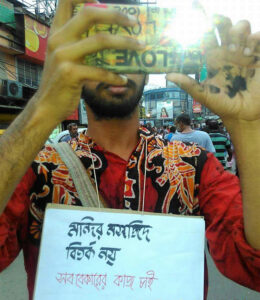
“We had planned to organise a road show to condemn the incident and to show solidarity in hour of tension. We shared our plan on social media asking people who believe in peace to participate in this communal harmony march. We were overwhelmed with the response,” Rabin Das, one of the conveners of the peace march and a resident of Barasat told eNewsroom.
Another resident of Barasat, Masud Khan pointed out that efforts are being made by certain people to malign the identity of Bengal. “They want to make us fragile by dividing us. We are not going to fall in to their trap. Certain people are their best to polarise the Bengali society, just like the British did so many years back. Money is being spent by these miscreants to create communal unrest. We need to be tolerant and not get instigated by Facebook and WhatsApp messages,” said Khan who is an owner of a grocery shop.
In another incident at Berachapa, Deganga area, youths from the local Muslim community compelled certain people, who were identified as outsiders trying to create communal tension, to leave the area to restore peace.
Police said that, at least forty people have been arrested so far for the violence and the number can increase in days to come.

