



Kolkata: On a busy Friday morning, when the men in every Muslim locality prefer to get ready for the Jumma prayer, things were a little different in ‘Calcutta 23′. Things were happening a faster rate than usual, and why not, after all, they had a fixed date with visitors who had travelled from different part of the city to spend a day with them, to meet them, to know them and above all build bridges that perhaps can last for a lifetime.
Pincode 700023 area comprising Khidirpur, Mominpur and Ekbalpur, commonly perceived as the city’s biggest Muslim ghetto, is not one, claims the residents of the area, who predominantly are Hindi-speaking Muslims. In an attempt to do away with such myths, prejudices and stereotypes, a unique two-day cultural festival – Calcutta 23 – Celebrating Diversity was organised at Government Girls’ General Degree College (GGGDC), Ekbalpur, in association with Know Your Neighbour initiative of association SNAP, on November 29 and 30.
Stressing upon the need of such events, author Joya Mitra, said, “At a time when diversity is being used as a tool by politicians to create divisions within the society, such initiatives are a must. This is the perfect way to break the misconceptions that we harbour in mind, which leads to the creation of the ‘other’ who cant be your friend or be trusted.”
When asked about the reason for the two-day cultural event being called Calcutta 23, Dr Syeda Shariqatul Moula Alquadri, officer-in-charge of GGGDC, said, “Khidirpur, has a rich cultural and religious diversity. To reach this college, you first have to cross a temple, then a church, then an Imam Bara. Doesn’t this indicate the cosmopolitan nature of this area? But how many will call it so? Most know it as one of the biggest Muslim ghettoes in Kolkata. We have organised this cultural festival, with the sole intention of breaking myths and building bridges.”
Stressing upon the need of such events, author Joya Mitra, said, “At a time when diversity is being used as a tool by politicians to create divisions within the society, such initiatives are a must. This is the perfect way to break the misconceptions that we harbour in mind, which leads to the creation of the ‘other’ who cant be your friend or be trusted.”
Mitra maintained that discussion like the one she had on Kabir, would ease the growing communal tension between different communities. Stressing upon the need of such events being hosted in colleges more frequently, singer Moushumi Bhowmik, said, “There is a tremendous need for the youth hailing from different communities to know each other, to be friends with each other. Such events will iron out prejudices.”
If Sufiya’s work spoke of peace, then mixed media artist, Soumyodeep Roy’s art installation – Fish that travels through time, philosophically tried bringing the two community (Hindu-Muslim) together by using fish. “Whether it is Jhulelal or Al Khidr (From whom many believe the name of Khidderpore has been derived from) both seem to float on a fish. The fish also takes a socio-political character across regions and time,” said Roy.
The event was flagged off early in the morning with a neighbourhood walk, saw the participants from at least 60 colleges meet the community people, visit the churches, imam baras and temples of Calcutta 23 area. Following which the event was formally inaugurated by the Mayor of Kolkata, Firhad Hakim.
The cultural programme, which was hosted within the college premise, had several food kiosks and art installations with unique messages. Peace poetry flag installation put up by poet-artist Sufia Khatoon, had a unique concept – unite diverse voices through poetry. “We need to learn to live peacefully with each other, without prejudice or stereotype. This precisely made me become part of Calcutta 23 event,” said Sufia.
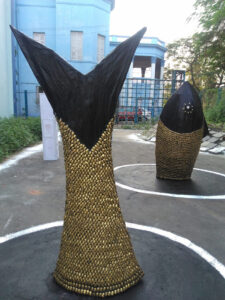
If Sufiya’s work spoke of peace, then mixed media artist, Soumyodeep Roy’s art installation – Fish that travels through time, philosophically tried bringing the two community (Hindu-Muslim) together by using fish. “Whether it is Jhulelal or Al Khidr (From whom many believe the name of Khidderpore has been derived from) both seem to float on a fish. The fish also takes a socio-political character across regions and time,” said Roy.
Another unique aspect of this programme was the Dastangoi performance by Delhi-based professor Nadeem Shah Suhrawardy. He gave two power-packed performances in Urdu. However, the key highlight of his performance was the Hindustani adaptation of Sarat Chandra Chattopadhyay’s Mahesh. Interestingly, Calcutta Karavan is all set to give a new twist to this traditional way of storytelling, with Suparna Deb narrating a love story in Bengali. Dastangoi is traditionally performed in Hindustani or Urdu language, globally.

