



Kolkata: The lynching of 24-year-old Tabrez Ansari in Jharkhand has sparked nation wide protests across India including Jharkhand, West Bengal, and Delhi. Three more incidents of hate crimes have been reported from major cities of India—Kolkata, Mumbai and Delhi.
Today, a Muslim cab driver in national capital was forced to chant Jai Sri Ram. Yesterday in Mumbai a similar incident took place in Mumbai, where Faisal Usman an Uber driver was trashed and forced to chant Jai Sri Ram.
Incidentally, a day after Tabrez’s death from merciless beating, Kolkata too witnessed a hate crime immediately after the Jharkhand lynching case, where Sharukh Haldar, a Madarsa teacher along with two other Muslim men were assaulted and beaten on a local train in the heart of the city.
In all the three cases, forcing victims to chant religious slogan—Jai Sri Ram, was common.
The incidents had called deep criticism from all quarters. Understanding the need for creating pressure on both the state and central government a series of protests, public meetings were organised in many cities.
United Against Hate, a movement against hate crime, spearheaded protest rallies in more than 70 cities, some other big and small organizations also came together in other districts to protest against Tabrez’s lynching and other hate crimes.
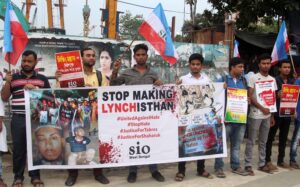
In Kolkata, since June 26, a number of NGOs and human rights organisations assembled at Bipin Behari Ganguly Street to have a public meeting to raise public concern on the same. A street theatre had also been staged.
Speaking to eNewsroom, Asit Roy, a social activist associated with Medha Patkar’s National Alliance for People’s Movement (NAPM) said, “This public meeting was organised on June 26, in the memory of the dark emergency days of 1975. Needless to say, at present, we have an undeclared emergency in our country since 2014. Mob lynching has become a norm today. The number of such cases has only increased with time. So, through this public meeting, we condemn not just the mob lynching of Tabrez Ansari in Jharkhand but also the assault on the Madarsa teacher in Kolkata by the saffron brigade.”
Aftab Ahmed, Assistant Secretary of APDR, said, “It’s not just in Bengal or Jharkhand that Muslims are being attacked. This trend is common across all Indian states. Mob lynching of Muslims only reflects the increasing fascism in the country, which needs to be countered vehemently.”
Contrary to the general perception that Bengal is a safe haven for Muslims, registered at least five mob lynching cases.
Muslim organisations like Jamiat-e-Islami-Hind, has threatened to take on to the streets on a regular basis if enough action is not taken to reign control on the cow vigilantes.
Perturbed by increasing number of hate crimes against Muslims Bhasha Chatana Samity organised a protest at Sealdah Station on June 27, while the Student Islamic Organisation of India (SIO) organised a human chain at Kolkata’s iconic Dharmatalla crossing to put forward their demand for justice in both Tabrez Ansari and Sharukh Haldar’s case.
President of SIO West Bengal, Osman Gani condemning these incidents said, “Recently mob lynching in the name of ‘Jai Shree Ram’ has become common. The Government should make a powerful law to stop such incidents.’’
Meanwhile, CM Mamata Banerjee who was maintaining an eerie silence over the Kolkata train assault case met the victims and announced for compensation worth INR 50000 each. However, activists believe that this is not enough as the culprits are yet to be arrested.
Delhi Waqf board has also come forward to extend a helping hand to Ansari’s widow Sahista Parveen, by offering a job along with compensation worth INR 5,00,000.
On Friday cities like Deoband, Bhopal, Giridih, Bhojpur and Gadhani witnessed similar protest meets.
Voices against mob lynching and hate crimes being committed in India is now being heard internationally. Tomorrow, on June 29, people will hit the streets of Boston, Unites States, to condemn the increasing trend of religious racism in India.

