



Kolkata: On the morning of 3 August 2026, Rumpa Mondal, an ASHA worker from Gangajalghati in Bankura district, died of cardiac arrest. She had spent the previous night working on E-KYC formalities for the Ayushman Bharat scheme. By the time her husband and nephew helped her down the stairs the next morning, her legs had become numb, and she could no longer stand. Doctors at the hospital detected a faint pulse, then declared her dead ten minutes later.
Her death immediately became linked to a viral video that had circulated the day before. On 2 August, Saltora constituency BJP MLA Chandana Bauri arrived at a makeshift camp in Gangajalghati, where ASHA workers were processing forms. In the footage, she repeatedly accused them of having obtained their jobs through theft. The language was public, sustained and humiliating.
Rumpa Mondal’s Last Night: E-KYC Work Until 10.30 PM
Subhas Mondal, Rumpa’s husband, recounted the final hours.
“She had been working as an ASHA worker since 2014. Currently, our household consists of three members—myself, my daughter, and my mother. My wife had no prior medical conditions. The other night on August 2, she was working on E-KYC tasks alongside my nephew. They worked until around 10:30 PM, after which we wrapped up, returned home, and had dinner. We went to bed around 12 at night.”
The next morning, she woke earlier than he did, around 6 am, complaining of a mild stomachache. He suggested it might be gas or acidity caused by late nights and irregular meals.
The pain did not subside. While sitting in an auto-rickshaw on the way to seek help, she soiled her clothes with faeces, felt nauseous, and grew so weak that she needed support to reach the bathroom.
“After cleaning up and coming out, she told me she couldn’t make sense of what was happening and couldn’t stand; her limbs, specifically from the waist down to her legs, felt numb,” he said.
As he and his nephew supported her down the stairs, she suffered a stroke. A Maruti van took her to hospital. Ten minutes after doctors noted a faint pulse, she was gone.
Subhas has no formal job; he is a farmer and works on a small plot of land. Rumpa was the sole breadwinner, earning between ₹6,000 and ₹7,000 a month, including incentives.
“There was a lot of pressure—meaning, there was anxiety regarding the work—but she was capable of handling it and would complete everything personally; still, the pressure was immense. Every day, it would be nearly 11 at night by the time the work such as filing reports and maintaining records was finished.”
Visits from MLA Chandana Bauri and the local police inspector brought verbal promises of possible employment and support for their daughter, but no written assurance has followed yet.
‘Are We Thieves?’: ASHA Workers React to MLA’s Remark
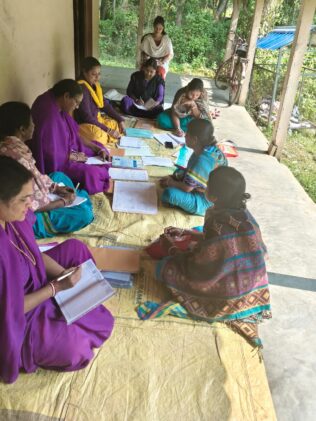
Sumitra, an ASHA worker from Bankura district who was present at the scene, responded to the MLA’s words with fury.
“Are we thieves? Have we got our jobs by theft? We all who are present here joined this work in 2011; from then we have been trained to take care of pregnant women, children’s and babies’ health. We worked giving our sweat and blood during COVID time; back then no one thought us thieves!” she said.
Ismat Ara Khatun, state secretary of the West Bengal ASHA Workers’ Union, placed the confrontation in the context of a larger pattern of administrative pressure and political display.
“In Gangajalghati, the work was being conducted at a makeshift camp set up in a spot with good network connectivity where residents had been asked to gather. A BJP individual acting with a specific agenda pointed out to the MLA that the ASHA workers were supposed to visit homes to perform their duties, yet here they were simply sitting at the camp. Subsequently, MLA Chandana Bauri arrived and questioned them using highly inappropriate language. Her actions were entirely unethical and exceeded the scope of her authority.”
Khatun recalled that Health Minister Dr Sharadwad Mukherjee had once told the union that if anyone ranked above God, it was the ASHA workers.
“Yet, look at what MLA Chandana Bauri said. She called us thieves, claiming we secured our jobs through theft. This represents a stark contrast in character.”
Why ASHA Workers Are Struggling With Ayushman Bharat E-KYC
The E-KYC work is part of the central Ayushman Bharat–PMJAY programme. ASHA workers were assigned the task by the National Health Authority (NHA) because many eligible rural residents lack smartphones.
The process itself is stringent. Workers must receive OTPs twice, capture facial images, navigate roughly 15 sequential questions, and often restart entirely if a blink invalidates an eye scan or the server times out.
“The very nature of the work and process of executing the Ayushman Bharat scheme for making this card involves receiving the OTP on mobile twice, capturing the face and so on. So it’s basically a very time-consuming procedure,” Khatun explained.
Each ASHA covers a population of roughly 1,000 to 1,200 people.
“Sometimes there is no internet, or there are glitches and issues. Even when the Internet is working, the site server remains down. Then even after everything seems fine, it still doesn’t go through. The site keeps circling, gets stuck, and eventually gets rejected with an error message.”
Madhuja Sen Roy, state president of the West Bengal ASHA Workers’ Union, described the same technical barrier.
“The E-KYC task requires a significant level of proficiency in data entry. It is a job that requires the skills of a data entry operator, yet ASHA workers are being forced to do it without proper training; in some places, they received only an hour of training, while in others, they received none at all.”
Completing one KYC under stable conditions takes 30 to 40 minutes.
“With unreliable networks, the process becomes hopeless. Workers sit in people’s homes waiting for OTPs that never arrive, sometimes enduring the irritation of household members,” she added.
Papia Adhikary, an ASHA worker in Paschim Medinipur since April 2010, received around 1,300 Ayushman Bharat forms after a training session that lasted barely 15 or 20 minutes.
“Sorting through the forms we received was like looking for a needle in a haystack. Matching names against Aadhaar cards was an arduous task in itself, but on top of that, we had to take the forms home to fill them out and organise them household by household.”
She has not yet completed a single E-KYC herself.
“I am trying to use my phone, but it keeps getting stuck on a particular page; even after trying 5 or 6 times, it shows an error. The internet connectivity here is so poor.”
How E-KYC Work Is Pushing ASHA Workers Beyond Their Duties
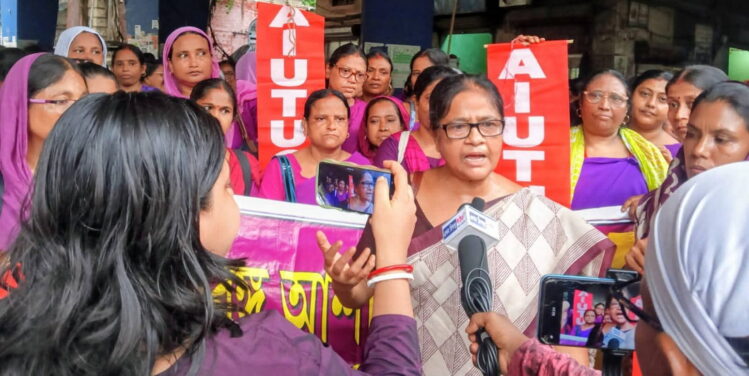
Faced with daily targets of 50 to 60 forms, the administration directed workers to set up camps in places with better connectivity and to enlist tech-savvy family members.
“Since the health department mandated that these tasks had to be performed and had also suggested seeking assistance from family members, specifically those technologically advanced, these tasks were successfully carried out. It was precisely because the entire family pitched in to help,” Khatun said.
In many districts, the core maternal and child health work—check-ups for pregnant women, polio drops, iron supplementation and hospital admissions—has been pushed aside.
“We, across a large part of Murshidabad district, have not done this work. We have stopped the KYC work through deputation,” Madhuja Sen Roy noted.
“If we do this, then the regular work which is supposed to be maternal and child health care falls behind because the entire day is being spent on doing E-KYC.”
Long Hours, Household Duties and No Medical Leave
Archana Khan, 48, works in Kashipur block of Purulia. Her husband has been paralysed since suffering a brain stroke 18 months ago; their son studies in Kolkata. She is the sole earner.
“I have to wake up between 4:30 and 5:00 AM to bathe him. I manage to cook a simple meal—just rice, lentils, and a vegetable dish—before heading out for work by 10:30 AM.”
Fieldwork, cooking, more fieldwork, and then 16 different registers keep her awake until midnight or later.
“I even dream about this work; in fact, I have forgotten what a pleasant dream feels like.”
During menstruation, she walks instead of cycling because of cramps. There is no medical leave.
“We keep medicines with us for things like fever, colds, coughs, or stomach aches; we just take the medicine and head to work.”
Papia Adhikary described similar exhaustion.
“It has cost us our sleep; sometimes we work until 2:00 or 2:30 AM, and there have even been days when we were still at it at 3:45 AM.”
Monsoon rains leave no dry place to sit and fill forms.
“How am I supposed to fill out the form without documents? It’s monsoon season now, and it rains every day.”
ASHA Workers Say Wages Are Low and Payments Often Delayed
ASHA workers receive an honorarium of ₹6,250. After a prolonged struggle, the total was raised to ₹11,250, with a further ₹5,000 increase announced in the 2026–27 state budget by Finance Minister Swapan Dasgupta and scheduled from September. Central incentives remain irregular.
For each completed E-KYC, the stated payment is ₹5 or ₹8, yet three to five attempts are often required.
“If I even work for ₹10, then I expect to receive that exact amount on time,” Khatun said.
“Instead, I am forced to run back and forth from the block office to the municipality and the health department as many as five times a month just to get paid for the work I have already done. The remuneration received relative to the work performed is meagre and is even rarely paid on time.”
Madhuja Sen Roy was blunt about the classification that keeps workers vulnerable.
“They extract labour from us, yet when it comes to claiming our rights, we are dismissed as mere ‘volunteers’—this simply cannot happen and is unacceptable.”
The demand for a minimum wage of ₹24,000 has been consistent for years. Maternity leave of 180 days was won only after a major protest in January 2026.
A proposed ₹5 lakh payment in case of death on duty or retirement still awaits Finance Ministry clearance.
“In general, ASHA workers do not even have the right to be sick; there is no provision for leave in the event of illness. Taking time off is not considered a right; it is something ASHA workers receive only as an act of charity.”
Lina Sarkar of the West Bengal AIUTUC Workers’ Union pointed to the structural contradiction.
“According to government guidelines, the scope of work for ASHA workers is strictly limited to matters concerning mothers, infants, and children. However, it is increasingly observed that these workers who receive only an honorarium are being assigned various other tasks. Why are ASHA workers being tasked with it? When registrations fail or are delayed by higher authorities, it is the ASHA worker who faces public anger,” she said.
45-Day Strike Shows the Cost of Resistance
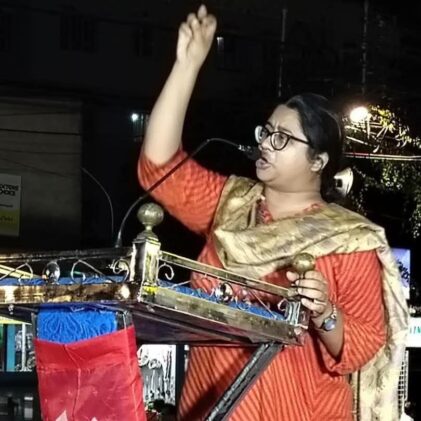
Early in 2026, ASHA workers staged a 45-day work stoppage. They endured salary deductions running into thousands of rupees, administrative threats, and social-media trolling from supporters of both previous and present ruling parties.
“There is a prevailing narrative that this government has increased the amount by ₹5,000; however, if one looks at the reality, the question arises: did the government do this voluntarily, or was it compelled to do so?” Lina Sarkar asked.
Deputations submitted to BMOHs, CMOHs, DMs and BDOs requesting exemption from E-KYC work have largely gone unanswered.
In places where alternative assistance centres were set up, the pressure eased; in most others, it did not. Reporting problems brings not help but threats of being sidelined or removed.
After Rumpa’s Funeral, ASHA Workers Return to the Same Work
Rumpa Mondal’s registers are closed. The forms she was processing remain unfinished.
Across West Bengal, thousands of women continue the same cycle: rising before dawn to care for household members or small children, cycling through villages in all seasons, waiting for servers that refuse to respond, filling the same data twice—once on paper, once online—then returning home to update 16 registers until midnight.
They are the bridge envisaged by the National Rural Health Mission in 2005: local women who would carry maternal and child health to the doorstep.
Two decades later, that bridge is expected to carry digital welfare schemes, survey after survey, and political deadlines, all while remaining legally classified as volunteers whose sickness is not a right and whose death still requires another file to move through the Finance Ministry.
“Had this incident not occurred, the government’s eyes would not have been opened,” Ismat Ara Khatun added.

