



Kolkata: When television journalists marched through Kolkata on Monday condemning attacks on media persons during last week’s student protest, they presented the incident as yet another assault on press freedom.
But for many students and civil society activists who participated in the July 24 demonstration, the controversy surrounding the alleged attacks cannot be understood without examining another question: Why had a section of the mainstream media itself become the target of public anger?
Interviews with activists and students suggest that the hostility directed at what they repeatedly called “Godi Media” was not born overnight. Instead, they argue, it reflected years of frustration over what they describe as selective journalism that focused more on questioning protesters than questioning those in power.
While every activist interviewed by eNewsroom unequivocally condemned physical violence against journalists, they also insisted that many television reporters arrived at the protest carrying a narrative instead of an open mind.
Their criticism was blunt: the problem was not merely what television reporters showed, but the questions they chose to ask.
‘The Wrong Questions Were Being Asked’
Among the sharpest critics was Rimjhim Sinha, who previously led Kolkata’s widely discussed Reclaim the Night movement.
According to Sinha, the demonstration brought together not only university students but professionals, workers and ordinary citizens protesting the police action against students at Delhi’s Jantar Mantar and demanding accountability over repeated examination controversies involving the National Testing Agency (NTA).
Yet, she argues, much of the television coverage rarely centred those issues.
Instead, Sinha says, sections of the mainstream media focused on slogans, ideological labels and attempts to portray the movement as something more sinister.
According to her, television journalists repeatedly questioned why protesters were shouting slogans such as “Inquilab Zindabad” and drew comparisons with protests in China instead of asking why repeated examination paper leaks had pushed thousands of young people onto the streets.
For Sinha, this represented a deeper failure of journalism.
She argued that students raising legitimate questions over repeated examination failures were increasingly branded as “Pakistani”, “Chinese” or “Bangladeshi” sympathisers instead of having their concerns addressed.
At the same time, she drew a clear line.
“I do not support attacking or physically hurting anyone at all,” she said, while maintaining that journalists should reflect on the nature of the questions they ask during such movements.
Distrust That Predated Kolkata
The criticism extended beyond the events of a single afternoon.
Sinha believes sections of the mainstream media had already portrayed the Cockroach Janta Party (CJP)-led protests negatively from the beginning, whether in Delhi or in solidarity demonstrations across India.
According to her, this consistent framing created an atmosphere in which many protesters no longer expected fair reporting from large television networks.
In her view, the media conversation shifted away from systemic failures in the examination process and towards questioning the legitimacy of those protesting against them.
“Independent Media Asked Better Questions”
Similar concerns were voiced by Anushka Das, a Film Studies student from Jadavpur University who attended the rally.
She recalled that tens of thousands of people—including students, professors, teachers, elderly citizens and members of the transgender community—had gathered at Dharmatala.
According to Das, the demonstration remained peaceful for much of the day, and volunteers repeatedly appealed to participants not to respond to attempts at provocation.
She also alleged that people associated with the BJP attempted to provoke sections of the crowd but claimed civil society members prevented any escalation.
Her strongest criticism, however, was reserved for television coverage.
Das claimed she hardly saw mainstream television reporters covering the march from its starting point at Sealdah.
Instead, she alleged, many appeared only around Dharmatala alongside police personnel.
By contrast, she praised independent journalists for asking what she described as legitimate questions about the protest itself rather than trying to fit participants into predetermined political narratives.
She also objected to what she described as the rapid branding of protesters as Bangladeshi infiltrators, Pakistanis or outsiders.
Although acknowledging that frustration among demonstrators was real, she rejected claims that protesters had systematically attacked journalists.
What Happened at Dharmatala
The July 24 demonstration had begun peacefully.
Thousands assembled at Sealdah railway station before marching towards Dharmatala in solidarity with students protesting police action at Delhi’s Jantar Mantar.
The protesters demanded Union Education Minister Dharmendra Pradhan’s resignation, justice for injured students and the dissolution of the National Testing Agency following repeated examination controversies.
Tensions escalated after demonstrators began a sit-in at Dorina Crossing.
Police resorted to baton charges to disperse the gathering.
Some protesters allegedly threw bottles and shoes, and several protesters, police personnel and journalists sustained injuries before Rapid Action Force personnel restored order.
Journalists Say They Were Assaulted
Television journalists have maintained that they became victims of targeted violence.
Several reporters from Bengali television channels alleged that they were physically assaulted while covering the protest.
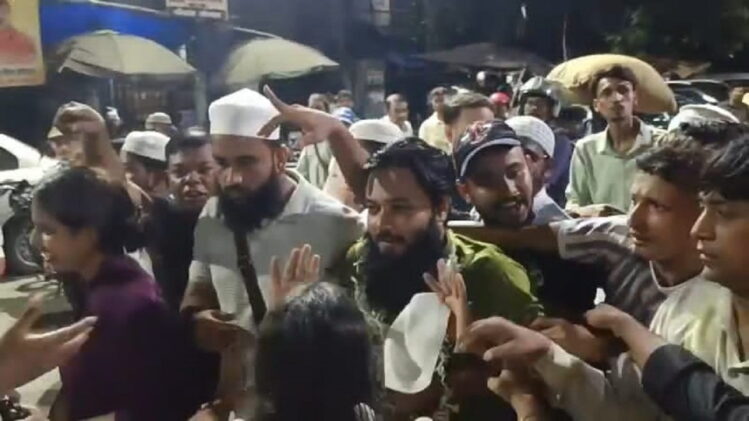
Videos circulated on social media showed groups of demonstrators shouting slogans such as “Godi Media Hay Hay” and “Godi Media Go Back.”
Among those reportedly targeted were journalists associated with News18 Bangla, Zee 24 Ghanta, TV9 Bangla and Ei Samay.
The incident prompted journalists from multiple media organisations to organise a protest march from Kolkata Press Club to Dorina Crossing, demanding accountability for attacks on media personnel.
Politics Deepened the Divide
Soon after the violence, Chief Minister Suvendu Adhikari accused “anti-nationals”, “Jamati” and “Moulobadi” elements of orchestrating the unrest and announced strict action under the Anti-Goonda law.
He also claimed those arrested had no connection with the original student movement and alleged possible foreign involvement.
However, activists interviewed by eNewsroom reject that interpretation.
For them, the larger issue remains the repeated examination controversies, police action against students and what they see as an increasingly hostile media ecosystem that treats dissent itself as suspicious.
A Crisis of Trust
The confrontation in Kolkata raises uncomfortable questions that go beyond one protest.
Physical attacks on journalists deserve condemnation regardless of political differences.
But the interviews conducted by eNewsroom also reveal another reality: a growing section of politically aware young Indians no longer sees parts of mainstream television media as neutral observers.
Instead, they believe certain channels arrive at protests seeking confirmation of an existing narrative rather than understanding the grievances that brought thousands onto the streets.
That, activists argue, explains why slogans against “Godi Media” echoed alongside demands for educational reform.
Whether one agrees with that perception or not, it reflects a widening crisis of trust between sections of the public and the country’s television news industry.
The sixteen protesters arrested after the Kolkata unrest have since secured bail following the Supreme Court’s intervention on student-related cases, but the larger debate remains unresolved.
The questions that students wanted answered—about repeated examination failures, accountability and the future of India’s education system—continue to linger.
And so does another question that emerged from Kolkata: When citizens lose faith in sections of the media, who is left to ask the questions that matter most?

