



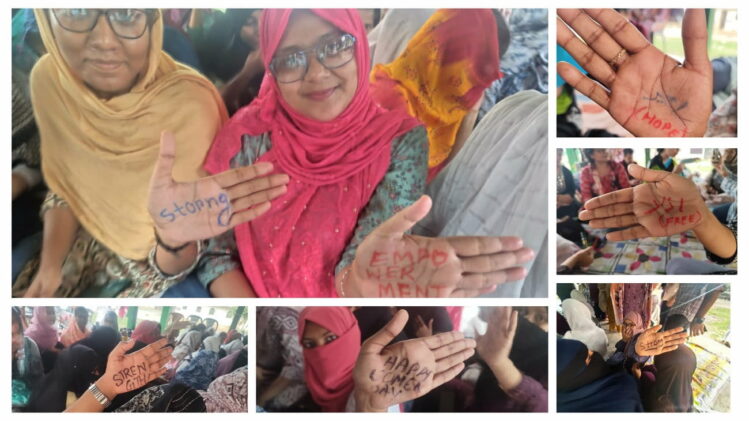
Kolkata: On 8 March, International Women’s Day, an unusual yet powerful activity unfolded at the sit-in protest at Park Circus Maidan. Titled “Identity Beyond Labels,” the collective action invited women to write words on each other’s palms—words that reflected how they saw the woman standing beside them beyond the labels society assigns.
Across societies, women are often introduced through labels that are social, biological, and political. Daughter, wife, sister, mother—identities that are deeply meaningful but often used to reduce women to relational roles rather than recognising them as individuals. Even language and everyday slurs carry gendered assumptions. In bureaucratic systems, too, a woman’s existence is frequently recorded through the names of fathers, husbands, or guardians.
“Identity Beyond Labels” sought to gently disrupt that pattern. The activity asked a simple question: How do you recognise the woman next to you, beyond these labels?
Women responded by writing words on each other’s hands—hope, freedom, courage, strength, empowerment, grace, unstoppable, iconic—each word becoming a small declaration of recognition.
Writing Identity Beyond Labels at Park Circus Protest
One of those palms belonged to Anwari Bibi.
Anwari Bibi knew a little Bengali and some Urdu. Writing was not something she was very comfortable with, but she attended the protest in solidarity. Her husband’s name had recently been deleted from the electoral rolls, and another member of her family faced a similar situation.
She stood quietly but anxiously, asking what might happen next. For many women like her, identity in official records is closely tied to the husband or the primary male member of the household. When that name disappears from the voter list, uncertainty enters the household.
Yet Anwari Bibi came to the protest.
On her palm, someone wrote “Hope.”
Hope—not because her situation was easy, but because, despite anxiety and uncertainty, she chose to stand with others and participate. When the name of the household’s breadwinner disappears from official lists, fear often silences people. But Anwari chose presence over silence. That quiet act of showing up was itself a form of hope.
A Journalist’s Palm and the Meaning of “Azad”
Another palm carried the word “Azad” (Free).
It was written on the hand of Pritha, a journalist who was covering the protest from the ground. She was moving through the crowd, taking photographs and observing the gathering with visible curiosity and admiration. The way she watched the women—attentively, almost in awe—suggested more than the distance of a reporter.
When asked about it, she smiled. The word Azad captured something beyond her professional role: a young reporter trying to document voices that often remain unheard. In that moment, she was not just Pritha, the journalist; she was Pritha as someone seeking and witnessing freedom in stories of resistance.
Around them, many other women joined the activity. Some were students from nearby universities; others were residents of the locality. Laughter and quiet conversations filled the space as palms slowly turned into canvases of recognition.
Words appeared everywhere: Strong. Empowerment. Power. Hope. Freedom. Courage. Iconic. Strength. Unstoppable. Grace. Waqar (Dignity). Shahasi (Courage).
Each word reflected how women saw one another—not through bureaucratic categories or social expectations, but through lived qualities.
The Spirit of Resistance at Park Circus Dharna Mancha
The activity unfolded at the Park Circus Dharna Mancha, a space that already carries deep historical resonance in the city. Over the years, this ground has witnessed women gathering in large numbers to question authority, challenge unjust policies, and defend democratic rights.
In that sense, “Identity Beyond Labels” was not merely a symbolic exercise. It echoed a longer tradition of women’s resistance in the same space.
The women who gathered there were not only responding to a contemporary bureaucratic process like Special Intensive Revision (SIR) of voter list; they were also continuing a historical practice of collective assertion. Time and again, women at this site have challenged draconian policies like CAA, NRC and NPR, confronted exclusion, and transformed public space into a forum of dialogue and dissent.
The palms that carried words like hope and freedom were therefore more than gestures of solidarity. They were reminders that women’s identities cannot be reduced to administrative categories or official labels.
The spirit of the Park Circus Dharna Mancha has always carried the soul of resistance—a spirit that questions authority, stands against injustice, and inspires others to imagine a more equal and humane society.
On this International Working Women’s Day, that spirit found expression once again—written quietly, yet powerfully, on the open palms of women who refused to be defined by labels alone.

