



[dropcap]T[/dropcap]oday, as we celebrate the Mahavira Jayanti, I am reminded of his association with the western tract of Bengal, known since ancient times as the Rarh or Radh. When I served as the Additional District Magistrate of the Asansol-Durgapur belt of Burdwan (now known as Paschim Barddhaman district) in 1980-81, I had visited the ruins of a famous Jain temple at Punchra. It is a large village situated about one-kilometre northwest of Kelejora in the Barabani block of Asansol sub-division. Its name is a colloquial version of Pancha-Chura or the temple with five towers or spires. A lot of Jaina artefacts have been found here and these are kept at different sites in the village.
All over Barddhaman (Paschim and Purba) and the adjoining districts of Purulia, Birbhum and Bankura in the Rarh region, several Nyangteswara (nude) “Shiv” images are worshipped. These are actually unclothed Digambar sculptures of Jaina Tirthankars. This testifies to ancient and medieval connections with Jainism. There is a theory that the name Bardhaman is derived from Vardhaman Mahavira. The Parasnath hills in Dhanbad which are so holy to the Jains, are located nearby.
According to the “Acharang Sutra”, Lord Mahavira visited Radh Pradesh shortly after Diksha, and he had to face numerous calamities and was humiliated by wild tribes of the forested area and by animals. In “Bhagwati Sutra” also, it is mentioned that Lord Mahavira had spent many chaturmas in Panit Bhoomi, which is a portion of Radh Pradesh. It was here that Shulapani Yaksha rained numerous atrocities on the Lord and transformed himself into a wild elephant, a fearsome ghost and a poisonous snake to give Mahavira unbearable pain. This spot, Asthigram is known as Nutanhat in Barddhaman and the Yaksha is worshipped here as Shulapan Shiv.
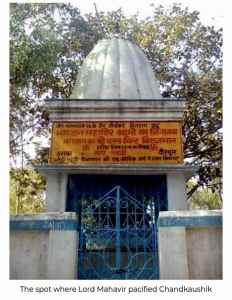
In adjacent Birbhum, Mahavira had to cross a dangerous forest where the Kanakhal Ashram was situated. Jaina scriptures mention how he was confronted by the deadly snake, Chandkaushika, that had killed numerous humans and beasts. The Lord, however, completely pacified this snake at a spot known as Jogi Pahadi in Ushka village near the Sainthia town of the district. The spot was identified by Shri Bhojrajji Parakh after 25 years of research. On 22nd January 1989, a small shrine bearing the footprints of Lord Mahavir Swami was installed by the Panchayati Jain temple of Kolkata.
The name, Veer-Bhumi or Birbhum is said to have been given by Mahavira to Vajra Bhumi or Vajjabhumi — after the Lord was given a grand reception by the king and the people of Shwetambika, the chief town of ancient Radh. The locals of Amuya, near Sainthia, still believe that a great spiritual soul was welcomed by their ancient ruler and thus they worship the tree that marks the spot. As a tradition, every family makes an offering of mud annually near the tree. Despite being located near the riverside, the tree and the land surrounding it has never been flooded even after torrential rains.

