



Kolkata: The 150th birth anniversary of the first Prime Minister of undivided Bengal Abul Kashem Fazlul Huq, nicknamed as Sher-e-Bangla came and passed by without much activities related to him.
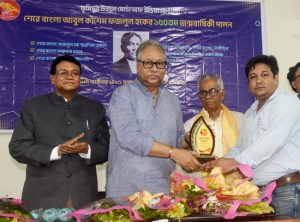
The only major event took place on October 26 in Kolkata, organized by the Bhumiputra Unnayan Morcha of India (BHUMI)
On the occasion, speakers not only recalled the work and persona of the Sher-e-Bangla but also regretted that he has not been celebrated much by the Bengali society.
Member of Parliament Jawhar Sircar, writer Khazim Ahmed, chairman of the West Bengal Minority Commission Ahmed Hasan Imran as well as joint secretary of the Paschim Banga Itihas Samsad and professor Dr Mahitosh Gayen were among the speakers.
The Sher-e-Bangla award was given to MP Sircar and educationist-lawyer Munshi Abul Kashem.
A documentary on the life of AK Fazlul Huq, directed by Mujibur Rahman was also screened on the occasion. ‘Sher-e-Bangla Souvenir’ was also unveled in the form of a collection of 24 thought-provoking essays.
Sircar recalled the period when Huq was emerging as a mass leader. He also highlighted his exceptional traits, contrasting him with other renowned politicians of that era.
The former IAS and Prasar Bharti Chairman said,”What was common among established Muslims during those days, was taking false pride in self imposed foreign identity. This sentiment existed among Bengali Hindus as well, but it was absent in AK Fazlul Huq. He was fully connected with the soil.”
He further pointed out, “There are very few Bengali Muslims who can be put before Fazlul Huq.” He identified himself as the son of this land. Huq even refused to go to Britain after becoming a barrister.”
Sircar reminded the audience about some people terming Huq as a communal figure. “If anyone gets branded as communal for working for the betterment of his community then those who are running the system should be called the biggest communal forces.”
Sircar and Imran lamented that the birth anniversary of Sher-e-Bangla is not celebrated in Bengal as it should be. It reflects the suicidal character of Bengalis.
Speaking on behalf of BHUMI, Dr Ramiz Raja claimed, ‘Sher-e-Bangla Fazlul Huq worked for the Bengalis all his life, irrespective of religion and caste. However, the Bengalis did not evaluate him properly. He demanded that Huq’s contribution to the Bengalis should be taught in schools and colleges The need of the hour is to bring him out of the shadow of oblivion and follow him.”
Dr Mahitosh Gayen, delivered a lecture on ‘Sher-e-Bangla Abul Kashem Fazlul Huq: pioneer of the political consciousness and education of the exploited and deprived Bengalis.’ He demanded that his contribution to the Bengalis should be spread in schools and colleges.
Historian Ahmed mentioned the rivalries against Huq, not only from the British and Caste Hindus, but also from other Muslim League leaders who carried aristocratic interests.
Imran, who is also the editor of Puber Kalom, highlighted the absence of discussion and celebrations about this great personality at both government and private levels.
The members of BHUMI have urged the Bengal government to build a memorial. A section of the dignitaries present at the event demanded that his house in Kolkata should also be acquired and a museum should be built there.


Is he not the person who led a coalition government with Savarkar led Hindu Mahasabha in 1942? In this government SP Mukherjee vice-President of Hindu Mahasabha was deputy to AK Fazlul Haq who played prominent role in suppressing the Quit India Movement.
In that coalition government members from various parties were there. Like Netaji’ Forward Block, Sarat Bose’s Congress, Schedule Castes, Krishak praja party etc. It was called progressive Qualition Ministry. Huq Saheb was the leader.
What Shyama did to Quit India movement, that’s his responsibility, not the responsibility of Qualition Ministry. AK FAZLUL HUQ always supported Quit India movement.