

Kolkata: Transparency activist Saket Gokhale has filed a representation affidavit with the Election Commission of India regarding Prime Minister Narendra Modi’s visit to Orakandi in Bangladesh.
On March 26 and 27, PM Modi will be in Bangladesh as State Guest. While on his first day of the tour, the first foreign country visit by the Indian PM after lockdown forced by Covid-19, Modi will attend Bangladesh’s 50th Foundation day functions. On his second day he will go to Orakandi.
Orakandi city has a shrine for the Matua community that influences several seats in Bengal.
Saket Gokhle said, “Modi is making this two day visit 200 km outside Dhaka just for campaigning on foreign soil targeting the Matua community in Bengal.”
He also mentioned that ironically and diabolically Modi is making this visit on 27 March i.e. the 1st day of Phase 1 polling in Bengal.
BBC in its report on March 21 mentioned that students are protesting in Dhaka demanding that the Bangladesh government led by Sheikh Hasina should not invite Modi for country’s foundation year celebrations.
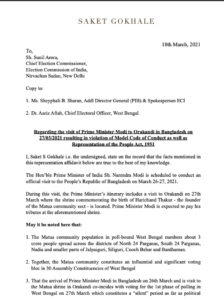
Through his representation affidavit, Saket has demanded that the Election Commission should;
1. Vet an advance copy of Modi’s speech to be delivered at Orakandi in Bangladesh
2. Require all TV media to broadcast Modi’s program at Orakandi only after the close of polling i.e. 6 pm
3. Restrain BJP from using this alleged state visit of PM Modi for election campaigning.
The Matuas are a close-knit group in Bengal belonging to the scheduled caste community, who migrated from Bangladesh during and after Partition.
The Matuas have a significant presence in four parliamentary seats here, making them one of the biggest vote banks in the state. Although no official count exists, it is estimated that there are about one crore Matua voters.
Matuas, mostly who have migrated to India post 90’s have yet to get Indian Citizenship and BJP had raised this issue just before the Lok Sabha polls in 2019. It paid well to the saffron brigade and for the first time, they won 18 out of 42 seats from Bengal.
However, after amending India’s citizenship law (CAA), the Modi government has not been able to frame rules which has irked Matua voters.
The Wire reported that Modi’s visit to Orakandi during the Bangladesh visit is an attempt at wooing the Matua voters in India.
“It is unfortunate that PM Modi is using foreign soil for election purpose. We are also going to write to Election Commission about it. And as far as Matua community is concerned they are slipping out of the hands of BJP”, Trinamool Congress MP Saugata Roy told eNewsroom.