



Delhi: When Congress leader Rahul Gandhi was in Jharkhand during his Bharat Jodo Nyay Yatra earlier this year, he interacted with some people who used to ferrycoal on their motorcycles and bicycles. He might not have asked about the caste of these people who eke out a living by selling coal or working in the coal industry. However, a report mentions that there are more chance of them being from Other Backward Caste (OBC) or Scheduled Tribe (ST) or Scheduled Caste (SC) communities..
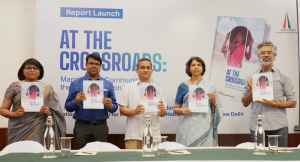
A new study by the National Foundation for India (NFI) sheds light on the challenges faced by marginalized communities during India’s transition from coal to greener fuels. The report, titled “At the Crossroads: Marginalized Communities and the Just Transition Dilemma,” reveals a troubling trend: a significant overrepresentation of marginalized groups in coal-dependent regions.
High Concentration of Marginalized Communities
The study surveyed 1209 households and conducted focus group discussions across six districts in three central Indian states – Chhattisgarh, Jharkhand, and Odisha. A striking finding was the caste composition of the surveyed population. 41.5% of surveyed households belonged to OBCs, 23% to STs and 17% to SCs. Only 15.5% belonged to the General category. This highlights a much higher dependence on coal among marginalized communities.
Disparities in Education and Health
The report further exposes significant disparities in education and health within these communities. A large portion of the population, particularly among SCs, STs, and OBCs, has limited access to education, with many having only primary education or no literacy at all. This lack of education poses a major challenge for reskilling the workforce as India transitions away from coal.
The health hazards of coal mining is also a matter of concern. At least 75% of the participants in focus group discussions reported respiratory and skin problems linked to prolonged exposure to coal pollutants. The ailments included chronic bronchitis, asthma, and various skin conditions.
Economic Impact and Caste Disparities
The phasing out of coal is expected to have a significant economic impact, particularly in coal-dependent regions. Job losses will not only affect coal miners directly but also the broader local economy reliant on coal-related services. The report warns that these economic impacts will disproportionately affect marginalized communities.
Caste-based inequities further exacerbate these challenges. The study found that access to resources and opportunities is skewed, with marginalized communities having significantly less compared to the General category.
Challenges and Recommendations for a Just Transition
The report identifies several hurdles to achieving a “just transition” – one that minimizes negative impacts on vulnerable populations. Key challenges include:
- Upskilling a largely under-educated workforce
- Creating alternative livelihoods for those who lose jobs in the coal sector
The report emphasizes the need for:
- Community-specific policies: Policies that take into account the specific needs and vulnerabilities of marginalized communities.
- Robust institutional mechanisms: Well-functioning institutions to deliver essential services and support programs.
- Coordinated efforts: Collaboration between government bodies to ensure a smooth transition.
The report proposes a framework for safeguarding these communities, including:
- Developing alternative livelihoods: Promoting new economic opportunities beyond coal mining.
- Ecological restoration: Mitigating the health impacts of coal mining through environmental recovery efforts.
- Inclusive policies: Designing transition policies that consider the needs of marginalized communities.
Vulnerability of Communities and Urgent Need for Action
The study highlights the significant social and economic disparities across coal-dependent regions. Districts solely reliant on coal production, like Dhanbad (Jharkhand) and Koriya (Chhattisgarh), reported lower incomes compared to more diversified districts like Angul (Odisha). The report also found a lack of access to basic welfare schemes, further exacerbating the vulnerability of these communities.
“Without a clear plan in place, workers in declining industries may face sudden job losses without adequate support or alternative employment opportunities,” said Pooja Gupta, co-author of the study.
The report‘s key takeaway is the urgent need for action. As Biraj Patnaik, the executive director of NFI, stated, “The findings highlight the stark caste-based inequalities in access to education and livelihood opportunities in coal-dependent regions.” He emphasized the need for “community-specific policies and robust institutional mechanisms” to address these challenges.

